Tuesday, 22 September 2026
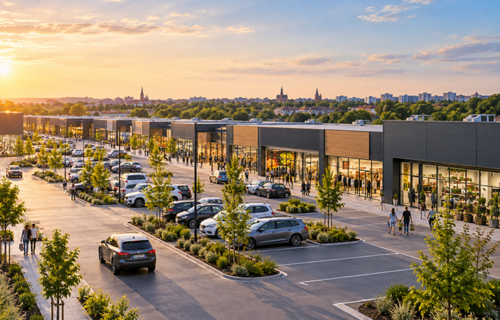
Retail parks are moving further into the mainstream of Poland’s commercial property investment market as rapid development, strong occupier demand and relatively low vacancy attract a broader range of capital. What began as a comparatively simple format concentrated around major cities has expanded into a nationwide market, with new projects increasingly targeting smaller towns and regional catchments.
The scale of the change is particularly visible in development activity. Retail parks accounted for 92% of new retail GLA delivered in Poland during the first half of 2026, according to the Polish Council of Shopping Centres. Almost 197,000 sqm of modern retail space was completed during the period, while around 558,000 sqm was under construction at the end of June. Other advisers confirm the same direction, although differences in definitions produce varying estimates of market size and development pipelines.
Avison Young estimates that Poland currently has around 3.8 million sqm of retail park space across 355 operating properties. Its research identifies approximately 746,000 sqm being developed across 88 retail park and convenience projects, with around 50 developers involved. Some 44% of the space under development is located in towns with fewer than 50,000 residents, demonstrating how the format is bringing modern retail into markets that historically supported relatively limited institutional-quality shopping provision.
Retail parks themselves are also changing. Discount stores, grocery operators and other everyday shopping remain central to the tenant mix, but landlords are increasingly introducing healthcare, fitness, leisure, food and beverage and specialist retailers. This broadening of uses can extend catchment areas and increase the frequency of visits, while giving owners additional opportunities to differentiate individual properties as competition between schemes increases.
The format has several characteristics that help explain its appeal to investors. Retail parks generally have relatively straightforward buildings, convenient access, substantial parking and operating models that are less complex than traditional enclosed shopping centres. Their concentration on frequently purchased goods and services can also support comparatively predictable occupier demand. European market research from CBRE has put retail park vacancy at around 3%, reinforcing the perception of the format as a resilient part of the retail property sector.
Investor interest is increasingly visible in transaction volumes. Poland attracted approximately €3 billion of commercial property investment during the first half of 2026, with retail accounting for around €1 billion and emerging as one of the country’s most active investment sectors. Retail park portfolios have participated in that recovery, while the fragmented ownership structure creates further possibilities for acquisitions and consolidation. Existing parks also offer opportunities to create value through extensions, changes to tenant mixes, refurbishment, energy improvements and more active management.
The large development pipeline nevertheless means investors are likely to become increasingly selective. Location, local purchasing power, competing schemes and the strength of individual catchments will become more important as additional space enters the market. After several years dominated by rapid construction, Poland’s retail park sector is therefore moving towards a more mature phase in which acquisitions, portfolio consolidation and improvement of existing properties are likely to play a greater role alongside new development.