Sunday, 20 September 2026
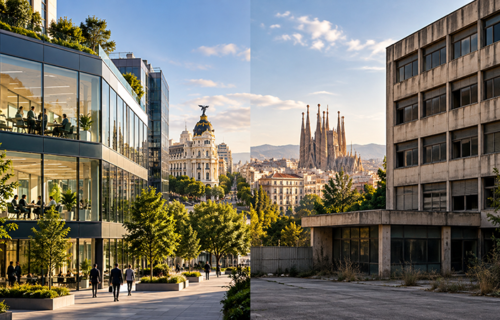
Madrid and Barcelona’s office markets are entering a period in which the amount of vacant space is becoming a less useful measure of market conditions. Both cities still have substantial office availability, yet companies looking for modern buildings in established business districts are finding their choices increasingly restricted. Demand is concentrating on properties offering efficient energy performance, modern technical specifications, strong public transport connections and working environments suited to changing corporate requirements.
The contrast is particularly visible in central Madrid. Availability across the wider market remains considerably higher than in the principal business districts, where good-quality space has become increasingly difficult to secure. Large occupiers seeking substantial contiguous floors can therefore face limited options even though headline statistics suggest plenty of offices remain vacant. Barcelona presents a similar picture, with significant availability across the wider city but much tighter supply of top-quality offices in its most sought-after locations.
Corporate requirements are accelerating this divide. Businesses are paying greater attention to energy consumption, environmental performance, employee experience, accessibility and long-term operating costs. When companies consolidate or relocate, many are using the opportunity to improve the standard of their accommodation rather than simply replacing one office with another. This concentration of demand is contributing to rising prime rents in Madrid and Barcelona, while less competitive buildings cannot necessarily expect to benefit from the same rental growth.
The trend creates a substantial challenge for owners of ageing properties. Research covering Madrid and Barcelona indicates that millions of square metres could require significant modernisation during the coming years if buildings are to remain competitive. Improvements to energy efficiency, building systems, common areas, accessibility and workplace facilities can involve substantial capital expenditure. Owners must therefore decide whether future rents justify refurbishment or whether a different strategy is required.
For some properties, conversion is becoming part of that calculation. Madrid has already seen offices repositioned for residential, hospitality and flexible accommodation, while research suggests that part of the obsolete stock across Madrid and Barcelona could potentially be converted into housing. However, building configuration, planning requirements, location and development economics mean conversion is not a solution for every ageing office. Well-located buildings with suitable structures may instead offer significant opportunities for refurbishment.
The development pipeline adds further pressure. New construction alone is unlikely to resolve the shortage of competitive space, particularly because part of forthcoming supply involves the renovation of existing buildings rather than completely new developments. Investors are consequently paying closer attention to individual asset characteristics. A vacant modern office in a strong location represents a very different investment proposition from an ageing building requiring extensive capital expenditure, even though both properties appear within the same city-wide vacancy statistics.
Madrid and Barcelona are therefore not simply moving from higher vacancy towards lower vacancy. Their office markets are becoming increasingly divided between modern, efficient and well-located buildings attracting concentrated occupier demand and ageing properties facing pressure to improve, reposition or find another purpose. The result is a market where office space can appear plentiful while the buildings companies most want to occupy are increasingly difficult to find.
Source: CIJ.World Research & Analysis Team