Tuesday, 15 September 2026
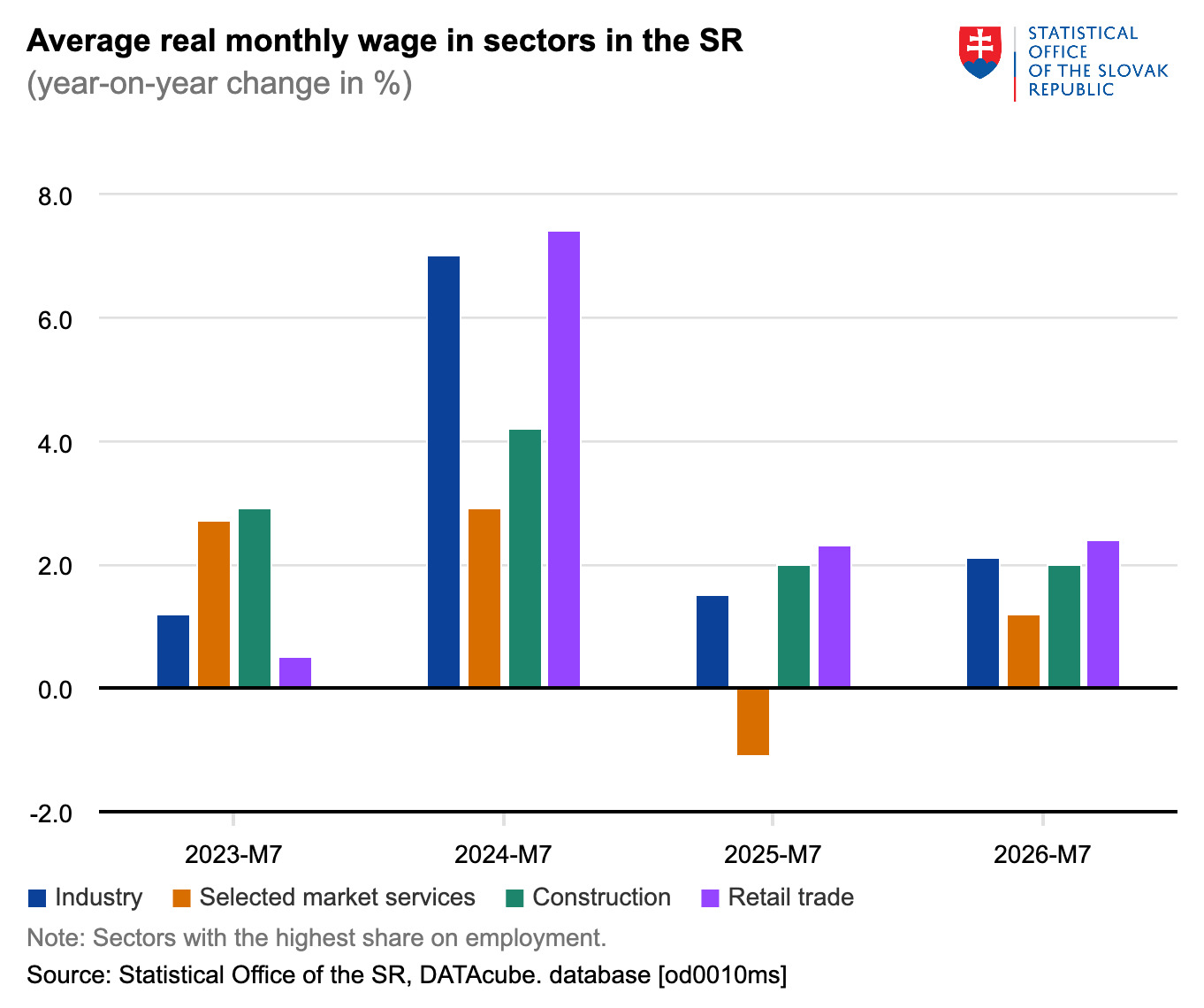
Wages continued to rise across Slovakia in July 2026, but employment moved in the opposite direction across much of the economy, according to preliminary data from the Statistical Office of the Slovak Republic. Average nominal monthly pay increased year-on-year in all ten sectors covered by the monthly survey, with gains ranging from 2.8% in information and communication to 7.5% in wholesale. After inflation, employees were better off in nine of the ten sectors, with wholesale recording the strongest real wage increase at 4.1%. Information and communication was the only sector to register a real decline, with wages falling 0.5%.
The employment picture was considerably weaker. Seven of the ten monitored sectors employed fewer people than a year earlier in July, with transportation and storage recording the largest contraction at 3.1%. Only selected market services, construction and accommodation increased employment, rising by 5.5%, 3.7% and 0.2% respectively. Construction therefore stands out as one of the areas combining expanding employment with the broader rise in wages, an important signal for Slovakia’s development and property sectors.
Across the first seven months of 2026, nominal wages increased in every monitored sector, while inflation-adjusted earnings improved in eight. Transportation and storage recorded the strongest real wage growth over the period at 2.5%, despite the sector’s sharp employment decline in July. Accommodation recorded real wage growth of 0.7%, while selected market services increased by 0.8%. Information and communication remained the weakest performer, with real earnings down 3.4% compared with the first seven months of 2025.
Employment during January to July declined year-on-year in five of the ten sectors. Wholesale recorded the largest reduction at 3.1%, despite delivering some of the strongest wage growth. Selected market services, accommodation, construction and information and communication increased employment compared with the same period last year, with gains reaching as much as 4.7%, while employment in food and beverage services was unchanged.
The figures point to an increasingly uneven Slovak labour market. Employers are continuing to raise salaries sufficiently to deliver real income growth across most industries, but higher pay is not translating into broader workforce expansion. The combination of rising wages and falling employment suggests that businesses in several sectors remain cautious about increasing headcount even as labour costs continue to rise.
For the property and construction markets, July provides a more positive signal. Construction was one of only three monitored sectors to increase employment, with its workforce expanding 3.7% year-on-year. By contrast, the 3.1% decline in transportation and storage employment warrants attention given the importance of these industries to Slovakia’s logistics and industrial property markets.
The Statistical Office cautioned that the monthly figures are preliminary and cover ten selected areas of the economy rather than the entire Slovak labour market. More comprehensive quarterly statistics cover 19 economic sectors and provide the reference measure for average wages across Slovakia.
Source: SOSR