Monday, 14 September 2026
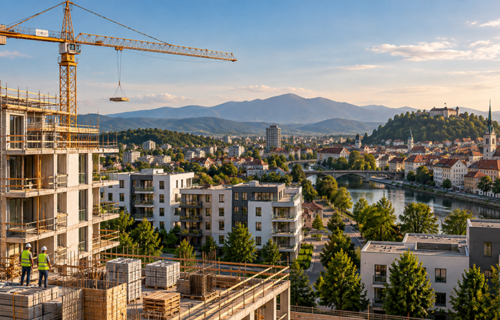
Slovenia’s housing problem is becoming increasingly difficult to describe as a Ljubljana-only issue. Residential construction remains insufficient to meet demand, while sharp increases in apartment prices in Maribor and other parts of the country suggest that pressure is spreading across the national housing market.
Residential property prices increased by 3.0% during the first quarter of 2026 and were 9.3% higher than a year earlier, according to Slovenia’s official statistics. Existing apartments recorded an annual increase of 10.7%, but the geographical differences reveal an important change in the market. Prices for existing apartments in Ljubljana increased by 6.3% year-on-year. In Maribor, the corresponding increase reached 17.5%, while existing apartment prices elsewhere in Slovenia, excluding Ljubljana, were 12% higher. Ljubljana remains the country’s most expensive and most constrained residential market, but the pace of appreciation elsewhere indicates that housing pressure is becoming much more geographically widespread.
The problem is rooted partly in the limited amount of new housing reaching the market. Slovenia invests only around 2.5% of GDP in residential construction, less than half the average level across the euro area. Although the number of residential building permits has shown some improvement, the development pipeline is not expected to produce enough additional homes in the short term to materially alter the balance between supply and demand.
Developers face several obstacles simultaneously. Suitable development land is limited in areas where demand is strongest, while construction costs remain high and the building industry faces shortages of skilled workers. Planning and permitting procedures add another layer of difficulty, slowing the ability of developers to respond when market conditions support additional construction.
This creates a difficult property-market equation. Rising prices would normally encourage developers to increase production, but higher sales values do not automatically make projects viable when land, labour and construction costs are also elevated. Lengthy development processes further increase financing costs and expose projects to changing economic conditions before construction is completed.
Demand, meanwhile, continues to receive support from the wider economy and improving financing conditions. Lower borrowing costs can increase purchasing capacity, while wage growth and relatively strong employment conditions support household demand. Unless construction accelerates at a similar pace, improvements in affordability from cheaper financing risk being partly absorbed by higher property prices.
Maribor is particularly significant in this context. A 17.5% annual increase in existing apartment prices does not mean the city has become more expensive than Ljubljana, but it does demonstrate how quickly demand can affect markets where available housing is limited. Similar double-digit growth outside the capital reinforces the argument that Slovenia’s housing imbalance is becoming broader.
That creates implications beyond the owner-occupied housing market. Slovenia has a relatively small and fragmented private rental sector compared with more established institutional residential markets elsewhere in Europe. Persistent shortages and rising purchase prices could increase demand for professionally managed rental accommodation, particularly among households unable or unwilling to purchase.
Public housing investment is also becoming a larger part of the response. Slovenia has established a programme capable of directing up to €100 million annually towards public rental housing, alongside additional financing mechanisms intended to support long-term residential development. The government is targeting around 20,000 additional public rental homes by 2035.
Student accommodation presents another potential area for expansion. Ljubljana continues to experience shortages of dedicated student beds, increasing dependence on the private rental market. Purpose-built student housing could therefore form part of a wider response to housing pressure, particularly if institutional investors can find projects with suitable land, planning conditions and operating economics.
For international residential investors, however, Slovenia remains an emerging rather than established institutional rental market. The conditions that have supported build-to-rent growth elsewhere in Europe – constrained housing supply, increasing purchase prices and demand for rental accommodation – are becoming more visible, but a substantial institutional rental sector has yet to develop.
That may eventually become part of the opportunity. Public-private residential development, affordable rental housing, student accommodation and professionally managed rental projects could all become more relevant if conventional housing construction continues to fall short.
The central challenge is therefore increasingly one of delivery. Slovenia has housing demand, rising prices and an acknowledged need for additional homes, yet development continues to be constrained by land availability, construction capacity, costs and planning. Ljubljana remains at the centre of the housing shortage, but the latest price movements show that the consequences are spreading. If Slovenia cannot substantially increase residential construction, housing availability and affordability are likely to become increasingly important property-market issues not only in the capital, but across the country.