Monday, 14 September 2026
Serbia’s property market continued to expand in monetary terms during the second quarter of 2026, but the headline growth conceals a notable change in market activity. More money was spent on real estate even though fewer properties changed ownership.
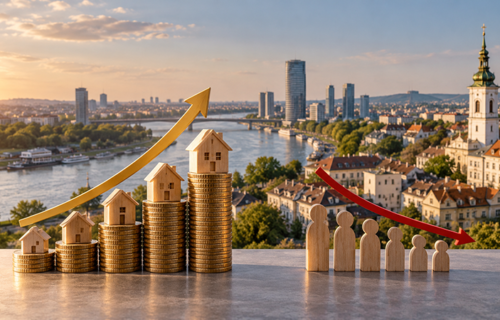
Approximately €2.2 billion of property was traded across Serbia during Q2, 8.1% more than in the corresponding period of 2025. However, the number of purchase contracts fell 5.4% to 30,495. Rather than growth being generated by an expanding number of transactions, increasingly expensive properties are supporting the overall value of the market. Residential property is at the centre of this shift, with apartments generating approximately €1.3 billion of transactions during the quarter and accounting for around 62% of the total value of property traded in Serbia.
Yet only 11,938 apartment transactions were completed, representing a decline of 5.8% compared with the previous year. Despite fewer apartments being sold, the amount spent on them increased by 7.7%. Prices are one reason for the divergence. Apartment values across Serbia were 5.25% higher than a year earlier during Q2. Existing homes recorded stronger annual price growth than newly built apartments, indicating that rising values extend beyond new developments and are affecting the wider housing stock.
Belgrade shows how pronounced the change has become. The value of apartment sales in the capital region increased by 12.6% year-on-year to approximately €742 million, even though the number of apartment contracts decreased by 2.5%. The country’s largest residential market is therefore producing substantially greater turnover from fewer completed sales.
Slower activity is also visible beyond the capital. Overall property transaction numbers declined by 1.7% in Belgrade, 1% in Novi Sad, 4.3% in Niš and 7% in Kragujevac. The simultaneous declines across Serbia’s largest urban markets suggest that the reduction in sales cannot easily be explained by weakness in one particular location.
The contrast with the first quarter is equally important. During Q1 2026, Serbian property transaction value increased by 13.9% compared with the previous year, while the number of deals also rose by 6.2%. By Q2, values remained firmly positive but transaction numbers had moved in the opposite direction. Looking across the first six months of the year makes the change clearer. Property worth approximately €4.2 billion was traded during H1 2026, an increase of 10.1%, while the total number of transactions was virtually unchanged, rising just 0.2%. Within the apartment market, transaction value increased by 11.4% even as the number of completed sales declined by 1.9%.
Financing also distinguishes Serbia from residential markets where mortgage lending determines much of purchasing capacity. Credit was involved in only around 15% of all property transactions during Q2. The proportion was considerably higher for apartments, where approximately one-third of purchases involved borrowing, but a substantial part of the market still operates without conventional housing finance.
That does not automatically mean that the remaining transactions can be classified as investment or diaspora purchases. The available market figures do not identify the source of capital behind every acquisition. Domestic savings, proceeds from previous property sales, corporate buyers, investors, overseas Serbians and foreign purchasers could all contribute, but determining their respective importance requires evidence beyond the transaction statistics.
The emerging issue for Serbia is therefore not simply whether property prices are rising. It is whether the pool of purchasers able or willing to transact at those prices is beginning to narrow. Higher values can keep total market turnover growing for some time even as transaction volumes weaken. But if prices continue rising faster than purchasing capacity, the difference between the value of the market and its underlying liquidity could become increasingly important for developers, lenders and investors.
Q2 2026 may consequently represent an early change in Serbia’s property cycle. The market remains valuable and prices continue to advance, but growth is increasingly being generated by higher transaction values rather than by more buyers entering the market. Whether transaction activity recovers or continues to decline will provide a much clearer indication of how sustainable Serbia’s current property pricing has become.
Source: CIJ.World Research & Analysis Team