Monday, 14 September 2026
The Dutch housing shortage is beginning to change the way investors may need to think about obsolete property. An ageing office, redundant school, struggling commercial building or underused business site may no longer be valuable primarily for the activity it was originally designed to accommodate. Increasingly, its more important value could lie in its potential to become housing. This possibility is moving further into national housing policy. The Dutch government is seeking to increase residential supply not only through conventional construction but also by making better use of buildings that already exist. Conversions, additional floors, subdivision and more intensive occupation are all part of that approach. The scale is already meaningful. Over the past decade, property transformations have produced approximately 10,000 homes a year on average, while the government believes broader measures to use existing buildings more efficiently could make a further significant contribution to annual housing production.
For property investors, this creates a different way of looking at ageing commercial stock. Instead of asking only how much rent a building can continue generating in its existing use, the more important question may increasingly be how many homes the property could realistically accommodate and what it would cost to create them. Offices provide one of the clearest opportunities. The Dutch office market is becoming increasingly selective as companies concentrate on modern, efficient and well-connected buildings. Older properties can remain physically functional while gradually becoming less attractive to corporate tenants. Owners then face a choice between investing heavily to improve the office, accepting weaker rental performance or considering another use.
Housing can become particularly interesting where an older office occupies an established urban location. Public transport, shops, employment and other services may already surround the property, giving it advantages that would take years to establish around a new development site. The existing structure can also potentially be reused rather than completely replaced. But the economics can vary enormously between apparently similar buildings. Offices with suitable dimensions, sufficient natural light and adaptable structures may convert relatively efficiently. Deep floorplates, difficult structural layouts, inadequate façades or obsolete technical systems can make another building extremely expensive to transform. A property that appears inexpensive because its office value has declined can therefore become costly once the full conversion programme is understood.
Retail buildings present another opportunity. Changes in consumer behaviour and retail networks have left some secondary commercial properties facing uncertain long-term demand. Not every shop should become housing, particularly where active retail is essential to the surrounding neighbourhood, but redundant upper floors, oversized commercial buildings and weaker secondary locations can offer possibilities. Mixed use may prove more appropriate than complete residential conversion. Commercial space can remain at street level while upper floors become apartments, allowing a property to retain economic activity while adding housing. In other situations, groups of neighbouring properties may need to be considered together to create a viable redevelopment.
Former schools offer a different proposition. Many occupy established residential areas and have large windows, communal spaces and surrounding land. Those characteristics can make them attractive candidates for alternative use, but classroom layouts do not automatically translate into efficient apartments. The investment case depends on whether the existing structure can be incorporated into the new design without requiring so much reconstruction that conventional redevelopment would have been more economical. Older care buildings may also offer opportunities, particularly as demand grows for housing suited to an ageing population. Properties that no longer meet modern institutional or healthcare requirements can still occupy suitable residential locations. Depending on their structure and planning position, some may support conventional housing, senior accommodation or combinations of independent homes and services.
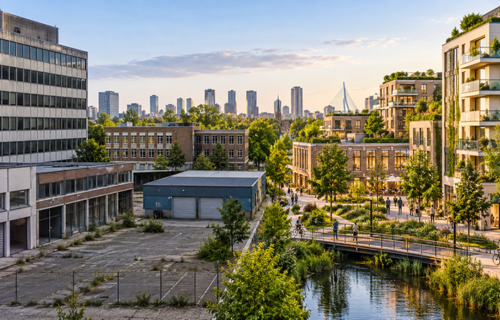
The opportunity becomes considerably larger when the focus shifts from individual buildings to entire commercial areas. Dutch cities contain business districts and employment locations with older offices, warehouses, extensive parking areas and relatively low development density. Some could eventually support substantially more intensive use. Transforming these areas is much more complicated than converting a single building. New residents require public transport, schools, shops, healthcare, public space and other neighbourhood infrastructure. Existing businesses may need to continue operating, while noise and environmental restrictions can limit where housing is possible. The most successful projects therefore need to create functioning neighbourhoods rather than simply replace commercial floor area with apartments.
For investors, acquisition price is fundamental to every version of this strategy. A building bought at a valuation based on strong commercial income can be extremely difficult to convert profitably. Transformation becomes more attractive when the value of the existing use has fallen sufficiently to compensate the investor for construction costs, planning uncertainty and development risk. This creates an important relationship between obsolescence and residential value. Declining demand for an office or commercial property does not necessarily mean that the underlying site is losing value. In some circumstances, the value is shifting from the building’s current use towards its redevelopment potential.
Construction costs determine whether that potential can be realised. Conversion can preserve significant parts of an existing structure, but it can also reveal expensive problems. Heating and ventilation systems may need replacement, façades may require reconstruction and fire protection, acoustics, access and daylight conditions must satisfy residential requirements. Older buildings may also require substantial improvements to their energy performance. These costs make detailed technical investigation essential before acquisition. A relatively cheap commercial property can become an expensive housing project if structural or technical problems are discovered after the transaction.
Taxation can alter the calculation further. VAT and property transfer taxes depend on the circumstances of the acquisition and redevelopment, meaning two projects with similar construction budgets can produce different financial outcomes depending on how the transaction and property are structured. Investors comparing an existing building with a conventional development site therefore need to consider taxation from the beginning rather than treating it as a secondary transaction cost.
Planning remains another major source of risk. Ownership of a commercial property does not automatically provide permission to introduce housing. Municipalities must determine whether residential use is appropriate, how much development the site can support and what proportion of the resulting homes should fall within different affordability categories. Parking, public space, infrastructure and environmental conditions can further influence the final scheme. The government’s increasingly active approach to using existing buildings is therefore important because greater predictability could make transformation easier to finance. Public support is also becoming more significant. National financing mechanisms have been expanded to help bring difficult transformation projects forward, particularly where redevelopment contributes affordable housing.
This does not remove development risk. It does, however, demonstrate that converting existing property is becoming an increasingly important component of the country’s housing strategy rather than a marginal solution applied only to occasional empty offices. The comparison with development land is consequently becoming more interesting. A cleared site allows a developer to design housing specifically around modern requirements, without having to work around existing structures. But land brings its own challenges. Planning can take years, infrastructure may need substantial investment and electricity, transport, environmental and other constraints can delay construction.
Existing buildings start from a different position. Many already sit within established urban areas and have roads, utilities and public transport nearby. Some possess structures that can be reused, potentially reducing the amount of demolition and new construction required. Existing infrastructure can be an advantage, although investors still need to establish whether connections have sufficient capacity for the proposed residential development. Neither approach is automatically cheaper. The investment opportunity lies in finding situations where the commercial value of a property has declined further than the residential potential of the site. Those buildings can create an unusual pricing opportunity because traditional investors may value them according to weakening existing income while transformation specialists value them according to what can eventually replace it.
That could gradually create a more recognisable market for conversion assets. Investors may begin targeting ageing offices, institutional buildings and underused commercial sites specifically because of their housing potential. Their valuation models would focus less on existing lease income and more on achievable residential density, construction complexity, planning probability and the value of the completed homes. Specialist capital could have an advantage in such a market. Investors capable of evaluating structures, navigating planning and managing complicated redevelopment programmes may identify value that conventional office or retail owners cannot easily realise.
Not every unwanted commercial building will qualify. Some will be in unsuitable locations, some will cost too much to transform and others will remain more valuable in their existing use. Conversion cannot replace the large volume of conventional construction the Netherlands still requires. But the country’s housing shortage means that obsolete buildings are becoming increasingly difficult to dismiss simply as yesterday’s property problem. They can also be tomorrow’s development sites.
For Dutch investors, the next competition for residential opportunities may therefore take place not only over vacant land but also over buildings whose original economic purpose is disappearing. The winners will be those able to recognise when an ageing commercial asset is worth more for the homes it could contain than for the activity it was originally built to serve.
Source: CIJ.World Research & Analysis Team