Saturday, 24 October 2026
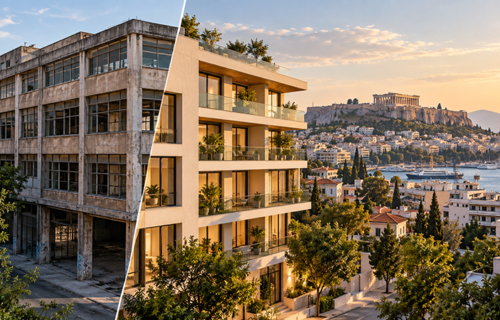
Greece’s revised property investment rules are creating an unusual connection between foreign residency demand and the redevelopment of ageing commercial buildings. A provision allowing qualifying commercial properties converted into homes to enter the Golden Visa programme at a €250,000 investment threshold could give owners and developers another reason to reconsider offices, shops and other premises that are losing their usefulness in their existing form.
The difference between the available investment routes is significant. Conventional residential acquisitions generally require at least €800,000 in Attica, Thessaloniki, Mykonos, Santorini and certain larger Greek islands, while a €400,000 threshold applies to the standard route in other parts of the country. Qualifying properties involving a change from commercial to residential use can enter through the separate €250,000 category. This does not mean that any inexpensive commercial property can simply be purchased and used to obtain residency. The lower threshold applies under specific conditions, including the legal completion of the property’s conversion to residential use before the residence permit application is submitted. Clarification issued by the Greek authorities in April 2026 provided additional guidance on the application of the rules, helping establish a clearer framework for investors, property owners and professionals involved in such transactions.
For the commercial property market, the significance goes beyond immigration. Parts of Athens contain older commercial buildings that can be increasingly difficult to position against modern properties. Companies looking for offices now place greater importance on energy efficiency, building systems, working environments and overall quality. Older properties that cannot economically satisfy these requirements risk becoming less competitive. Traditionally, owners faced several choices. They could continue operating the building with limited investment, undertake a substantial refurbishment, sell to another commercial investor or consider redevelopment. The Golden Visa conversion route introduces another factor into that decision.
A property capable of being legally and economically converted into housing can potentially appeal to a different buyer market. Instead of depending entirely on its future commercial income, its value can also be assessed according to the residential units that could ultimately be created. That possibility could become particularly relevant in Athens, where older commercial buildings coexist with strong demand for residential accommodation in many central locations.
Piraeus could present similar opportunities. The city has been undergoing wider changes associated with transport improvements, port activity, tourism and redevelopment. Older commercial properties in suitable locations may increasingly be assessed not simply according to their existing rents but according to alternative uses. Thessaloniki is another market where the rules could influence investment decisions. The combination of residential demand, tourism, universities, international connectivity and older urban building stock creates circumstances in which conversion may be considered alongside conventional refurbishment or redevelopment.
Whether a substantial market actually emerges in any of these cities remains to be seen. The Golden Visa framework creates the incentive, but it does not remove the practical difficulties associated with converting commercial property. Building configuration is one of the most important considerations. Offices designed around deep floorplates, limited natural light or unsuitable circulation may be expensive or impractical to transform into apartments. Structural condition, fire requirements, access, services and energy upgrades can add substantially to development costs.
Planning and legal considerations are equally important. The residential change of use has to be properly completed and documented. Investors therefore need to examine considerably more than the purchase price when assessing whether an apparently inexpensive commercial building represents a viable opportunity. Industrial property is subject to an additional restriction. For the relevant Golden Visa route, former industrial buildings must meet conditions concerning the cessation of industrial activity, including the requirement that industrial operations have not taken place there during the preceding five years. This makes long-redundant industrial premises more relevant to the programme than functioning production facilities.
For developers, the emerging opportunity could be to bridge the gap between obsolete commercial property and international residential capital. Rather than selling an ageing office building to another commercial landlord, an owner could potentially sell to a specialist developer capable of handling the planning, technical and construction process. The resulting homes could then appeal to domestic purchasers, conventional investors and qualifying international buyers.
The Golden Visa element is important because residency provides an additional reason for some non-EU investors to purchase. Their decision does not necessarily depend exclusively on the rental return available from the apartment. That broader motivation could improve the economics of certain conversion projects that would otherwise struggle to compete for development capital. It could also affect how some older commercial buildings are valued.
A property generating weak office or retail income may still have considerable underlying value if its configuration and location make residential conversion feasible. Investors considering such assets could therefore increasingly compare two potential outcomes: the income available from retaining the existing use and the value achievable after conversion. That does not mean commercial buildings will automatically become more valuable. Many will remain unsuitable for housing, while others will be worth substantially more if retained as offices, shops, hotels or industrial premises. Construction costs alone can eliminate the apparent advantage of buying an inexpensive older building.
The properties most likely to attract attention will therefore be those where several conditions coincide: a viable acquisition price, appropriate building configuration, legal potential for residential use, manageable construction costs and sufficient demand for the finished homes.
There is also a wider urban question. Converting buildings that have lost their original economic purpose can provide additional housing without requiring equivalent amounts of undeveloped land. It can also return poorly used properties to productive use and extend the economic life of existing structures. However, creating residential units does not automatically resolve Greece’s housing pressures. Much depends on what happens to the properties after conversion. Apartments occupied permanently or placed on the long-term rental market contribute differently to local housing supply from units primarily retained as investment properties.
The Golden Visa programme should therefore not be regarded as a substitute for housing policy. What it may provide is an additional financial incentive for a particular category of redevelopment that might otherwise be difficult to justify. The scale of that opportunity will become clearer as developers, investors and owners respond to the rules during the coming years. Transaction activity, conversion permits and completed projects will ultimately show whether the €250,000 route remains a relatively specialised investment strategy or develops into a meaningful segment of the Greek property market.
For now, the important development is that an immigration rule has changed the calculation surrounding some ageing commercial buildings. A property that no longer works particularly well as an office, shop or other commercial space may no longer be judged solely on what it is today. Increasingly, its value could depend on what it can become tomorrow.
Source: CIJ.World Research & Analysis Team