Friday, 23 October 2026
London’s railway network is increasingly becoming part of the capital’s property development infrastructure rather than simply a means of moving people around the city. Four years after the Elizabeth line opened, major stations and the land surrounding them are attracting another generation of offices, homes, hotels and mixed-use schemes, while railway operators themselves are increasingly looking above and around their tracks for development opportunities.
The effect is most visible at Paddington, Liverpool Street, Stratford and Old Oak Common, although development pressure extends west along the Elizabeth line through Southall and Hayes and ultimately towards Reading. What connects these locations is not simply access to a new railway. It is the combination of transport capacity, development land and the ability to support substantially greater density.
The Elizabeth line has altered London’s economic geography. Around 71,000 homes were completed within approximately one kilometre of its stations between 2015 and 2022, while employment around the corridor increased substantially following opening. Those numbers cannot be attributed entirely to the railway because many projects were already planned and other economic forces contributed to the growth. Nevertheless, they demonstrate the extraordinary amount of development concentrated around the route.
Passenger numbers provide another indication of the change. Liverpool Street has become Britain’s busiest railway station, while the Elizabeth line has transformed connections between Heathrow, Paddington, the West End, the City, Canary Wharf and east London. For property investors, locations that previously served particular parts of London can now provide direct access to several of its largest employment districts.
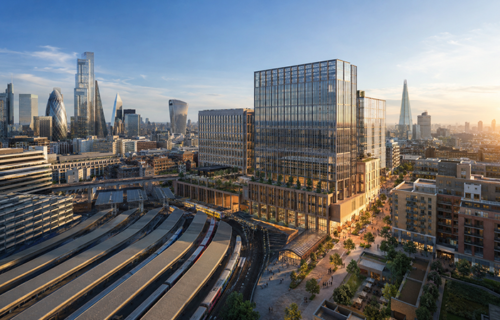
Paddington offers perhaps the clearest current example of how this accessibility is being converted into development value. A new office building of approximately 235,000 sq ft is being developed above the eastern entrance to Paddington station. The 19-storey project is expected to provide 15 floors of workspace together with retail and outdoor areas, with construction progressing towards a planned completion in 2028.
The financing behind the development is particularly significant. Approximately £220 million of development funding has been secured for the project, demonstrating that institutional capital remains prepared to finance high-quality speculative office development when the location and transport proposition are sufficiently strong. This comes after the completion of Paddington Square, which introduced more than 300,000 sq ft of offices together with retail, leisure space and a new public realm immediately beside the station. The next phase therefore represents something more important than a single new building. Paddington is experiencing successive waves of development as its role within London’s transport network strengthens.
The Elizabeth line has made the location considerably more connected to Heathrow, the West End, the City and Canary Wharf. This creates a powerful proposition for international businesses that want airport access without sacrificing connectivity to London’s principal commercial districts.
Liverpool Street demonstrates a different version of the same investment model. Rather than simply developing property beside a railway station, plans for the station increasingly envisage commercial development above the transport infrastructure itself. The proposed transformation would significantly increase passenger capacity while introducing substantial new office, retail, hospitality and leisure accommodation. Commercial development above the station is intended to contribute towards the enormous cost of modernising the transport facilities below.
This could become an increasingly important model for London. Land around major central stations is exceptionally scarce, while demand for modern buildings in well-connected locations remains strong. The air above railway infrastructure consequently represents one of the few remaining opportunities to create substantial development sites in established central districts.
Such projects are considerably more complicated than conventional development. New buildings have to be constructed while railways continue operating beneath them, creating major engineering, safety and logistical challenges. Heritage constraints can further restrict what can be built, while construction costs are significantly higher than on straightforward sites. The economics therefore depend on the premium occupiers are prepared to pay for exceptional connectivity. If high-quality offices above major stations can command top-tier rents, previously difficult development sites become financially viable.
Old Oak Common represents the largest version of this idea, although its development timeline is much longer. During the second quarter of 2026, plans advanced to consolidate approximately 70 acres of publicly controlled land surrounding the future station and bring a major private development partner into the regeneration programme. The initial development opportunity is expected to have a value of around £10 billion and could ultimately support approximately 8,000 homes, 11,000 jobs and up to 200,000 sq m of commercial and community accommodation.
The scale makes Old Oak one of London’s most important brownfield opportunities. The future station is designed to connect HS2 with the Elizabeth line, Great Western services and Heathrow Express. If successfully delivered, this combination could establish an entirely new commercial and residential centre between central London and Heathrow.
However, the investment case has changed substantially because HS2 will arrive much later than originally anticipated. Current government expectations indicate that passenger services between Old Oak Common and Birmingham may not begin until sometime between 2036 and 2039, while services continuing through to Euston could arrive still later. This means regeneration cannot depend solely on HS2.
Instead, developers will have to create a viable district using the transport connections and economic activity already available while preparing for the much larger connectivity benefits that could eventually follow. That makes Old Oak particularly interesting from an investment perspective. It will test whether major mixed-use regeneration can begin creating value around infrastructure more than a decade before the full transport proposition becomes operational.
The area’s existing Elizabeth line and Great Western connections provide a foundation, while extensive public land ownership offers something increasingly rare in London: the ability to assemble a genuinely large development district rather than delivering isolated individual buildings.
Stratford provides an indication of what such long-term transport-led regeneration can eventually become. Its transformation began well before the Elizabeth line and was driven principally by Olympic investment, Westfield, new infrastructure and extensive regeneration of former industrial land. The Elizabeth line should therefore be viewed as another layer of connectivity rather than the original catalyst.
The result is now one of London’s most mature mixed-use regeneration districts. Major office development around Stratford Cross has introduced institutional-quality workspace alongside residential, retail, education and cultural facilities. The area’s next phase is increasingly focused on completing the transition into a fully established urban district.
Plans for approximately 2,000 additional homes at Stratford Cross underline that change. Rather than continuing as an office-led business district, Stratford is moving towards a more balanced mixture of homes, workplaces, shops, leisure, education and public space. The development sequence is instructive for other station locations. Transport infrastructure initially creates accessibility. Offices and retail establish economic activity. Residential, education and cultural investment then broaden the area into a place where people live as well as work.
Further west along the Elizabeth line, a different type of development cycle is emerging. Southall has substantial long-term capacity for additional housing, supported by dramatically improved connections into central London. The regeneration of the former gasworks into the Green Quarter represents the largest example, but residential development around the wider station area is part of a much broader transformation.
The Elizabeth line did not create this opportunity. Major regeneration proposals existed before the railway opened. What improved transport has done is reduce the perceived distance between Southall and central London, strengthening the argument for greater residential density.
Hayes could follow a similar pattern. The area around Hayes & Harlington station combines Elizabeth line services with access to Heathrow and substantial former industrial land. This provides potential for additional housing and mixed-use redevelopment, although viability remains dependent on planning, construction costs and market pricing.
Reading demonstrates how the effect can extend beyond London itself. Major redevelopment around its station combines offices, homes and public realm, supported by fast national rail services and Elizabeth line connectivity. The town effectively forms the western end of a development corridor stretching from the City through central London and Heathrow into the Thames Valley.
But the experience of the western Elizabeth line also provides an important warning. Transport infrastructure does not automatically make every development commercially viable. Some locations have experienced significantly slower development than anticipated despite greatly improved connectivity. Slough illustrates the problem. Large office development opportunities exist around the station, but occupier demand has not always been sufficient to justify speculative construction.
A railway can improve accessibility, but it cannot manufacture office tenants or remove construction costs. That distinction is particularly important in the 2026 development market. Residential development remains under pressure from high construction costs, financing expenses, planning obligations and building-safety requirements. Development land values have weakened in parts of London, reflecting the difficulty of making new schemes financially viable.
The same problem affects commercial development. A station may support higher rents and greater density, but investors still have to demonstrate that the additional value exceeds the cost of building above or around complicated transport infrastructure. This is why the strongest opportunities increasingly involve several factors working together: exceptional connectivity, public-sector land ownership, planning support, strong occupier demand and sufficient development scale.
Railway organisations themselves are beginning to recognise the value of this combination. Transport-related land is increasingly being treated as a development portfolio rather than simply operational infrastructure. Across London, transport landowners are pursuing opportunities above stations, around depots and on surplus sites. At national level, railway property initiatives are targeting tens of thousands of homes and millions of square feet of commercial development over the coming decade.
This potentially creates a significant new source of development land at a time when conventional sites in London are increasingly difficult and expensive to assemble. The most valuable railway assets may therefore no longer be limited to tracks, platforms and passenger revenues. The development rights above and around those assets are becoming increasingly important.
Paddington demonstrates that institutional investors will finance major offices directly above transport infrastructure. Liverpool Street could establish commercial development as a mechanism for paying for station modernisation. Stratford demonstrates how transport investment can ultimately support an entire mixed-use district. Southall and Hayes illustrate the residential opportunities created when outer London locations become significantly better connected.
Old Oak Common takes the concept to an entirely different scale. If successful, it could create a new piece of London around one of Europe’s largest railway infrastructure projects. But the delayed arrival of HS2 means investors will need patience, substantial capital and confidence that the district can develop independently before the full railway network is completed.
London’s next property cycle around transport hubs will therefore not be driven by stations alone. Connectivity creates the possibility of higher density, but land assembly, planning, construction costs, financing and occupier demand determine whether that potential becomes investible real estate.
The Elizabeth line has demonstrated how dramatically transport can change perceptions of distance across London. The next phase will determine whether that connectivity can be converted into another generation of viable development. For investors, the most important opportunities may increasingly lie not simply beside London’s railway stations, but above them, around them and on the large areas of land that improved transport connections can finally make economically viable.
Source: CIJ.World UK Research & Analysis Team