Thursday, 22 October 2026
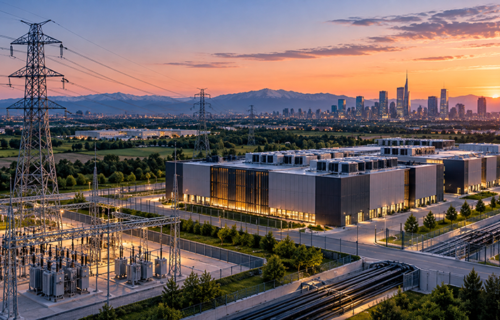
Italy’s rapidly expanding data-centre industry is beginning to change the economics of industrial property. For decades, the value of development land was largely determined by familiar considerations such as motorway connections, proximity to major cities, labour availability and access to customers. For a growing category of digital infrastructure projects, another factor is moving towards the top of the list: how much electricity can actually reach the site, and when. The shift became increasingly visible during the first half of 2026, when data centres emerged as a meaningful contributor to Italy’s exceptionally strong commercial property investment market.
Around €736 million was invested in the sector during the period, with transactions involving not only operational facilities but also development land and older industrial properties capable of redevelopment. Milan and the surrounding Lombardy region remain at the centre of this expansion. The area combines Italy’s largest concentration of corporate demand with extensive telecommunications infrastructure, established operators and connections to international digital networks, making it the country’s natural starting point for hyperscale, cloud and colocation investment.
Milan’s success, however, is creating a new property constraint. Building a large data centre requires much more than securing several hectares of industrial land. Developers need access to substantial quantities of electricity and confidence that this power can be delivered within a commercially viable timeframe. As projects become larger and more energy intensive, obtaining that capacity is becoming one of the decisive elements of site selection.
The scale of demand being presented to Italy’s electricity network demonstrates the pressure. Requests for data-centre grid connections have increased dramatically over the past two years, reaching levels far beyond the capacity represented by projects currently expected to be constructed. This does not mean that every application will become a functioning data centre. Some schemes will be delayed, reduced or abandoned, while multiple applications can form part of early-stage development strategies. Nevertheless, the volume of connection requests reveals something important for the property market: electricity infrastructure has become part of the competition for land.
This is beginning to challenge traditional assumptions about what makes an industrial site valuable. A large plot close to Milan with excellent motorway access might appear ideal for logistics or industrial development. But if a data-centre developer cannot secure sufficient electricity there for several years, its usefulness for digital infrastructure may be limited. A less obvious location can potentially become more attractive if it offers a realistic route to substantial power, suitable planning conditions and fibre connectivity. For these developments, distance from Milan may matter less than the certainty and timing of infrastructure delivery.
The consequence could be the emergence of a new category of Italian property: land whose value is determined partly by its ability to support substantial electricity demand. Two neighbouring sites can have similar road connections, planning characteristics and physical dimensions but very different potential for a data-centre developer if one has significantly better access to electricity infrastructure.
This can also affect existing industrial buildings. Older factories, warehouses and brownfield sites that might previously have been assessed primarily for logistics, manufacturing or residential conversion can acquire another possible use if they possess valuable electrical infrastructure or sit close to locations where significant additional capacity could realistically be delivered. That does not mean every former industrial site with a substantial connection will become a data centre. Development requires a much broader combination of factors, including telecommunications connectivity, planning approval, physical security, environmental considerations and cooling requirements. Electricity, however, can determine whether the project is viable in the first place.
The situation is particularly relevant around Milan because digital infrastructure is competing for some of the same development locations sought by logistics operators and other industrial users. This creates a potentially significant pricing question for landowners. A site valued for conventional warehouse development could be worth considerably more to a specialist infrastructure developer if its electrical characteristics allow a large data-centre project to proceed.
The resulting premium would not necessarily apply across the industrial market. Logistics occupiers will continue to prioritise motorway networks, distribution times, population catchments and labour availability, while manufacturers have their own operational requirements. Data centres represent a specialised use with unusually high infrastructure demands. Where sites are suitable for several competing uses, however, electricity could materially alter the economics.
This also raises questions about speculative land acquisition. The extraordinary quantity of electricity capacity requested by prospective data-centre developments should not be confused with committed construction. The gap between connection applications and projects likely to proceed suggests that developers and other market participants may be attempting to secure strategic positions before infrastructure becomes more constrained.
For property investors, this makes due diligence increasingly complex. Ownership of land close to electricity infrastructure does not necessarily guarantee access to the required capacity. A theoretical connection opportunity is very different from a technically viable project with a credible delivery schedule. The value of a data-centre development site therefore increasingly depends on certainty. Investors need to understand not simply how much electricity exists nearby but whether capacity can actually be allocated, what network reinforcement may be necessary, who will pay for it and how long the process could take.
Planning presents another layer of risk. Large data centres can require substantial supporting infrastructure and may generate concerns around electricity consumption, environmental impact and the use of scarce industrial land. As the number and scale of proposed developments increase, municipalities will have to balance digital infrastructure investment against competing requirements for logistics, manufacturing, housing and other economic uses.
Italy has been working to improve the regulatory environment surrounding data-centre development, but the interaction between planning and electricity infrastructure remains critical. Faster administrative procedures are of limited value if the power required by a project cannot be delivered within the same development timetable.
The concentration around Milan also raises a larger geographical question. If grid constraints intensify in Lombardy, developers may eventually have stronger incentives to examine alternative Italian locations. This would not necessarily produce an immediate migration away from Milan because data centres benefit from clustering. Existing fibre routes, customers, technical expertise and established operators reinforce the attraction of locations where the industry is already concentrated.
Yet electricity constraints have changed data-centre geography elsewhere in Europe. When additional capacity becomes difficult or slow to secure in established hubs, operators begin evaluating secondary markets. Italy could experience a similar process if alternative locations can combine substantial power availability with strong fibre connections, suitable land and predictable permitting.
Such a shift could have important consequences for regional property markets. Industrial land previously considered secondary because of its distance from Milan could become strategically significant if it can support large-scale digital infrastructure. The same could apply to brownfield properties where existing industrial connections provide an advantage over undeveloped sites.
For investors, the opportunity is therefore broader than ownership of completed data centres. There may also be value in identifying land and obsolete industrial assets where electricity infrastructure creates redevelopment potential that conventional property valuation does not fully recognise. The risk is equally significant. Land acquired on the assumption that power will become available can remain undevelopable for years if network reinforcement is delayed or connection expectations prove unrealistic. As competition intensifies, distinguishing genuinely viable sites from speculative ones will become increasingly important.
Italy’s data-centre expansion is consequently creating a property market in which infrastructure and real estate are becoming increasingly difficult to separate. The value of a site is no longer determined solely by what can physically be constructed on it. For power-intensive developments, value increasingly depends on whether the infrastructure required to operate that building can actually be secured.
Milan will probably remain Italy’s dominant data-centre location for the foreseeable future, but the next stage of expansion may be shaped as much by the electricity network as by traditional property geography. That could influence which industrial sites are developed, which brownfield assets are reconsidered and which regional locations begin attracting infrastructure capital. Road access, land availability and proximity to major economic centres remain important, but for data centres they are no longer enough. In an increasingly constrained market, one of the most valuable characteristics of Italian development land may be largely invisible: the ability to secure enough electricity to make the project possible.
Source: CIJ.World Research & Analysis Team