Sunday, 25 October 2026
Italy’s shortage of student accommodation is beginning to influence a different part of the property market. As international investors, developers and specialist operators compete to expand their portfolios, attention is shifting from completed student residences towards the land and existing buildings from which the next generation of accommodation can be created. The scale of the imbalance explains the interest. Italy has roughly two million university students, but only a small proportion can obtain places in dedicated student residences. At the same time, investment in the sector has accelerated, with capital increasingly entering projects before completion rather than waiting to acquire established properties.
This changes the nature of the investment opportunity. When relatively few completed residences are available for sale, investors seeking exposure to the sector have to move earlier in the property cycle. That means acquiring development sites, financing projects, partnering with developers or purchasing buildings that can be converted into student accommodation. As a result, Italy’s student-housing shortage is beginning to affect the value of properties that were never designed for students. An ageing office building, redundant hotel, former institutional property or residential block can potentially become the starting point for a new residence, particularly in cities where suitable development land is scarce.
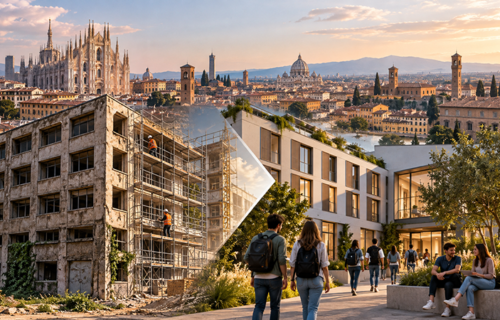
Conversion, however, is considerably more complicated than changing the purpose of a building on paper. A successful student residence needs enough bedrooms to generate income while also providing kitchens, communal areas, study space, circulation, technical facilities and other services. The efficiency with which these uses fit into an existing structure can determine whether a project works financially. Former offices illustrate the problem. Large floorplates can initially appear ideal because they provide substantial amounts of space under one roof, yet excessive building depth can make it difficult to create bedrooms with adequate daylight. Structural columns may interfere with room layouts, while converting areas originally designed for desks into hundreds of bedrooms can require extensive plumbing and mechanical work.
Hotels can offer a more natural configuration because they already contain individual rooms, bathrooms and circulation corridors. Even then, room sizes, common areas, fire protection, kitchens and operational requirements may require significant reconstruction. Historic and institutional buildings present another category of opportunity. Italy contains numerous former schools, hospitals, administrative properties, religious buildings and other structures that could potentially accommodate residential uses. Their locations can be attractive, but protected architectural features, complicated layouts and restrictions on structural alteration can make redevelopment expensive.
The real investment question is therefore not how many obsolete properties Italy possesses, but how many can be acquired cheaply enough and converted efficiently enough to produce student accommodation at a viable total cost. That calculation varies considerably between cities. Milan remains the country’s most competitive institutional market. Its universities attract a large domestic and international student population, while high housing costs strengthen demand for professionally managed accommodation. Those same characteristics make development difficult because land is expensive and student-housing investors compete with residential, office, hotel and mixed-use developers.
This can make existing Milan buildings particularly valuable. A secondary office that no longer satisfies corporate occupiers may have greater potential as student accommodation, provided its structure and location allow conversion. However, Milan’s high property values also mean investors can quickly overpay for the redevelopment opportunity. Strong student rents do not automatically compensate for an excessive acquisition price and expensive construction programme.
Rome offers enormous underlying demand but presents different obstacles. Its universities generate a large potential customer base, yet the city’s historic fabric, planning complexity and fragmented property stock can make the delivery of large schemes difficult. Finding buildings with sufficient scale, appropriate configuration and a realistic path through redevelopment can therefore be as important as identifying neighbourhoods with student demand. Older offices and institutional buildings could provide potential supply, particularly outside the most constrained historic locations, but the difference between an attractive redevelopment opportunity and an expensive problem can be narrow.
Bologna provides another model. The university plays an unusually important role in the city’s housing market, creating persistent competition between students and conventional residents. Limited availability and strong demand make purpose-built accommodation attractive, but they also increase the price of properties that could be converted. Transport connections could consequently become increasingly important. Student accommodation does not necessarily need to occupy the most expensive streets close to university buildings if residents can reach campuses quickly by public transport or bicycle, potentially expanding the investment map towards regeneration areas and less central sites where larger projects can be delivered.
Florence presents a different form of competition. Buildings suitable for student accommodation can also be attractive to hotel investors, serviced-apartment operators and residential developers. Tourism gives many centrally located properties substantial alternative value, meaning a technically suitable student conversion may still fail financially because another use can support a higher acquisition price. Investors therefore cannot assess a potential residence only according to expected student rents. They have to consider what competing buyers might pay for the same building and whether student housing can generate enough income to justify matching that price.
Turin potentially offers more favourable acquisition economics. Its large university population, established educational institutions and extensive urban fabric create opportunities for projects at a lower entry cost than Milan. Former commercial and industrial properties associated with regeneration areas may also provide larger sites capable of supporting accommodation at institutional scale. Padua demonstrates why the opportunity is spreading beyond Italy’s largest investment markets. A significant university population creates structural demand, while lower property values than Milan can improve development economics. For institutional investors, cities such as Padua can become attractive where student numbers, rental pressure and limited existing accommodation combine with realistic land and construction costs.
The growing interest in these cities is also changing how projects are financed and sold. Investors increasingly do not need to wait until a residence is operating before committing capital. Agreements can be reached while projects are being developed, allowing an investor to secure future supply and a developer to establish an exit before construction is completed. Partnerships can take the process further by combining institutional capital with local development expertise, particularly where acquiring and converting property requires detailed knowledge of planning, construction and local demand.
This could gradually create a separate market for properties with student-housing potential. An obsolete office may no longer be valued only according to the rent it can generate as an office. Its price may also reflect what a residential, hotel or student-housing developer believes can be created from it. The same applies to land. Sites near universities and transport infrastructure can attract competition from several residential uses, forcing student-housing developers to determine how much they can pay while still delivering acceptable returns. Where land becomes too expensive, attention naturally moves towards conversion and regeneration opportunities.
Yet conversion has a financial limit. Acquisition cost is only the beginning. Investors must account for demolition, structural work, energy improvements, fire safety, mechanical systems, bathrooms, kitchens, communal areas, professional fees, financing and the period during which the building generates no income. Unexpected problems discovered after construction begins can quickly erode the advantage of buying an existing property. New construction can therefore sometimes be cheaper than conversion despite requiring land and a longer development process. A purpose-designed residence allows bedrooms, circulation and common areas to be arranged efficiently from the beginning, while modern energy performance can be incorporated directly rather than retrofitted into an older structure.
The decision between conversion and redevelopment will consequently become one of the most important calculations in Italy’s expanding student-housing market. Some buildings will justify preservation because their structure, location and acquisition price create a clear advantage. Others may be better demolished and rebuilt, while a third group will prove unsuitable for student housing altogether. Environmental performance adds another dimension because investors typically intend to own or finance these properties for long periods. A cheap older building can become considerably less attractive if bringing it to an acceptable standard requires extensive additional expenditure.
Scale also matters. Institutional investors generally need projects large enough to justify acquisition, operating and management costs. A small building close to a university may have excellent demand but still be unsuitable for a large investment platform. This favours properties and sites capable of accommodating hundreds rather than dozens of beds. As competition increases, the ability to identify those opportunities early could become increasingly valuable. The obvious buildings near major universities will attract multiple buyers, meaning future development margins may depend on finding less obvious properties in regeneration districts, emerging transport corridors and secondary university cities before their alternative-use potential is fully reflected in land values.
Italy’s student-housing shortage is consequently becoming more than an accommodation problem. It is beginning to influence investment decisions across offices, hotels, residential property, institutional buildings and development land. For investors, the next phase will not simply be a race to acquire existing student residences. It will be a search for the buildings and sites capable of becoming them.
Milan, Rome, Bologna, Florence, Turin and Padua each offer different combinations of student demand, property prices, planning constraints and redevelopment opportunities. There will be no single conversion model that works across all six markets. The most successful investors may therefore be those that understand not only student demand but the economics of the underlying real estate. As competition for beds intensifies, the decisive question will increasingly be asked long before the first student moves in: what is this building worth today, what will it cost to transform, and does enough value remain once the conversion is complete?
Source: CIJ.World Research & Analysis Team