Monday, 19 October 2026
The difficulties facing parts of France’s office market are encouraging property owners to reconsider what some older commercial buildings should become. In locations where offices face persistent vacancy, substantial refurbishment costs or limited investor demand, hotels are increasingly being considered alongside housing and other alternative uses. The opportunity is most apparent in Paris, where strong visitor demand exists alongside a large office market containing buildings that no longer satisfy modern occupier requirements. It is considerably more selective elsewhere in France, but the same investment calculation could eventually apply to individual properties in Lyon, Marseille, Nice and Bordeaux.
This is not evidence of a nationwide conversion boom. Most French offices will remain offices, while many buildings that lose their commercial competitiveness will be unsuitable for hospitality. The emerging opportunity concerns a much narrower category: properties in locations capable of supporting a hotel where retaining the existing office use no longer produces an attractive return.
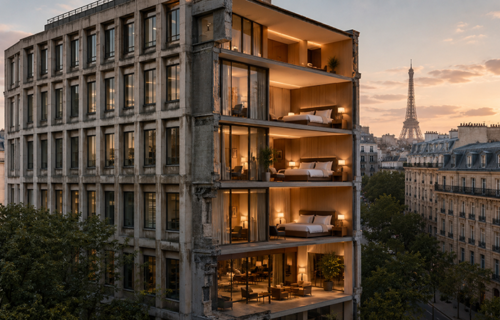
A current Paris project illustrates how that decision can work. Covivio is transforming a vacant office property on boulevard Raspail into a four-star hotel containing 106 rooms. The redevelopment represents an investment of approximately €50 million, with opening expected in 2029. The property has already secured a long-term operating commitment. More important from a real-estate perspective is the reasoning behind the project. Alternative possibilities were considered for the property before hospitality was selected as the preferred repositioning strategy. It demonstrates that an office building can reach a point where its future value depends less on finding another workplace tenant and more on identifying a different economic purpose for the asset.
Conditions in the wider Paris office market make that question increasingly relevant. Île-de-France entered the second half of 2026 with approximately 6.5 million square metres of immediately available offices. Around 750,000 square metres was taken up during the first six months of the year, below both the previous year and longer-term market levels. The weakness is not evenly distributed. Modern buildings in strong central locations remain capable of attracting occupiers, while older properties requiring substantial investment face much greater challenges. This distinction is increasingly important because environmental performance, workplace quality, accessibility and amenities have become central to corporate property decisions.
For owners of weaker buildings, refurbishment can become expensive. Large amounts of capital may need to be invested simply to return an office to a competitive standard, without any guarantee that future rents will justify the expenditure. At that point, alternative uses become part of the investment calculation. An owner can compare the expected return from refurbishing an office with the economics of converting it into housing, hospitality, student accommodation or another specialist property type. The answer depends on the building, its location, acquisition value, planning position and the amount of construction work required.
Hotels can become particularly interesting in central Paris because the city combines enormous visitor demand with limited opportunities to create new accommodation in prime locations. Suitable development land is scarce, while planning and construction can be complicated and expensive. Existing commercial buildings can therefore provide another route into the market. Paris has already demonstrated that office-to-hotel transformation is physically achievable, with commercial properties converted while retaining significant portions of their existing structures. Such projects can preserve buildings that might otherwise require extensive demolition and reconstruction, although the financial and environmental advantages depend heavily on the individual property.
The biggest obstacle is often the building itself. Offices and hotels require fundamentally different internal arrangements. Hotel bedrooms normally need windows and efficient access to corridors, while very deep office floors can leave internal areas that are difficult to use productively. Columns, ceiling heights and façade design can further restrict the number and size of rooms that can be created. Hotels also need appropriate lifts, staircases, fire-safety systems, kitchens, storage, deliveries, housekeeping areas and other operational spaces that may not exist in an office. Resolving these issues can require extensive reconstruction.
That makes the purchase price of the original office particularly important. A building may be technically capable of becoming a hotel but still be economically impossible to convert if the acquisition price is too high. This is where the adjustment in office values becomes relevant. As an ageing office becomes less attractive to occupiers and investors, its value can decline. If the property sits in a location where hotel revenues remain strong, a lower acquisition basis may eventually provide enough room to finance the conversion works. The relationship is not automatic. Falling office values do not create successful hotels, but they can change the financial equation surrounding buildings that already possess strong alternative-use potential.
The French hotel investment market provides some support for investors considering that equation. More than €680 million was invested in French hotels during the first quarter of 2026, following a particularly active 2025 when annual transactions exceeded €3 billion. Hospitality therefore continues to attract investment capital despite the uncertainty affecting several conventional commercial property sectors. Investors have also become increasingly comfortable with property where performance depends partly on the operation taking place inside the building. Hotels sit within a wider group of operational assets that includes student accommodation, senior housing and other managed residential formats. These sectors require different expertise from conventional office investment, but they can provide access to income streams driven by different economic factors.
The opportunity outside Paris requires greater caution. Lyon has a substantial office market and experienced a sharp slowdown during the first half of 2026, with approximately 63,000 square metres of take-up. That weaker leasing environment could eventually encourage more owners to examine alternatives for properties that struggle to attract tenants. But Lyon’s hotel conversion potential will be highly dependent on location. Central areas benefiting from tourism, business travel, conventions and major transport connections present a fundamentally different proposition from peripheral business districts where visitor demand may be limited.
Marseille presents another possible case. Regeneration has transformed parts of the city while its tourism profile has strengthened. Commercial buildings close to the Old Port, major railway connections and established visitor destinations could potentially attract hospitality interest where the property characteristics and acquisition price support conversion. This should not be interpreted as evidence of widespread office-to-hotel redevelopment in Marseille. The opportunity remains asset-specific and would need to be tested against local hotel supply, operating performance and construction costs.
Nice has a different property structure. Its international tourism market provides a strong foundation for hospitality, but the pool of obsolete institutional offices suitable for conversion may be smaller than in major commercial centres such as Paris or Lyon. Bordeaux similarly combines tourism with a significant regional economy. Individual central properties with appropriate architecture and strong accessibility could potentially support hotel repositioning, although there is not currently evidence of a large conversion pipeline.
The differences between these cities illustrate why the trend should be viewed as an investment strategy rather than a new national development model. The important question is not whether a city attracts tourists. It is whether an individual office can generate greater value under another use after accounting for every cost involved in changing the building.
Planning can determine the answer. Changing a commercial property into a hotel may require approval for a different use as well as compliance with accessibility, fire protection and building regulations. Historic buildings can introduce additional restrictions, particularly in central districts where hotel demand might otherwise make conversion attractive. Municipal policy can also influence what happens to obsolete offices. French cities face competing demands for housing, employment, tourism and economic development. A hotel may provide the highest theoretical return for an investor while another use is favoured by local planning priorities.
For that reason, alternative-use analysis increasingly needs to begin before an investor buys the property. The potential room layout needs to be tested. Construction requirements must be understood. Planning risks need to be assessed. Hotel demand and achievable room rates must be examined, while a suitable operator or brand may need to be identified. Only after those questions have been answered can an investor calculate what the existing office is actually worth.
This is an important distinction because a cheap office is not necessarily a conversion opportunity. The most interesting properties are those where declining office economics coincide with a stronger alternative use. Hotels will also compete with other potential solutions. France’s housing shortage creates an obvious case for residential conversion in suitable locations. Offices close to universities might support student accommodation, while buildings near medical and research clusters could have completely different possibilities. Each alternative has its own physical, regulatory and financial requirements.
Hospitality becomes compelling where the building is located in a strong visitor market, the structure can be adapted efficiently and projected hotel income is sufficient to cover the acquisition and redevelopment costs. Paris currently offers the clearest combination of these conditions.
The wider implication for French property investment is that an office building’s existing use can no longer always be assumed to represent its highest future value. As owners confront vacancy, refinancing requirements and increasingly expensive refurbishment programmes, more properties will have to be evaluated according to what they could become rather than what they have historically been.
That process will not transform every obsolete office into a hotel. It could, however, create a small but increasingly important acquisition pipeline for hotel investors and operators prepared to look beyond conventional hospitality assets. For some of France’s ageing offices, the next tenant may therefore never arrive. The more important question may be whether the building should still be an office at all.
Source: CIJ.World UK Research & Analysis Team