Tuesday, 20 October 2026
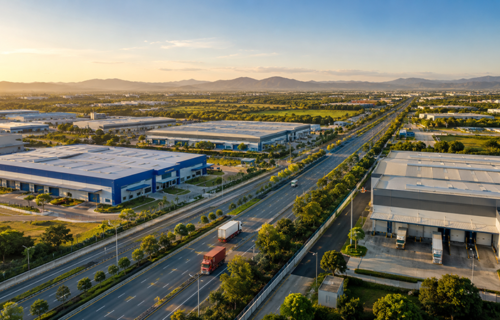
India’s manufacturing strategy is beginning to alter the country’s industrial property landscape as investment spreads beyond established metropolitan areas towards a wider network of planned production and logistics centres.
At the heart of this transition is the National Industrial Corridor Development Programme, which links manufacturing locations with highways, freight railways, ports and other major infrastructure. The programme currently encompasses 11 industrial corridors and 32 projects at various stages of development. The scale of the initiative is significant, although the locations within it are far from uniform. Some industrial areas are already developed, several are approaching completion and others remain at much earlier stages of implementation.
Among the most advanced are Dholera in Gujarat, Shendra-Bidkin in Maharashtra, the Integrated Industrial Township at Greater Noida and Vikram Udyogpuri in Madhya Pradesh. These locations demonstrate India’s attempt to provide manufacturers with prepared development areas where essential infrastructure is established before major occupiers arrive.
Other projects are progressing at Tumakuru in Karnataka and Krishnapatnam in Andhra Pradesh, while logistics infrastructure around Haryana and Greater Noida is strengthening connections between manufacturing locations and national distribution networks.
The programme entered another phase when the central government approved 12 additional industrial cities in 2024. Together, the projects cover almost 26,000 acres across ten states and involve planned public investment of approximately ₹28,602 crore.
The new locations include Khurpia, Rajpura-Patiala, Hisar, Agra, Prayagraj, Gaya, Dighi Port, Jodhpur-Pali-Marwar, Kopparthy, Orvakal, Zaheerabad and Palakkad. Government projections suggest these developments could eventually attract more than ₹1.5 lakh crore of investment and support close to one million jobs. These remain targets rather than completed investment, but they demonstrate the scale of the manufacturing geography India is attempting to create.
For commercial real estate, the significance goes considerably further than providing land for factories. India already has a substantial institutional industrial and logistics property sector, particularly around Delhi-NCR, Mumbai, Bengaluru, Chennai, Pune, Hyderabad, Kolkata and Ahmedabad. Modern warehouses, logistics parks and purpose-built manufacturing facilities have attracted considerable domestic and international capital.
Industrial corridors could now help extend this market into a much broader group of locations. This is particularly important because modern manufacturers increasingly assess entire operating environments rather than simply comparing land prices.
A major production facility needs dependable electricity, water, road access, rail connections, workers, suppliers and logistics infrastructure. Export-oriented businesses may also require efficient connections to ports, while advanced manufacturing companies need access to engineering and technical skills. When these elements are available within or around a planned industrial location, the time and complexity involved in establishing production can be reduced.
That principle becomes particularly important as India attempts to expand domestic manufacturing across electronics, automobiles, pharmaceuticals, engineering, renewable-energy equipment, defence-related production and food processing.
Large manufacturing projects also create demand well beyond the factory itself. An automotive plant, for example, can attract component producers, engineering companies, packaging businesses and logistics providers. Electronics manufacturing creates similar supplier networks, while pharmaceutical clusters require specialist storage, distribution and research facilities.
This can produce a much larger property market around the original investment. The result is that India’s manufacturing expansion increasingly has the potential to generate clusters containing factories, warehouses, distribution centres, research facilities and supporting commercial property.
Industrial and logistics demand remained strong during the first half of 2026. Depending on the methodology used, market surveys recorded more than 30 million sq. ft. of leasing across India’s leading industrial and logistics locations, while manufacturing-related demand showed particularly strong growth.
Third-party logistics companies, engineering businesses, automotive occupiers, e-commerce companies and manufacturers continue to account for a substantial proportion of activity.
Modern industrial stock is also expected to expand significantly during the remainder of the decade. India’s eight principal markets currently contain hundreds of millions of square feet of Grade-A industrial and warehousing space, with forecasts indicating that supply could exceed 500 million sq. ft. by 2030.
The more interesting question is how much of the next wave of development will occur outside those established locations. Rising land prices and congestion around major cities are already encouraging developers and occupiers to examine peripheral and regional markets. New expressways, freight routes and industrial corridors are making some of these locations increasingly practical alternatives.
Research published in 2026 identified around 30 Indian cities with meaningful long-term industrial and warehousing potential, including more than 20 outside the country’s eight principal markets. Not every emerging city will develop into a major institutional property market, but the number of potential locations is increasing.
For investors, this creates different levels of opportunity and risk. Established industrial nodes can provide stabilised warehouses and manufacturing properties capable of generating immediate rental income. Developing locations may offer opportunities for build-to-suit facilities and logistics parks anchored by individual occupiers.
Earlier-stage industrial cities provide a different proposition. Land may be cheaper and potential growth greater, but investment depends much more heavily on infrastructure completion and the arrival of genuine manufacturing demand.
This is why India’s industrial corridors should not be considered one uniform investment market. The Delhi-Mumbai corridor is considerably more advanced than many other parts of the national programme and already contains several of India’s most developed new industrial locations.
The Chennai-Bengaluru corridor is progressing through major projects including Tumakuru and Krishnapatnam, while the Amritsar-Kolkata corridor contains several of the industrial cities approved in the latest expansion programme. Other corridors are at earlier stages and will require considerably more development before they can support mature institutional property markets.
The success of individual locations will therefore depend less on their inclusion on the national corridor map and more on whether infrastructure and occupier demand actually materialise.
For property developers, manufacturing companies themselves may become the catalyst. A large factory commitment can provide the confidence required to develop warehouses, supplier facilities and additional industrial buildings nearby. As more occupiers arrive, the location can gradually develop sufficient scale to attract institutional investors.
Grade-A logistics is likely to be one of the clearest beneficiaries. Manufacturers increasingly require sophisticated distribution facilities capable of supporting automated inventory systems, modern loading infrastructure and larger regional supply chains. Growth in organised retail and e-commerce adds another source of demand.
Industrial corridors can help connect these facilities with both production centres and consumer markets. More specialised property categories could emerge as well.
Cold-storage facilities may develop around food and pharmaceutical clusters. Electronics and engineering locations can create requirements for light-industrial buildings and component warehouses, while advanced manufacturing could generate demand for research and technical facilities. Large industrial employment centres can eventually support workforce housing, retail, hospitality and other commercial services.
The property consequences of a successful industrial corridor can therefore spread far beyond the boundaries of the industrial park itself.
India’s wider transport investment strengthens this opportunity. The country has expanded highways, freight railway infrastructure, ports and multimodal logistics facilities over the past decade. India ranked 38th in the World Bank’s latest Logistics Performance Index, compared with 44th in 2018.
That improvement cannot be attributed to industrial corridors alone. It reflects a much broader modernisation of India’s transport and trade infrastructure. The importance of the corridor strategy is that it can connect those national improvements with specific locations where manufacturing investment takes place.
This also strengthens India’s position as global companies reconsider their supply chains. International manufacturers are increasingly interested in maintaining production across multiple countries rather than depending heavily on one geography. At the same time, Indian companies are expanding domestic manufacturing capacity.
India therefore has an opportunity to capture both international and domestic investment, but infrastructure availability will be only one part of the competition. Labour, energy costs, regulation, supplier networks, taxation and the speed of approvals will remain important when companies choose where to establish production.
Industrial corridors can provide the physical framework, but they cannot create successful manufacturing centres without occupiers. Execution will therefore determine which of India’s new industrial cities become genuine investment markets.
Locations where infrastructure is completed, manufacturers establish operations and supplier networks develop could eventually support significant institutional property portfolios. Others may take much longer to achieve sufficient scale.
For real-estate investors, this makes individual project selection increasingly important. The opportunity is not simply to buy industrial property because it sits somewhere along a nationally designated corridor. The stronger investment proposition will be found where transport infrastructure, manufacturing demand, available labour and supporting services are converging.
India’s industrial property market has already evolved from basic warehouses and owner-occupied factories into a substantial institutional sector. The next stage could be geographical.
If the country’s new industrial cities successfully attract manufacturing investment, institutional-quality warehouses, production facilities and specialist industrial property could spread into markets that currently have little modern stock.
That would make India’s industrial corridors much more than an infrastructure programme. They could become the foundation for a new generation of manufacturing and logistics property markets, expanding the country’s investible industrial geography well beyond its traditional metropolitan hubs.
Source: © CIJ.World India Research & Analysis Team