Tuesday, 20 October 2026
Africa’s expanding network of special economic zones is beginning to create a new class of industrial property markets, but a widening divide is emerging between locations that have attracted factories, warehouses and international occupiers and those that remain primarily development ambitions. For investors, that distinction is becoming increasingly important. Governments across the continent have used preferential tax treatment, simplified administration and designated industrial areas to encourage manufacturing investment. Yet experience increasingly suggests that incentives alone are not enough. Manufacturers need dependable electricity, efficient transport connections, serviced land, suitable buildings, skilled workers and predictable operating conditions.
The result is an emerging hierarchy of African industrial locations. At one end are established manufacturing ecosystems such as Tangier, where ports, factories, suppliers and logistics infrastructure operate together. At the other are zones with large investment pipelines but considerably less completed industrial activity. Between them is a growing group of projects in Nigeria, Kenya, Rwanda, Gabon, Egypt and Ethiopia attempting to turn infrastructure investment into functioning industrial property markets.
Morocco provides perhaps the clearest example of how far the model can develop. The industrial platform associated with Tanger Med now extends across approximately 3,000 hectares and accommodates around 1,500 companies supporting more than 145,000 jobs. Automotive manufacturing has become particularly important, but the ecosystem has expanded into logistics, electronics, food production and other industrial activities. Tangier’s advantage comes from the combination rather than any single incentive. Manufacturers have access to a major international port, road and rail infrastructure, established suppliers and industrial land while remaining geographically close to European markets. New factories and logistics facilities continue to open, reinforcing an existing industrial base rather than attempting to create one from nothing.
This makes Tangier an important benchmark for the rest of Africa. Its development demonstrates that the most successful zones eventually cease to function as isolated areas offering preferential conditions and instead become integrated manufacturing and logistics economies.
Nigeria is developing a different version of this model around Lekki. Lagos Free Zone covers approximately 860 hectares and is increasingly combining industrial property with one of West Africa’s most important new maritime gateways. Manufacturers already operating within the development include international businesses from food production, consumer goods, chemicals and industrial sectors. The presence of Lekki Deep Sea Port changes the property proposition significantly. Manufacturing and distribution facilities can be positioned close to maritime infrastructure, reducing some of the logistical disadvantages associated with moving goods through congested parts of Lagos.
The zone provides serviced industrial land alongside completed warehouses and factory buildings, giving occupiers the option of developing their own facilities or moving into existing space. Utilities, telecommunications and supporting infrastructure are also incorporated into the development. Institutional capital has begun to recognise the model, with IFC committing up to US$50 million to support further development of the zone, including industrial infrastructure and serviced land. This is significant because it demonstrates that African SEZs can attract international investment not simply into individual factories but into the property platform supporting those occupiers.
Kenya provides another increasingly property-led example through Tatu City outside Nairobi. Rather than functioning purely as a traditional industrial zone, the development combines manufacturing, logistics, commercial and residential uses within a large master-planned environment. More than 100 businesses are operating or developing facilities there, while the industrial component increasingly includes purpose-built warehouses and logistics properties as well as land for manufacturing.
The first phase of the Link Warehousing & Logistics Park opened following approximately KES2.5 billion of investment, providing units ranging from smaller warehouse facilities to spaces suitable for substantially larger occupiers. Further expansion is planned, illustrating growing demand for professionally developed logistics buildings rather than basic industrial sheds. Tatu City’s attraction is closely connected to infrastructure. Reliable utilities, internal roads, security and planned development allow occupiers to avoid some of the infrastructure problems associated with less organised industrial districts. For investors, this creates the possibility of developing institutional-quality property within an environment where the surrounding infrastructure is controlled as part of the wider project.
Gabon offers a more specialised example through Nkok. Rather than attempting to compete across every manufacturing category, Nkok has built a significant industrial cluster around timber processing. The zone covers more than 1,100 hectares, with roughly 600 hectares developed, and has attracted more than 140 investors across numerous sectors. Wood processing is particularly important because it demonstrates how an African SEZ can connect industrial property directly with domestic resources. Timber can move through several stages of processing within the industrial ecosystem rather than leaving the country largely as an unprocessed commodity.
New projects are broadening the range of activities at Nkok, although it is important to distinguish between operating facilities and developments that remain under construction. Proposed steel production and digital infrastructure investments, for example, add to the future pipeline but should not yet be treated as completed industrial capacity.
Rwanda’s Kigali Special Economic Zone represents a smaller but comparatively structured model. Its first phase covers approximately 98 hectares and provides businesses with roads, electricity, water, telecommunications and other essential infrastructure. Manufacturing companies are already operating from the zone, while investment is gradually expanding into more specialised property. A new cold-chain packhouse opened during 2026, with a larger cold-storage facility planned for 2027.
This illustrates another direction for African industrial real estate. Future SEZ demand will not necessarily come solely from conventional manufacturing. Agricultural exports, pharmaceuticals, food processing and temperature-controlled logistics can create requirements for specialised buildings that are considerably more sophisticated than traditional warehouse stock.
Egypt’s Suez Canal Economic Zone presents an opportunity on a much larger scale, but it also demonstrates why announced investment needs to be separated from delivered property. Qantara West has accumulated dozens of contracted industrial projects representing substantial proposed investment and several million square metres of allocated land. Those commitments indicate considerable investor interest, but contracts and investment agreements do not automatically represent operating factories.
Physical development is nevertheless progressing. Infrastructure has been completed across parts of the zone and factories have begun opening. More importantly for commercial property investors, developers are now committing capital to ready-built factories and storage facilities rather than concentrating exclusively on the sale or allocation of industrial plots. One programme announced during 2026 envisages approximately 150,000 sqm of ready-built factory and storage accommodation following investment of around EGP2.4 billion, while other industrial-building programmes are also planned.
This could mark an important evolution in Egypt’s SEZ model. Providing completed buildings allows companies to establish operations without purchasing land and developing factories independently. It also creates an asset that can potentially generate rental income, bringing SEZ development closer to the conventional institutional industrial-property model.
Ethiopia provides perhaps the clearest warning against measuring success simply by counting industrial parks. The country has invested heavily in purpose-built manufacturing locations, particularly for textiles, apparel, pharmaceuticals and export-oriented production. Several have genuine operating businesses and substantial physical infrastructure, but performance differs considerably between locations. Hawassa remains one of the most established examples, with most of its factory sheds leased. Bole Lemi also contains completed manufacturing facilities, while Kilinto has been developed with a particular focus on pharmaceuticals and technology.
These projects have generated jobs, exports and manufacturing investment, and further occupier expansion continues. However, financial performance across Ethiopia’s publicly managed industrial parks remains uneven, with activity and revenues concentrated heavily in the stronger locations. The experience illustrates an important lesson for the wider African market: constructing industrial buildings does not automatically create an industrial economy. Without sufficient occupier demand, infrastructure, competitive operating costs and connections to suppliers and export markets, completed factory space can remain underused.
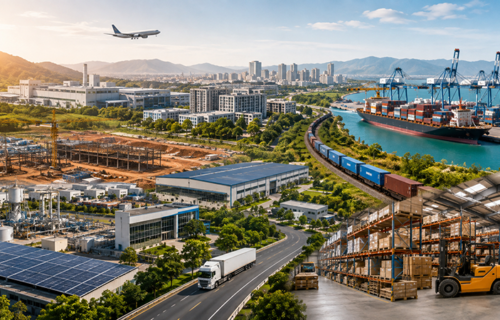
The same principle will increasingly influence commercial real estate investment across the continent. The strongest SEZs are beginning to provide investors and occupiers with several different property products. These include serviced industrial plots, completed factories, build-to-suit facilities, modern warehouses, cold storage and logistics parks. In more advanced locations, these assets are being integrated with ports, railways, highways and inland freight infrastructure.
That relationship between transport corridors and industrial property could become increasingly important. Africa is investing heavily in improving connections between ports, inland markets and neighbouring countries. As those routes become more efficient, strategically positioned SEZs could provide locations where goods are manufactured, processed, stored and redistributed rather than simply transported through the continent.
AfCFTA could strengthen this model further. If practical barriers to intra-African trade continue to fall, manufacturers may eventually be able to serve several countries from a single regional production base. Logistics companies could similarly operate larger distribution centres designed around regional rather than purely national supply chains. That would increase the attraction of SEZs positioned close to major ports and cross-border transport routes. Instead of being primarily export enclaves serving markets outside Africa, successful zones could gradually become production and distribution platforms for the continent’s own expanding consumer economies.
The implications for industrial land could also be significant. Sites combining reliable electricity, water, fibre connectivity and direct transport access should command an increasing advantage over unserviced industrial land, even where the latter is considerably cheaper. For institutional investors, however, the quality of the underlying property market remains critical. Clear ownership, enforceable leases, credible occupiers, predictable regulation and the ability to exit an investment are as important as construction costs or tax concessions.
This is where the divide between Africa’s SEZs is likely to become increasingly visible. Tangier already demonstrates the characteristics of a mature international manufacturing ecosystem. Lagos Free Zone is developing a strong port-linked industrial platform. Tatu City is demonstrating how privately developed infrastructure can support institutional-quality logistics property. Nkok shows the potential of sector-focused processing clusters, while Kigali illustrates how smaller markets can compete through organisation and specialised infrastructure.
Egypt offers enormous scale and an expanding development pipeline, but the amount of operating industrial space still needs to be distinguished carefully from announced investment. Ethiopia, meanwhile, demonstrates both the potential of large-scale industrial-park development and the risks created when supply grows faster than sustainable occupier demand.
Africa’s next manufacturing winners are therefore unlikely to be determined by which governments provide the most generous incentives. The more important competition is becoming physical: which locations can provide factories with continuous power, functioning logistics, suitable buildings, development-ready land, efficient administration and connections to suppliers and workers.
That shift has important consequences for commercial real estate. The continent’s most successful SEZs are evolving from policy instruments into identifiable property markets, with their own development pipelines, occupiers and increasingly specialised industrial assets. Africa’s improving transport corridors may determine where goods can move efficiently. The SEZs that successfully combine those connections with reliable infrastructure and investible real estate could determine where an increasing share of those goods are actually manufactured, stored and distributed.
Source: © CIJ.World Africa Research & Analysis Team