Friday, 23 October 2026
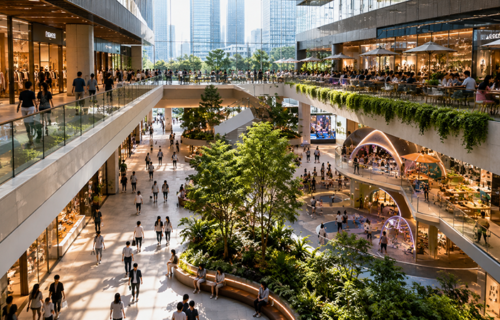
China’s shopping-centre market is behaving differently from what the country’s subdued consumer environment might suggest. Household spending remains cautious, traditional retailers are under pressure and landlords continue to reduce rents, yet shopping-centre occupancy has remained relatively resilient. The explanation increasingly appears to lie not in a broad revival of consumption, but in a change in the type of physical retail space that businesses and consumers value.
Across China, shopping-centre vacancy edged down to approximately 7.5% during the second quarter of 2026 even as rents continued to weaken. Around 700,000 square metres of new retail space was completed during the quarter, while average ground-floor rents declined further. The combination suggests that landlords are succeeding in filling space, but often at pricing below previous levels.
The economic background remains challenging. China’s overall retail sales increased only modestly during the first half of 2026, and several traditional store formats recorded declining turnover. Department stores, specialist retailers and brand-exclusive shops were among the weaker segments, while online commerce continued to grow faster than overall retail spending. Other categories performed considerably better, including clothing, cosmetics, telecommunications equipment, supermarkets and convenience stores. The picture is therefore not one of universally weak consumption, but of spending being redistributed between different products, channels and experiences.
That redistribution is becoming increasingly visible in commercial property. Consumers may have fewer reasons to visit a conventional store simply to purchase something readily available online, but restaurants, entertainment, technology demonstrations, specialist hobbies, social activities and large brand experiences offer something that digital commerce cannot reproduce in quite the same way.
Shanghai provides one of the clearest examples. Significant new shopping-centre space entered the market during the second quarter, yet leasing remained active. Sports and outdoor brands, collectible-toy companies, consumer-electronics businesses, restaurants and specialist food and beverage operators were among those taking space. Vacancy remained relatively stable in stronger parts of the market despite the additional supply.
Rental performance tells another side of the story. Shanghai landlords continued to offer competitive terms, and average rents declined again during Q2. Retailers therefore retain considerable negotiating power. The market is not experiencing a conventional recovery in which increasing demand allows owners to raise rents. Instead, lower occupancy costs are helping landlords maintain leasing activity while retailers concentrate expenditure on locations they believe can generate the greatest return.
This concentration is particularly visible in the expansion of large flagship stores. Shanghai has attracted a growing number of concepts occupying substantially more space than conventional shops. Some combine retail with technology demonstrations, events, product launches, entertainment and customer interaction. Rather than evaluating every square metre exclusively according to sales generated inside the store, major brands can use these locations to strengthen their wider relationship with consumers.
Physical property consequently performs several functions. It can provide a place to sell products, but it can also introduce customers to a brand, allow them to test products, generate digital content, host communities and create experiences that subsequently influence purchases through other channels.
That helps explain why the continued growth of online commerce does not necessarily eliminate demand for physical stores. It can instead change the number, size and purpose of those stores. A retailer may require fewer ordinary branches while simultaneously committing substantially more capital to a small number of highly visible locations.
Collectible toys demonstrate the principle particularly clearly. Consumers do not need a physical store to purchase these products, yet stores can provide discovery, displays, limited releases and interaction with other enthusiasts. Sports and outdoor companies can connect locations with running communities, training activities and product testing. Technology companies can demonstrate equipment that customers may later purchase through another channel.
Food, entertainment and leisure have an even more obvious physical advantage. They give consumers reasons to spend time at a property rather than merely complete a transaction.
For shopping-centre owners, this creates both an opportunity and a threat. Many stronger properties are becoming less dependent on conventional product-led retail and increasingly combining shops with restaurants, entertainment, technology, lifestyle businesses and specialist concepts. These uses can increase dwell time and help differentiate a property from online alternatives.
But the same transition can make life considerably more difficult for ordinary malls.
Retailers do not need flagship locations everywhere. As brands concentrate investment in their best-performing stores, secondary branches can become expendable. A company might close several conventional outlets while opening one substantially larger flagship in a stronger centre.
This can produce a retail market in which overall occupied space appears reasonably stable while demand becomes concentrated among fewer properties.
Successful shopping centres can benefit from a reinforcing cycle. Major brands and popular restaurants generate traffic. Higher visitor numbers attract other tenants. Additional entertainment and lifestyle businesses strengthen the destination further, making the centre more attractive to consumers and increasingly difficult for competing malls to replicate.
Weaker properties face the possibility of the opposite process. When recognised brands leave, visitor numbers can decline. Landlords may respond with lower rents and larger incentives, but cheaper space alone does not necessarily restore the attraction of the property. If replacement tenants generate less traffic, the centre can gradually lose relevance even while headline occupancy remains relatively high.
This is why vacancy rates alone may become increasingly inadequate for judging Chinese retail property.
A shopping centre can be almost fully occupied but still face declining investment quality if rents are falling, tenants have weak sales and the property struggles to attract consumers. Another centre undergoing substantial tenant changes might ultimately be strengthening if management is replacing weaker operators with restaurants, entertainment, flagship concepts and businesses capable of generating additional visits.
For investors, the composition and productivity of occupancy therefore matter increasingly alongside the occupancy percentage itself. Tenant sales, visitor numbers, lease structures, rental affordability, tenant concentration and the contribution of food, leisure and entertainment can provide a more complete indication of asset quality.
The continuing development pipeline makes those distinctions even more important. Shanghai is still adding shopping-centre space despite already possessing a large and sophisticated retail market. New projects must therefore compete not only with existing malls but with established shopping streets, entertainment districts, online commerce and an enormous range of consumer choices.
Simply constructing additional shop units is unlikely to provide sufficient differentiation.
The stronger projects increasingly combine retail with restaurants, public spaces, cultural activities, entertainment and events. In central locations, tourism adds another dimension. Shopping centres and retail districts capable of capturing spending from visitors as well as local residents can benefit from proximity to hotels, heritage, entertainment and other urban attractions.
This makes location important in a broader sense than simply accessibility. The most successful retail properties increasingly form part of a larger urban destination.
The trend also has implications for investment values. A shopping centre capable of generating dependable visitor traffic, maintaining strong occupancy and attracting desirable tenants presents a different income proposition from a conventional centre that relies on repeated rental reductions to keep units occupied.
China’s developing commercial-property REIT market could eventually make that distinction even more important. Retail properties are among the assets being considered for listed ownership, creating another potential route through which owners of mature, strongly performing shopping centres can recycle capital.
That does not mean the REIT market will rescue struggling retail properties. Institutional investors are likely to place greater emphasis on sustainable income, operating history and asset quality. Properties unable to demonstrate those characteristics may remain difficult to finance or sell.
Over time, the expansion of institutional ownership could therefore contribute to a wider valuation gap between destination retail assets and conventional shopping centres, although it is still too early to determine how significant that effect will become.
For investors, the opportunity is consequently not a simple bet on a recovery in Chinese consumption. The more important question is whether individual properties can adapt to the changing role of physical retail.
The strongest malls increasingly need to give consumers reasons to visit even when purchasing a product no longer requires leaving home. Food, entertainment, communities, technology, flagship experiences, tourism and social interaction can all contribute to that purpose.
Properties unable to make that transition face a more difficult future. Lower rents may maintain occupancy temporarily, but price alone cannot guarantee relevance.
China’s shopping-centre market is therefore unlikely to divide neatly between occupied and vacant buildings. The more important division may emerge between properties that people actively choose to visit and those they merely use when convenient.
That distinction could determine which shopping centres remain attractive to tenants and institutional capital during the next stage of China’s property cycle. The country may still have substantial demand for physical retail space, but increasingly it is demand for a different kind of retail property.
Source: CIJ.World Research & Analysis Team