Monday, 19 October 2026
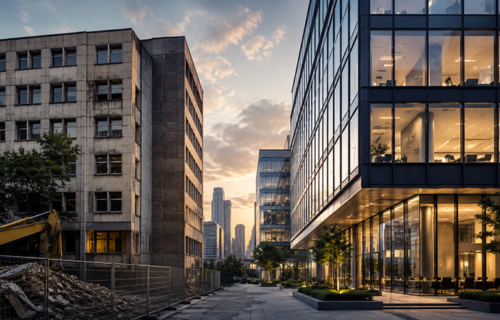
Germany’s office market is entering a stage in which the age, specification and future investment requirements of individual buildings may matter more than the direction of the overall market. Vacancy continues to increase across several major cities, but the headline numbers conceal a widening difference between modern offices that companies actively seek and older properties that are becoming progressively more difficult to lease, finance and sell.
German office property values remained under pressure during the second quarter of 2026, with prices 1.2% lower than a year earlier. Yet this national decline tells only part of the story. Prime rents have continued to rise in several major markets despite increasing vacancy, demonstrating that occupiers have not simply stopped needing offices. Instead, companies are becoming much more selective about the buildings they are prepared to occupy.
This is creating an unusual market in which vacancy can rise at the same time as rents increase for the best space. Modern offices in central locations, particularly buildings offering strong environmental performance, efficient layouts and good public transport connections, continue to attract tenants. Older buildings with weaker specifications are accumulating a growing share of available space.
Across Germany’s largest office markets, vacancy increased again during the first half of 2026. Leasing activity was uneven, but demand remained concentrated on higher-quality properties. Berlin provides a particularly clear example. Office take-up strengthened considerably during the first six months of the year and prime rents continued to rise, while older properties and weaker locations faced substantially greater competition for occupiers.
Munich is showing a similar pattern. Leasing recovered during the first half, but companies continued to favour modern, well-connected properties. Frankfurt’s overall leasing market remained comparatively subdued, yet searches for high-quality offices continued to demonstrate that businesses remain willing to pay for the right product. The consequence is that Germany’s office problem is becoming less about the total quantity of empty space and more about which buildings are empty.
That distinction has major implications for investors. For much of the previous property cycle, office buildings could be compared relatively easily through location, rent, lease length and investment yield. Today another variable has become increasingly important: the amount of capital required to keep the property competitive during the next decade.
An office constructed in the 1990s or early 2000s may require extensive investment in heating and cooling systems, insulation, façades, ventilation, lifts, digital controls and internal layouts. Environmental performance is also becoming more important to corporate occupiers, lenders and institutional investors. A building that remains technically usable today may therefore require substantial expenditure before it can compete successfully for future tenants.
This changes how apparent investment discounts should be interpreted. An older building may trade at a significantly lower price per square metre than a newly developed office nearby. At first glance, that difference can appear to represent an attractive investment opportunity. But the acquisition price is only the beginning of the calculation.
If substantial refurbishment expenditure is required immediately after acquisition, the real cost of creating a competitive building may be much closer to the value of modern stock than the initial purchase price suggests. Investors therefore increasingly need to calculate the combined cost of acquisition and modernisation rather than simply comparing headline yields. That creates an important question for Germany’s investment market: how cheap does an ageing office have to become before refurbishment makes financial sense?
For buildings in exceptional locations, the answer may still support substantial investment. Central sites in Berlin, Munich, Frankfurt, Hamburg and other supply-constrained locations can justify major refurbishment because a successfully repositioned property may achieve considerably higher rents.
This creates opportunities for investors capable of purchasing ageing buildings, upgrading them and returning them to the market as modern offices. Retaining and modernising an existing structure can also have environmental advantages compared with demolition and complete reconstruction, particularly where substantial embodied carbon can be preserved.
However, the same strategy becomes much more difficult when the building is in a weaker location. An obsolete office in a peripheral business district may require essentially the same investment in mechanical systems, energy performance and internal refurbishment as a centrally located building. The difference is that the achievable rent after renovation may be considerably lower.
At some point, the economics stop working. This is where Germany’s office correction could evolve into a more fundamental problem of building obsolescence. Some properties may become too expensive to refurbish as offices but remain too valuable for owners to accept the price required by redevelopment investors. These buildings risk becoming trapped between their historical valuations and their economically viable future use.
Converting offices into housing is frequently proposed as a solution, particularly in German cities facing residential shortages. In practice, however, conversion is far from straightforward. Office buildings can have floorplates that are too deep for residential layouts, inadequate natural light, unsuitable structural configurations or circulation systems that are difficult to adapt.
Residential conversion can also require substantial spending on plumbing, kitchens, bathrooms, fire protection, sound insulation and external areas, while planning requirements can add further complexity. For some buildings, residential conversion will provide an attractive alternative. For many others, demolition, substantial reconstruction or continued office use may remain the only realistic options.
The investment decision therefore increasingly depends on the individual building rather than the broader office market. Germany’s financing environment is reinforcing this divide. A modern office with strong tenants, good energy performance and predictable rental income presents lenders with a relatively straightforward refinancing proposition. An older property facing vacancy and requiring substantial refurbishment creates several layers of uncertainty simultaneously.
The lender has to consider not only the current value of the property but also how much additional capital will be required, whether tenants will remain during construction, what rent the renovated building can achieve and whether the owner has sufficient equity to complete the work. This means Germany’s quality divide is increasingly becoming a financing divide.
Owners of older properties approaching loan maturity may therefore face difficult choices. Some will contribute additional equity and refurbish. Others will seek development partners or specialist investors. Some may decide that selling the building at a substantial discount is preferable to committing further capital.
The refinancing cycle could consequently accelerate the transfer of older offices from traditional institutional owners toward investors specialising in redevelopment and repositioning. Germany’s investment market is already becoming more active. Office transaction volumes increased strongly during the first half of 2026 compared with the previous year, although activity remains well below the levels recorded during the cheap-debt era.
Importantly, the recovery is highly selective. Investors have shown greater willingness to acquire properties with secure income and clear investment strategies, while buildings requiring significant expenditure remain harder to price. This suggests the market already understands that prime and secondary offices should not command similar valuations.
The unresolved issue is whether the discount on weaker buildings is large enough. That could become one of the defining investment questions of the next phase of Germany’s property cycle.
A secondary office trading at half its former value is not necessarily cheap if another large amount of capital must be invested before tenants want to occupy it. Conversely, a heavily discounted building in an excellent location could offer considerable upside if refurbishment costs can be controlled and the finished property can capture rising prime rents.
Location itself is also becoming more nuanced. The traditional distinction between Germany’s largest cities and regional markets may matter less than the combination of building quality, tenant strength and local demand. A modern office with a secure tenant in a smaller German city can potentially offer a clearer investment proposition than an outdated building in one of the country’s largest office markets.
Capital is therefore likely to become increasingly selective at building level rather than simply allocating according to city rankings. This changes the meaning of Germany’s rising office vacancy.
The central question is no longer whether companies are reducing their office footprints. Hybrid working has undoubtedly changed space requirements, but the continuing strength of prime rents demonstrates that companies still compete for buildings that meet contemporary expectations.
The deeper problem is that Germany has a substantial stock of offices designed for a different era of occupier demand, energy costs and investment requirements. During the next several years, the market will have to determine which of those buildings can economically be modernised.
Some will become successful refurbishment projects. Others will be converted to alternative uses. Buildings on valuable sites may eventually be demolished and replaced. But a portion of the existing stock could struggle to find any financially attractive route forward.
For investors, that distinction matters considerably more than the national vacancy rate. Germany’s office market is increasingly dividing between buildings capable of attracting tenants, finance and investment capital and those requiring increasingly expensive intervention simply to remain competitive.
The next major repricing of German offices may therefore have little to do with whether Berlin performs better than Frankfurt or Munich outperforms Hamburg. It may instead occur building by building, as investors calculate which ageing offices can profitably be given a second life—and which have reached the point where their existing use no longer justifies the capital required to save them.
Source: CIJ.World Research & Analysis Team