Wednesday, 16 September 2026
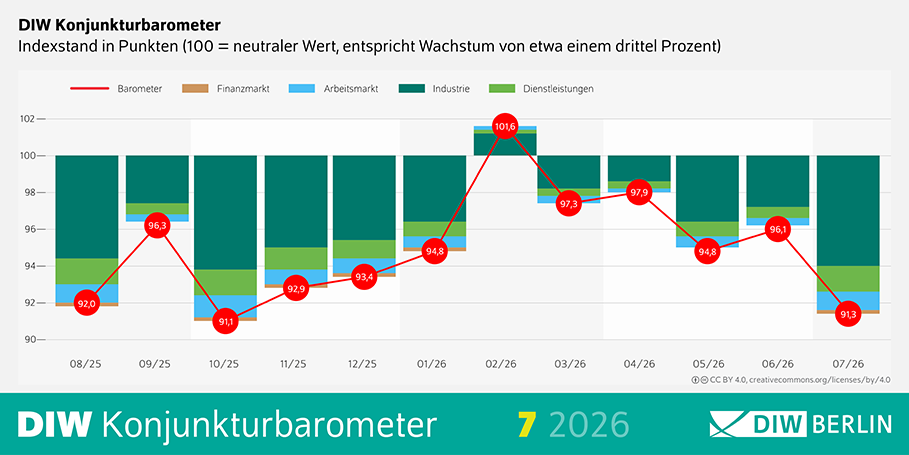
Germany’s economic outlook weakened again in July, with the latest economic barometer from the German Institute for Economic Research (DIW Berlin) falling to its lowest level since autumn 2025, highlighting continued uncertainty for Europe’s largest economy.
The DIW Economic Barometer declined to 91.3 points, remaining well below the neutral 100-point threshold that indicates average economic growth. The reading continues a pattern of alternating monthly gains and declines seen throughout 2026, reflecting the fragile nature of Germany’s recovery.
According to DIW Berlin, geopolitical developments remain a major source of uncertainty. Elevated energy prices, driven by instability in the Middle East and ongoing concerns over shipping through the Strait of Hormuz, continue to weigh on businesses and consumers despite some recent easing in oil prices. Higher energy costs have reduced household purchasing power while increasing operating expenses for companies.
Germany’s export-oriented economy is also facing weaker global demand, with slower international growth and concerns over a potential moderation in artificial intelligence-related investment adding further pressure. Domestically, while government spending measures have provided some support, uncertainty remains over the implementation and economic impact of planned infrastructure and climate investment programmes.
Recent hot weather has created additional logistical challenges, with low water levels on the Rhine and other rivers increasing freight costs for manufacturers and distributors.
Industry continues to be the weakest part of the economy. Manufacturing output remains largely stagnant, and new orders have yet to show a broad-based recovery, although defence-related industries continue to benefit from increased public spending. Business surveys conducted in July indicated some improvement in sentiment, with companies reporting slightly stronger expectations for demand and production, but investment decisions remain cautious amid the uncertain economic and geopolitical environment.
The services sector is also under pressure. Persistent inflation, particularly higher fuel prices, has constrained consumer spending, while the labour market remains subdued. Although unemployment has edged lower, overall employment has continued to decline, limiting confidence among service providers.
DIW concludes that Germany’s economic recovery remains uneven and vulnerable. Without stronger domestic demand and greater stability in both geopolitical conditions and economic policy, the economy is likely to remain exposed to external shocks and continued periods of weak growth.