Friday, 16 October 2026
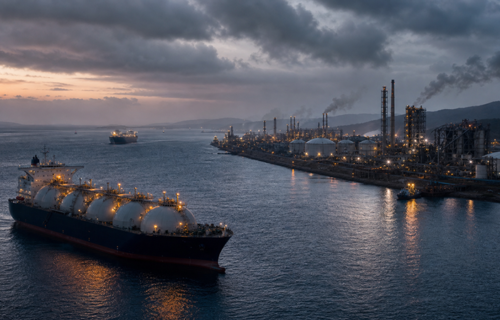
Renewed conflict between the United States and Iran and the closure of the Strait of Hormuz have pushed natural gas prices higher in Europe and Asia, disrupted Gulf LNG exports and weakened global demand, according to Kamco Invest’s July 2026 natural gas market report.
European natural gas prices averaged $15.58 per million British thermal units in the second quarter, an increase of 31.2% from a year earlier. Average LNG prices in Japan rose 11.3% to $13.79. The United States moved in the opposite direction, with prices falling 7.5% to an average of $2.95 amid expanding domestic production.
Prices in Europe and Asia have eased from peaks reached in March but remain above 2025 levels. Kamco said geopolitical uncertainty, restricted shipping through Hormuz and Europe’s continued shift away from Russian gas were keeping the market under pressure. Seasonal demand for air conditioning is also expected to support prices during the summer.
The supply impact has been substantial. LNG deliveries from Qatar and the United Arab Emirates fell by 35 billion cubic metres between March and June compared with the same period last year, according to International Energy Agency figures cited in the report. Production from new projects in North America and Africa increased by about 27 billion cubic metres, limiting the net decline in global LNG supply to 8 billion cubic metres.
Qatar’s Ras Laffan Industrial City suffered severe damage to two gas-processing units during the early weeks of the conflict. The damage affected about 17% of the facility’s production capacity and led to a shutdown. A subsequent explosion during an attempted restart in June further complicated the recovery.
The UAE has also experienced production and shipping difficulties. LNG loadings at the Das Island plant slowed to one or two cargoes a month between March and June, compared with an average of seven during the same period in 2025. The Habshan gas-processing complex, damaged in April, is operating at about 60% of capacity. Kamco expects that figure to rise to 80% by the end of 2026, with full recovery projected for 2027.
The IEA forecasts that combined LNG supplies from Qatar and the UAE could fall by about 45%, or 55 billion cubic metres, over the full year. That decline is expected to leave global LNG trade broadly unchanged in 2026 despite additional output elsewhere.
Higher prices and restricted supplies are already reducing consumption. Asian gas demand fell an estimated 1% during the first half of 2026, prompting the IEA to revise its full-year forecast from 4% growth to a 0.5% decline. Demand fell in China, Japan and South Korea, with some countries switching to alternative fuels.
Worldwide natural gas consumption is now expected to decline by about 1% in 2026. Consumption in North America fell 1% during the first half, including a 1.5% decline in the United States, while OECD European demand slipped 0.5%.
Europe nevertheless increased its gas imports by 1.9% to 159.9 billion cubic metres. The region imported 43.9 billion cubic metres of LNG from the United States—twice the volume of its gas imports from Russia.
Global production fell 1% during the first four months of the year, largely because of lower Gulf output. European production declined 3.2% to its lowest level in five years, while US production rose 4.1% during the first five months as new export terminals increased demand for feed gas.
Market analysts cited by Kamco expect the Strait of Hormuz to reopen fully during the third quarter. However, damaged infrastructure, higher shipping-insurance costs, geopolitical uncertainty and a backlog of vessels mean Gulf LNG exports could take considerably longer to return to normal.