Saturday, 19 September 2026
Japan’s demographic challenges are becoming increasingly visible outside its major metropolitan areas. While the country continues to attract investment, advance technology and strengthen key sectors of its economy, most prefectures are experiencing population decline. Rural communities and smaller cities are facing the sharpest reductions as younger residents continue to move toward larger urban centres, particularly Tokyo, Osaka and Nagoya.
One of the clearest signs of this shift is the growing number of vacant homes. Government housing surveys show that the country now has more than nine million unoccupied residential properties, representing approximately 14 percent of the national housing stock. A substantial proportion of these vacant homes are located in regional areas where population losses have been most pronounced.
New Uses for Old Buildings
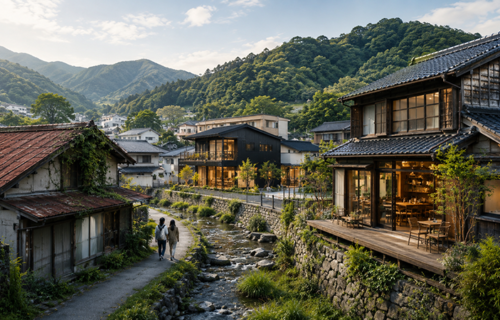
Rather than viewing abandoned buildings as liabilities, many local authorities and private investors are exploring ways to repurpose them. Across Japan, former residences, schools, shops and public buildings are being converted into accommodation, restaurants, co-working facilities, cultural centres and community spaces.
The approach offers both economic and environmental benefits. Reusing existing structures typically requires significantly lower capital expenditure than constructing entirely new buildings while also reducing demolition waste and preserving local architectural character. In regions where demand for new development is limited, redevelopment through adaptive reuse is emerging as a practical strategy for maintaining economic activity and attracting visitors.
Government-backed initiatives have supported this trend by enabling municipalities to acquire neglected properties and return them to productive use. In many cases, formerly abandoned buildings have been transformed into local businesses, tourism facilities or public amenities that help sustain communities facing long-term population decline.
The Growing Challenge of Empty Homes
The issue of vacant housing, commonly referred to as “akiya,” continues to expand. Recent government data indicates that the number of unoccupied homes has increased substantially over the past decade, driven by ageing homeowners, low birth rates and continued migration toward larger cities.
Inheritance patterns have further complicated the situation. Many properties remain under family ownership after the original occupants pass away, but heirs often have little interest in maintaining homes located far from where they now live and work. As a result, thousands of houses remain empty for years, creating maintenance, safety and urban planning challenges for local governments.
To address the issue, municipalities across the country have established online property platforms known as “akiya banks.” These databases connect potential buyers and investors with vacant homes, often at prices significantly below those found in major cities. Some local governments also provide renovation grants and tax incentives to encourage occupancy and redevelopment.
Financial Incentives to Attract New Residents
National and regional authorities have increasingly turned to financial incentives to support population redistribution. Various programmes offer grants to households willing to relocate from the Tokyo metropolitan area to regional communities, with additional support available for families, entrepreneurs and remote workers.
These measures form part of broader efforts to strengthen local economies, encourage business investment and create employment opportunities outside Japan’s largest urban centres. Incentives have also been introduced to support industries closely tied to regional development, including agriculture, forestry, tourism and food production.
Despite these efforts, attracting younger residents remains a challenge. Employment opportunities, educational institutions and lifestyle preferences continue to draw many people toward major cities, limiting the effectiveness of relocation programmes in some regions.
Different Paths to the Same Problem
Japan’s regional communities are responding to demographic decline in different ways. Some municipalities continue to pursue growth by investing in tourism, technology and infrastructure projects designed to attract new residents and businesses. Others have adopted strategies focused on managing decline more effectively through the consolidation of public services, housing and transport networks.
Examples from locations such as Yubari in Hokkaido, Suzu in Ishikawa Prefecture and Manazuru in Kanagawa Prefecture illustrate how local governments are experimenting with different approaches. While circumstances vary, a common objective is emerging: creating communities that remain functional and economically sustainable despite smaller populations.
A New Vision for Secondary Cities
The long-term future of Japan’s regional cities may depend less on reversing population decline and more on adapting to it. Urban planners and policymakers increasingly recognise that maintaining quality of life does not necessarily require population growth.
Investment in digital connectivity, environmental assets, local entrepreneurship and community-focused redevelopment is becoming central to many revitalisation strategies. Rather than attempting to recreate past growth patterns, many regional cities are seeking to define new economic roles that reflect their changing demographic realities.
For investors, developers and policymakers, Japan’s shrinking cities present both challenges and opportunities. While population decline will continue to reshape the country’s urban landscape, the transformation of vacant properties, targeted public incentives and innovative planning strategies suggest that regional communities can still play an important role in Japan’s future development. The question is no longer whether these cities will become smaller, but how successfully they can reinvent themselves in the process.
Copyright: CIJ.World Japan Research & Analysis Team