Thursday, 10 September 2026
The European Union’s efforts to build a stronger and more resilient photovoltaic (PV) manufacturing sector could be undermined by inconsistent national regulations, according to a new study by the German Institute for Economic Research (DIW Berlin).
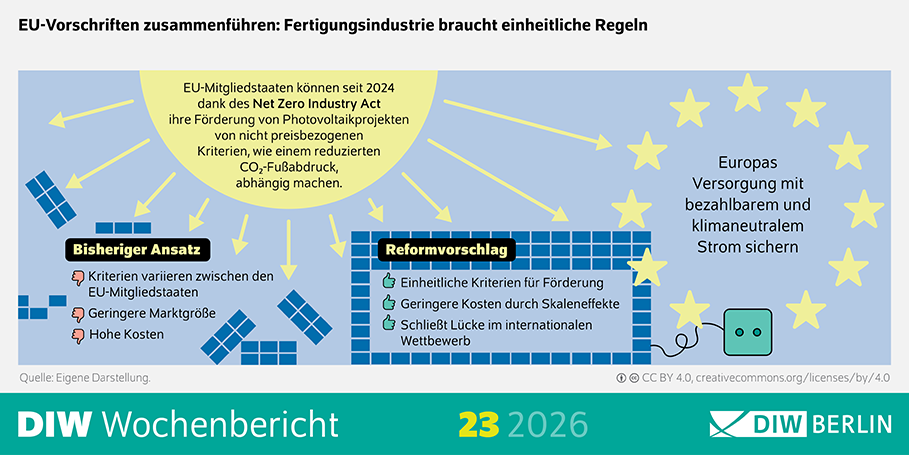
The EU’s Net Zero Industry Act (NZIA) aims to reduce reliance on global supply chains and increase domestic production of clean energy technologies. Under the legislation, Member States are permitted to incorporate non-price criteria, such as carbon footprint and energy efficiency, into subsidy schemes for solar projects. However, the study warns that differing approaches across the bloc may increase costs and weaken the competitiveness of European manufacturers.
The NZIA forms part of the EU’s broader strategy to ensure that 40 percent of the bloc’s photovoltaic demand is met by European-made products by 2030. Researchers argue that achieving this objective will require greater coordination among Member States.
According to the analysis, the current patchwork of national requirements creates additional complexity for manufacturers and investors. Different technical and sustainability criteria across countries limit the ability of companies to operate efficiently across the European market and reduce opportunities to benefit from economies of scale.
The study’s modelling of the European PV module production sector indicates that fragmented implementation of support measures prevents the internal market from reaching its full potential. As a result, production costs increase and investment decisions become more challenging.
Researchers found that harmonising non-price criteria across the EU would help create a more integrated market, reduce manufacturing costs and provide greater certainty for investors. Standardised rules would also enable producers to serve larger markets with fewer regulatory barriers.
The report highlights that European solar manufacturers continue to face intense competition from lower-cost imports, particularly from China. Consistent policy frameworks and predictable market conditions are therefore considered essential to improving the competitiveness of European producers.
In addition to the NZIA, the proposed Industrial Accelerator Act (IAA) could further support the sector by allowing greater consideration of European content requirements, including “Made in EU” criteria, in subsidy programmes. The study stresses that the effectiveness of both initiatives will depend on coordinated implementation across Member States.
DIW Berlin concludes that a unified European industrial strategy, combining industrial, competition and environmental policies, will be necessary to strengthen domestic solar manufacturing, lower production costs and improve the EU’s position in the global photovoltaic market.
Source: DIW Berlin