Sunday, 4 October 2026
German Institute for Economic Research has warned that Germany’s research-intensive industries are losing international competitiveness, with declines in value creation, productivity growth and global export share since 2015.
According to a new study by the institute, Germany’s traditionally strong sectors in high-quality technology goods, including automotive manufacturing and mechanical engineering, have lost ground compared with international competitors. The study also found that cutting-edge technology industries such as pharmaceuticals and electronics have failed to achieve above-average growth.
“Germany’s economic strength was long based on its research-intensive industries. But this strength is waning,” said Alexander Schiersch from the Entrepreneurship research group at DIW Berlin, who co-authored the report together with Christian Danne from DIW Econ.
The researchers analysed developments in value creation, productivity and global trade shares across research-intensive industries between 2015 and 2024. While many major industrial economies recorded declines, the report states that Germany’s deterioration was more pronounced than in countries such as Japan or South Korea.
In contrast, several smaller European economies, including Denmark, Switzerland and Netherlands, increased their shares of value creation in research-intensive sectors. The study noted that these gains were sometimes driven by individual companies or specialised industries, such as Novo Nordisk in Denmark and the pharmaceutical sector in Switzerland.
“The growing disparity between countries is therefore not based on broad trends. However, the successes of our European neighbors show that it is still possible to generate additional value creation and economic growth through innovation,” Schiersch said.
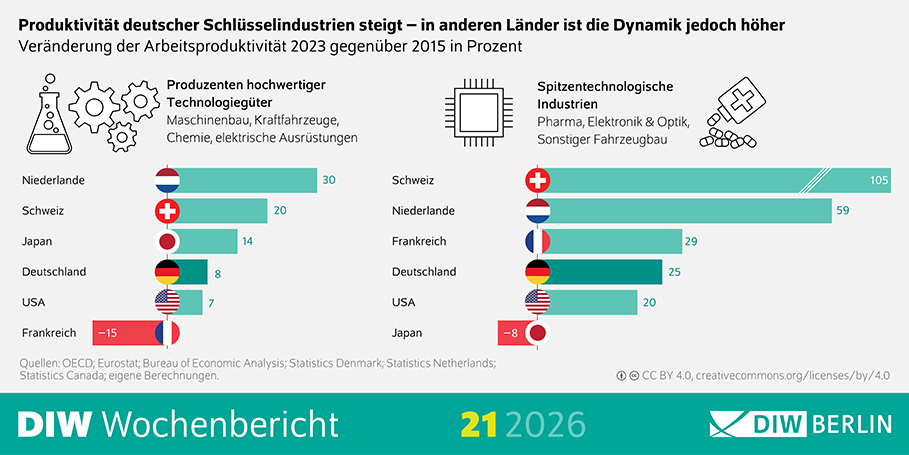
The report also highlighted weak productivity growth in Germany. Since 2015, labour productivity in Germany’s high-quality technology industries has increased by only eight percent, while productivity in cutting-edge technology sectors rose by 25 percent.
The loss of competitiveness is also visible in international trade performance. Germany’s share of global exports of research-intensive goods has declined by around 15 percent since 2015, according to the study.
“Germany’s success in trade with research-intensive goods was long driven primarily by quality and innovation. This comparative advantage is increasingly at risk,” said Danne.
The authors noted that China increased its share of global exports of research-intensive goods by 22 percent during the same period. However, they also pointed out that several smaller European countries, including Denmark, the Netherlands and Belgium, managed to increase their positions in global trade despite growing Chinese competition.
“Innovation and the development of highly specialized, difficult-to-replace products can increase a country’s share of global trade, despite China’s growing importance,” Danne added.
The study concludes that political action is needed to improve Germany’s industrial competitiveness. The authors identified reducing regulatory burdens, improving public administration and further integration of the European single market as key priorities.
“Less regulation, better public administration, and a less fragmented European single market—without these levers, the competitiveness of German industry cannot be sustainably secured,” Schiersch said.