Sunday, 4 October 2026
What is the price ceiling for people buying new apartments with a mortgage in the most expensive cities in Poland? At what price point does buyers’ creditworthiness end? What apartments are available at this price point?
Joanna Chojecka, Sales and Marketing Director for Warsaw, Wrocław, and Łódź at Robyg Group
Currently, the “price ceiling” in the housing market is determined primarily by buyers’ creditworthiness, which, given the persistently high bank margins, remains the main constraint on demand. In practice, this means that most customers financing their purchases with a loan operate within a rather narrow budget range. At the same time, it’s important to emphasize that new property purchases are also made in cash, so in the case of development companies with a dominant share of this type of clientele, the “price ceiling” is not dependent on creditworthiness.
For typical households, the actual level of creditworthiness translates into the ability to purchase an apartment worth approximately PLN 600,000–900,000, with the upper limit of this range primarily affecting couples with stable, relatively high incomes. A level above approximately PLN 1 million–1.2 million is only achievable for a narrow group of customers with above-average incomes or those with a high down payment. Therefore, the PLN 800,000–900,000 range currently represents the actual “ceiling” for mass mortgage buyers.
In the most expensive cities, such as Warsaw, Krakow, and Gdańsk, this level coincides with the prices of relatively small apartments. In practice, this means that at current market prices, most buyers’ creditworthiness ends with the purchase of a property of approximately 40–60 square metres in a standard location. Purchasing a larger apartment in these cities often exceeds the financial capacity of the average borrower. However, this should not be interpreted as a reduction in new apartment purchases in these cities, as cash buyers are active there.
The greatest creditworthiness problems occur in the largest metropolitan areas, where the ratio of apartment prices to income is the least favourable. This applies primarily to Warsaw, Krakow, and the Tri-City. The situation is slightly better in cities such as Wrocław and Poznań, although the availability of apartments for mortgage buyers is also limited there. In smaller regional centres, relatively lower prices make the creditworthiness barrier less acute.
The current market is characterised by a clear reduction in demand due to creditworthiness limitations. For most buyers, the threshold is around PLN 800,000–900,000. The PLN 1 million barrier represents a significant cut-off point for the mass market. This is most evident in the largest and most expensive cities, where apartment prices are rising faster than the financial capacity of buyers using loans.
Agnieszka Gajdzik-Wilgos, Sales Manager, Ronson Development
We are observing that in Warsaw, in the popular segment, in locations such as Ursus and Białołęka, a clear price ceiling is emerging, linked to borrowing capacity. For two-room apartments, this is most often around PLN 650,000–700,000, and for three-room apartments, up to around PLN 800,000. In the four-room segment, which is very popular, prices start at around PLN 970,000, with the upper limit of most buyers’ affordability hovering around PLN 1.1 million.
In more prestigious locations, such as Mokotów, price levels are significantly higher and depend more on the standard and additional features of the property. Two-room apartments reach around PLN 18,500 per square metre, three-room apartments around PLN 17,000 per square metre, while four-room apartments typically range from PLN 1.5 million to as much as PLN 2 million, especially if they offer amenities such as a terrace or garden.
Currently, the greatest sensitivity to customer creditworthiness is observed in Wrocław, especially in the segment of apartments purchased as part of the Osiedle Startowe development. This is where purchasing decisions are most dependent on financing availability.
Tomasz Kaleta, Managing Director of Sales and Marketing at Develia
The upper price level for apartments depends primarily on the market segment and the city. There is no clear “price ceiling” in the premium segment. Prices are based on the unique features of the project, such as location, finishing standard, and amenities. The most expensive premium apartments in our offer are located in the Kopernika 71 development in Gdynia and Królowej Jadwigi in Poznań, with prices ranging from approximately PLN 2.5 million to just over PLN 3 million, respectively.
In the popular segment, the highest prices are found in the Warsaw market, reaching approximately PLN 1.6 million. In Wrocław and Krakow, the upper price range for apartments is approximately PLN 1.3 million, while in Katowice and Łódź, it is approximately PLN 1 million. At higher price levels, many customers begin to consider buying a house as an alternative.
Regarding financing availability, the share of mortgage clients in our transactions increased to approximately 50%, compared to 44% a year earlier, primarily due to the return of first-time home buyers to the market. Market data shows that in March, a typical family could count on average creditworthiness of approximately PLN 1.176 million, while the average loan requested was approximately PLN 506,000.
Agnieszka Majkusiak, General Director of Sales and Marketing at Atal
From our perspective, customers’ financial capabilities and their expectations regarding the property they purchase vary greatly. A cash buyer interested in a spacious, well-located apartment for personal use is willing to spend more. Those targeting an apartment in the popular segment and financing the purchase with a loan have a different maximum price point. An investor maximising the rate of return approaches the matter differently again.
A reference point for these considerations can be the average loan amount in Poland, which hovers around PLN 500,000. This figure is often used when comparing bank offers for a typical borrower. However, it should absolutely not be considered a “ceiling”, but rather a general optimal loan level for the Polish primary market.
It is difficult to clearly identify a specific threshold, not just for Warsaw, at which purchases become impossible. This is a highly individual matter and depends on many factors, including household size and financial situation, income, existing liabilities, down payment, and the specific loan parameters. It is also important to consider whether the client has another apartment for sale that can be used to finance the purchase of a new one.
Regional disparities in apartment prices, for example between Łódź and Warsaw, are greater than differences in income, which favours people from smaller cities. They can afford larger apartments of their own. In Warsaw, the greatest challenges arise in the three- and four-bedroom apartment segment, where total transaction values are highest and the price-to-creditworthiness ratio becomes a key factor influencing purchasing decisions.
Andrzej Swoboda, Vice President of the Management Board, CTE Group
It is difficult to talk about a single, universal “price ceiling” these days – the market varies greatly locally, and the price-to-income ratio and availability of financing are key factors. In Wrocław, however, it is clear that activity in the owner-occupier segment depends on the district and the standard of the property. Acceptable price levels currently range from approximately PLN 11,000 per square metre, for example in Lipa Piotrowska, to PLN 15,000 per square metre in districts such as Krzyki and Śródmieście. Above this level, demand begins to narrow significantly, and at rates exceeding PLN 20,000 per square metre, we are already dealing with a niche segment accessible to a narrow group of customers, most often with a high down payment or cash financing. It is in this area that creditworthiness limitations become most apparent.
Damian Tomasik, President of Alter Investment
Today, I would not talk about a “price ceiling” in the classic sense. The housing market has entered a stage where the limit is no longer the price per square metre, but rather the ability to service financing over time. This is a very significant change. Customers have stopped focusing solely on how much an apartment costs. They have started looking at how much the decision will cost over the next 20–30 years. Therefore, the real limit today is not the price per square metre, but rather the monthly payment that the customer is psychologically and financially able to accept.
In the largest cities, this means that the lending market naturally “closes” to the range of apartments that generate instalments manageable on average salaries. Above this level, demand does not disappear, but its structure changes. Cash buyers or those with a large down payment enter the market, as do investors who evaluate purchases based on return potential rather than price.
We see the greatest tension in cities where prices are simultaneously high and the labour market is dynamic, such as Warsaw, Krakow, and the Tri-City. There, the gap between purchase aspirations and actual financial capacity is greatest. But this is not just a credit issue. This is a moment of product redefinition. The market is beginning to adapt by offering smaller floor areas, greater functionality, and different usage models.
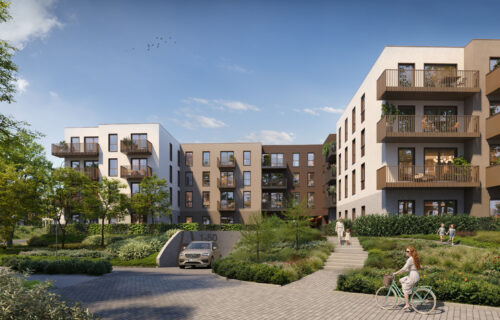
Photo: Podhalanska Vita by Develia
Source: dompress.pl