Thursday, 10 September 2026
A new analysis from the German Institute for Economic Research based on data from the Socio-Economic Panel highlights persistent gaps in pension provision across Germany, showing that supplementary retirement savings remain limited and unevenly distributed among different population groups.
The findings come shortly after the Bundestag approved a new retirement savings account intended to replace the Riester pension. The reform aims to expand private pension participation, but the research suggests structural issues continue to limit its effectiveness.
According to the study, fewer than 10 percent of current pensioners receive income from private supplementary pensions, while around one-third benefit from occupational schemes. Among the working population, participation in private pension products rose in earlier years but has stagnated since the mid-2010s and recently declined.
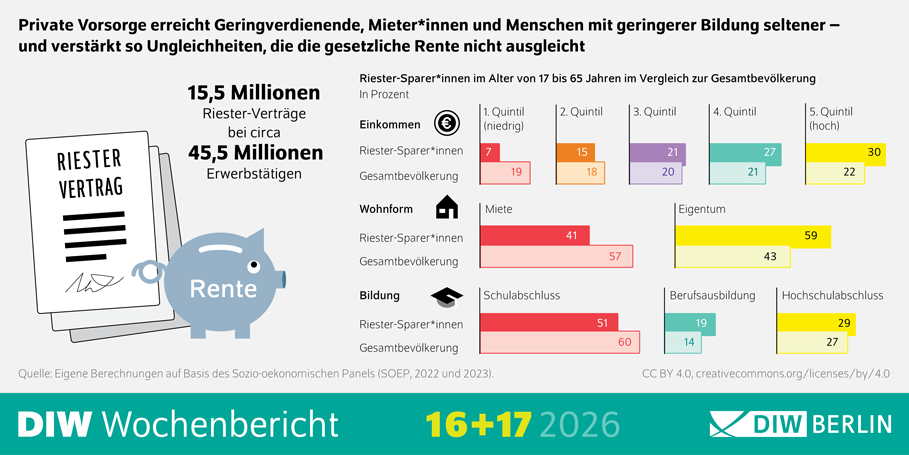
The data reveals clear disparities. Individuals with higher incomes, stronger educational backgrounds and no migrant background are significantly more likely to hold additional pension savings. Gender differences are also evident, with women more likely than men to make supplementary provisions. However, low-income earners and those with interrupted careers remain the least covered.
“Supplementary private pension provision has so far been far from reaching all population groups equally and tends to exacerbate existing inequalities in old age rather than balancing them out,” said Peter Haan, who co-authored the research with Johannes Geyer and Marcus Borlinghaus.
Occupational pension schemes, while more common than private ones, also show uneven access. Employees in larger companies and certain sectors are significantly more likely to participate than those working in smaller firms, with additional variation across regions and genders.
The new savings account introduces features such as potentially higher-yield investment strategies and a standardised state-backed option, which could improve uptake. However, researchers argue that voluntary systems continue to fall short.
“We know from research that voluntary supplementary pension schemes are not achieving the necessary uptake, because it is primarily those who already have sufficient resources who are making provisions,” said Johannes Geyer.
The study also raises concerns about the design of state subsidies. Since benefits are closely tied to individual contributions, higher-income households stand to gain more, reinforcing existing inequalities rather than reducing them.
The authors conclude that more fundamental reform may be required. They suggest a system that is more deeply integrated, potentially including mandatory elements and collective risk-sharing mechanisms similar to occupational pension models. Such an approach could better accommodate varying employment histories and reduce exposure to market fluctuations.
At the same time, public opinion appears to favour a strong role for the state. Around 60 percent of respondents in the SOEP survey support a predominantly state-led system to secure living standards in retirement, while only a minority believe responsibility should rest primarily with individuals.
Source: DIW Berlin