Moldova’s Housing Market Surges as PAS Win Points to Stability Ahead

Moldova’s residential real estate sector is undergoing one of its sharpest upswings in years, with home prices in Chișinău climbing rapidly even as transaction volumes slow. Against this backdrop, the victory of the pro-European Party of Action and Solidarity (PAS) in Sunday’s parliamentary elections is expected to have a stabilizing effect on investor sentiment, potentially influencing the future direction of the market.

According to the National Bank of Moldova, the Residential Property Price Index for the capital rose by 18.4 percent in the first quarter of 2025 compared with the previous quarter, and by 35.4 percent year-on-year. Newly built apartments have led the surge, though resale prices are also climbing. By the second quarter of the year, however, sales activity had weakened even as prices continued to rise, creating a widening gap between demand and affordability.

Independent analysis echoes these findings. Data analysis shows that after a period of stagnation in 2022–2023, demand rebounded strongly. In the third quarter of 2024, the index increased by 18.5 percent year-on-year, underlining the intensity of the recovery. Analysts point to robust demand in Chișinău and tight supply as key drivers behind the spike in valuations.

Mortgage lending has played a critical role in sustaining momentum. The central bank reports that more than 70 percent of transactions in the second quarter of 2025 were financed by mortgages, reflecting the influence of government-backed programmes such as Prima Casă Plus, which have eased access to credit for first-time buyers. Yet rising reliance on debt is unfolding amid a sharp decline in the number of transactions. Economist Veaceslav Ionita, writing in the economic outlet Logos-Pres, described the situation as a paradox: while mortgage issuance is growing, completed transactions have dropped to their lowest level in over a decade. He attributes this to soaring prices, regulatory hurdles and a shortage of new housing stock.

The outcome of the parliamentary elections adds a new dimension to the market outlook. PAS’s victory is widely seen as a mandate for continued European integration, institutional reform and economic stabilization. For the property sector, this could translate into greater investor confidence, an acceleration of housing policy reforms and an increase in foreign interest. Developers expect that a more predictable legal and regulatory environment will help expand housing supply, while households could benefit from improved access to EU funding mechanisms that support affordable housing and urban renewal projects.

At the same time, PAS faces the challenge of reconciling rising housing costs with stagnant transaction volumes. Without policy intervention to expand supply and address affordability, the gap between prices and completed deals could widen further, fueling concerns of a market imbalance. Economists argue that PAS’s stronger position in parliament gives it the ability to enact structural reforms in construction permitting, land regulation and financing frameworks, which could ease constraints and improve affordability over time.

In the short term, Moldova’s housing market is likely to remain characterized by high prices and relatively low deal numbers. In the longer term, however, PAS’s strengthened mandate offers an opportunity to align housing policy with broader economic modernization, making real estate both a symbol and a beneficiary of Moldova’s pro-European trajectory.


Poland’s 2026 Draft Budget Sets Record Spending, Debt Levels to Rise

Poland’s 2026 Draft Budget Sets Record Spending, Debt Levels to Rise

Poland’s government has approved a draft state budget for 2026 along with new legislation to support its implementation and a medium-term borrowing plan. The package points to record public spending on defence, health care and social support, while at the same time projecting higher levels of debt.

The budget sets out total revenues of about PLN 647 billion and planned spending of PLN 919 billion, leaving a shortfall of PLN 272 billion. Under the official national measure, public debt is expected to climb to just under 54 percent of GDP in 2026, while using European Union definitions the figure could exceed 66 percent. The forecasts assume Poland’s economy will expand by around 3.5 percent next year, with inflation averaging 3 percent and unemployment near 5 percent by December.

The largest single increase is in military funding, which will reach more than PLN 200 billion, roughly 4.8 percent of national output. Health care will also receive a record allocation of PLN 248 billion, including expanded financing for fertility treatment and new crisis support lines. Social policies continue to take up a major share of the budget: the Family 800+ benefit is expected to cost nearly PLN 62 billion, while two extra annual pension payments will total about PLN 32 billion. Additional commitments include pension indexation of roughly PLN 22 billion, a higher funeral benefit, new housing subsidies, and support for maritime training and research.

On the revenue side, the government expects stronger tax receipts, particularly from consumption and corporate taxes. Value-added tax is forecast at PLN 342 billion, while income from excise duties is projected at PLN 103 billion, partly due to higher levies on alcohol, tobacco and electronic cigarettes. A new electronic invoicing system is scheduled to roll out in 2026, which authorities say will help reduce tax evasion.

The accompanying legislation includes modest salary increases for teachers at the start of their careers and managers of state companies, as well as provisions allowing greater flexibility in responding to emergencies such as natural disasters or security threats.

The debt strategy for 2026–2029 aims to ensure borrowing needs are met while keeping financing costs in check. It also pledges to maintain the credibility of the government bond market.

The draft budget highlights the government’s priority of maintaining high levels of social and defence spending, but it also reflects the cost of those choices in terms of growing debt. For households, the measures mean continued support programmes and higher pensions, while for the economy as a whole they signal more pressure on public finances in the years ahead.

Poland’s Telecommunications Market in 2024: Mobile Growth, Internet Expansion, and Shifting Revenues

Poland’s telecommunications sector recorded continued growth in 2024, according to data from the Statistical Office in Szczecin, based on figures from the Office of Electronic Communications (UKE). Total revenues from telecommunications activities rose to PLN 44.4 billion, up from PLN 43.1 billion in 2023, despite declines in some traditional services.

The structure of revenues highlights the ongoing transformation of the market. Mobile telephony remained the dominant source, generating PLN 16.5 billion, compared with PLN 15.3 billion in 2023. Internet access also strengthened, reaching PLN 10.8 billion, supported in particular by mobile technologies. Bundled services, which combine mobile, internet, television and sometimes VoIP, accounted for PLN 14 billion, reflecting the growing preference of consumers for package offers. By contrast, traditional fixed-line telephony continued to contract, with revenues falling from PLN 924.5 million in 2023 to PLN 827.3 million in 2024. VoIP telephony also saw a sharp drop in users, from 2.8 million to 2 million, with call volumes declining from 2.7 to 1.8 billion minutes.

Mobile subscriptions continued to form the backbone of Poland’s telecoms market. By 2024, there were more than 53 million active mobile lines, up from 52.4 million a year earlier. Post-paid contracts dominated with 39.7 million users, while prepaid services stagnated. Outgoing mobile calls reached 105 billion minutes, similar to the previous year. Data transmission volumes grew significantly, with combined mobile and fixed traffic reaching 11,243 petabytes, compared with 9,486 petabytes in 2023. SMS messaging stabilized at around 38.6 billion messages, while MMS use rose slightly to 2.4 billion.

Internet access is now close to universal. Mobile technology dominates with 80.5 million users, of which 59 million are consumers and 21.5 million are businesses. Fixed-line wired connections reached 9.1 million users, while wireless fixed access served 565,000. Fibre optic networks strengthened their position, representing 56 percent of fixed-line connections, while older xDSL connections fell to 27 percent.

Pay-TV remained an important part of the market. In 2024, cable television counted 4.6 million subscribers, up from 4 million in the previous year. Satellite television remained strong, although its share continued to be eroded by IPTV and digital cable services. Bundled services also expanded, reaching 14.1 million subscribers compared with 13.7 million in 2023. The most common package included mobile telephony and mobile internet, followed closely by television combined with fixed-line internet.

The data suggest three important developments for readers. Traditional fixed-line services are in steady decline, both in revenues and subscribers, confirming their diminishing role in the digital age. At the same time, data consumption is growing at an unprecedented pace, reshaping investment priorities in fibre optics and 5G. Finally, bundled services are becoming the norm, as consumers increasingly opt for integrated solutions rather than individual services.

The outlook for the sector points to further consolidation around mobile, broadband and bundled packages. Fixed-line telephony is close to obsolescence, VoIP is losing relevance, and competition is shifting toward network capacity, speed and value-added services. For households and businesses, this means a deeper dependence on digital infrastructure, while policymakers face the challenge of ensuring broad and resilient access to support continued growth.

Source: GUS

Poland’s Telecommunications Market in 2024: Mobile Growth, Internet Expansion, and Shifting Revenues

Poland’s telecommunications sector recorded continued growth in 2024, according to data from the Statistical Office in Szczecin, based on figures from the Office of Electronic Communications (UKE). Total revenues from telecommunications activities rose to PLN 44.4 billion, up from PLN 43.1 billion in 2023, despite declines in some traditional services.

The structure of revenues highlights the ongoing transformation of the market. Mobile telephony remained the dominant source, generating PLN 16.5 billion, compared with PLN 15.3 billion in 2023. Internet access also strengthened, reaching PLN 10.8 billion, supported in particular by mobile technologies. Bundled services, which combine mobile, internet, television and sometimes VoIP, accounted for PLN 14 billion, reflecting the growing preference of consumers for package offers. By contrast, traditional fixed-line telephony continued to contract, with revenues falling from PLN 924.5 million in 2023 to PLN 827.3 million in 2024. VoIP telephony also saw a sharp drop in users, from 2.8 million to 2 million, with call volumes declining from 2.7 to 1.8 billion minutes.

Mobile subscriptions continued to form the backbone of Poland’s telecoms market. By 2024, there were more than 53 million active mobile lines, up from 52.4 million a year earlier. Post-paid contracts dominated with 39.7 million users, while prepaid services stagnated. Outgoing mobile calls reached 105 billion minutes, similar to the previous year. Data transmission volumes grew significantly, with combined mobile and fixed traffic reaching 11,243 petabytes, compared with 9,486 petabytes in 2023. SMS messaging stabilized at around 38.6 billion messages, while MMS use rose slightly to 2.4 billion.

Internet access is now close to universal. Mobile technology dominates with 80.5 million users, of which 59 million are consumers and 21.5 million are businesses. Fixed-line wired connections reached 9.1 million users, while wireless fixed access served 565,000. Fibre optic networks strengthened their position, representing 56 percent of fixed-line connections, while older xDSL connections fell to 27 percent.

Pay-TV remained an important part of the market. In 2024, cable television counted 4.6 million subscribers, up from 4 million in the previous year. Satellite television remained strong, although its share continued to be eroded by IPTV and digital cable services. Bundled services also expanded, reaching 14.1 million subscribers compared with 13.7 million in 2023. The most common package included mobile telephony and mobile internet, followed closely by television combined with fixed-line internet.

The data suggest three important developments for readers. Traditional fixed-line services are in steady decline, both in revenues and subscribers, confirming their diminishing role in the digital age. At the same time, data consumption is growing at an unprecedented pace, reshaping investment priorities in fibre optics and 5G. Finally, bundled services are becoming the norm, as consumers increasingly opt for integrated solutions rather than individual services.

The outlook for the sector points to further consolidation around mobile, broadband and bundled packages. Fixed-line telephony is close to obsolescence, VoIP is losing relevance, and competition is shifting toward network capacity, speed and value-added services. For households and businesses, this means a deeper dependence on digital infrastructure, while policymakers face the challenge of ensuring broad and resilient access to support continued growth.

Source: GUS

Political Parties in Poland: Membership Edges Up, Revenues Surge in 2024

Poland ended 2024 with 97 registered political groupings, of which 70 were active, according to new data published by Statistics Poland. Together, they counted just over 209,000 members and reported combined revenues of PLN 301.2 million.

Seven new parties were registered during the year, while 16 were removed from the official register. The total number of registered parties at the close of 2024 was two fewer than in 2022, but still 24 more than in 2014. Of the active groupings, 21 were represented in parliament or government, 12 held seats only at the local level, and 37 had no presence in public authorities. Nearly two-thirds of all parties were based in the Mazowieckie region, with 46 headquartered in Warsaw.

Membership in political parties rose 2.6 percent compared with 2022, though the total remained almost 30 percent lower than a decade earlier. The overwhelming majority of members—more than 90 percent—belonged to parties with parliamentary representation, even though such groups made up only about a third of all active organizations. Men accounted for two-thirds of the membership, though their share has been gradually declining.

Organizationally, more than half of the parties maintained field structures, but the number of local units has fallen since 2022. Parties most often reported activities such as public gatherings, press conferences, debates, and media appearances. Forty-eight organized civic events, 46 engaged in public debates and educational campaigns, and 43 reported interventionist actions aimed at helping social groups or individuals. Publishing and legislative work were less common, and only five parties undertook research activities.

Cooperation with other organizations was widespread: 47 parties said they worked with external groups, most often with other political parties (40) or associations and foundations (32). Far fewer reported links with churches or employers’ organizations. Fourteen parties declared youth associations, although their total membership fell to 4,200, nearly 3,000 fewer than in 2022.

Volunteerism continued to play an important role. Nearly 20,000 people provided unpaid work for political parties in 2024, up 18 percent from two years earlier but far below levels seen a decade ago. Most of these volunteers were also party members, and the bulk of their efforts supported parliamentary parties. Paid employment remained limited, with only 14 parties hiring staff. Altogether, 192 people worked on employment contracts and 229 under civil law agreements, both fewer than in 2022.

Party revenues surged to PLN 301.2 million in 2024, up sharply from 2022, mainly due to post-election subsidies and higher individual contributions. Public funds accounted for nearly 56 percent of the total, with PLN 167.9 million transferred from the state budget. Parliamentary parties dominated financially, taking in 99.7 percent of all revenues. Half of the parties reporting income raised no more than PLN 13,000, while six large organizations each exceeded PLN 1 million and together accounted for nearly 99 percent of all revenues.

The biennial survey underlines both the concentration of resources among Poland’s leading parties and the continuing decline in grassroots membership compared to a decade ago. While more parties are on the register than in 2014, participation and revenues remain heavily skewed toward parliamentary players.

Poland’s Employment Stable in April 2025, With Shifts Across Sectors

Poland’s labour market remained stable in April 2025, with 15.08 million people employed in the national economy, according to data from Statistics Poland (GUS). The figure was unchanged from both April 2024 and March 2025, highlighting steady overall employment despite sectoral shifts.

Men continued to make up the majority of the workforce, accounting for 52.6 percent of all employed. Compared with April 2024, the number of employed women rose by 0.3 percent, while male employment fell by the same proportion. The average age of workers also increased to 43 years, reflecting demographic ageing and longer participation in the workforce.

The structure of employment by sector showed modest but significant changes. Manufacturing remained the largest employer with 2.76 million people, or 18.3 percent of the total, though employment in the sector declined by 0.8 percent year on year. Trade and motor vehicle repair accounted for 14.4 percent, down 2.2 percent from April 2024. The steepest fall was in agriculture, forestry and fishing, where employment dropped by 4 percent.

By contrast, service-oriented sectors continued to expand. Employment rose in education (up 2.8 percent), public administration and defence (up 2.1 percent), and construction (up 1 percent). Healthcare and education remained the most female-dominated industries, reinforcing long-term labour patterns.

Employees made up the dominant share of the workforce, with 11.92 million people, or 79 percent of all employed. The self-employed, including family workers, represented 20.7 percent, little changed from a year earlier.

The data underline three structural trends shaping the Polish labour market: a gradual shift away from traditional industries toward services and public administration, a narrowing gender gap as female employment rises, and a steadily ageing workforce. These factors point to longer-term challenges in sustaining productivity and labour supply, requiring policy focus on skills development, mobility, and competitiveness.

Source: GUS

Poland’s Tourism Hits Record High in July 2025, Driven by Domestic Demand

Poland’s tourism sector delivered one of its strongest summer performances in years this July, welcoming 4.64 million tourists to accommodation establishments with at least 10 beds, according to the Central Statistical Office (GUS). This figure represents a sharp 27 percent increase compared with July 2024, when 3.65 million guests were recorded. Hotels remained the cornerstone of the industry, hosting 3.16 million visitors this July, up from 2.34 million a year earlier, while alternative accommodation such as guesthouses and rentals also absorbed significant demand.

The rise in overnight stays mirrored this trend. Tourists spent a total of 13.76 million nights in Poland in July 2025, compared with 11.45 million a year earlier. Hotels accounted for 6.91 million of these overnight stays, an increase of nearly 1.75 million year on year. The average length of stay held steady at just under three nights, suggesting both stability and volume growth across the sector.

A closer look at the figures reveals that the surge was driven largely by domestic travellers. In July, 3.64 million Polish tourists stayed in registered accommodations, compared with 2.65 million in July 2024. They also accounted for 11.45 million overnight stays, up from 9.18 million a year earlier. By contrast, foreign arrivals remained stable at around one million visitors, contributing 2.31 million nights, only slightly higher than the 2.27 million recorded in July 2024. While smaller in number, international visitors continue to play a crucial role in supporting Poland’s service exports and cultural industries.

The strength of this year’s results points to several underlying trends. The year-on-year momentum highlights that Poland’s tourism industry has not only recovered from recent slowdowns but is undergoing structural growth. Domestic travel has clearly become the main driver of expansion, as households appear to be prioritising local holidays amid rising costs of foreign trips. At the same time, hotels have emerged as the chief beneficiaries of this surge, confirming the resilience of higher-standard accommodation and signalling opportunities for investors.

The broader economic impact is also notable. Increased domestic travel spreads spending across regions, bringing benefits not only to major cities such as Warsaw, Kraków and Gdańsk but also to smaller towns and rural destinations. Restaurants, transport operators and cultural attractions are seeing stronger revenues, and this momentum is providing support to the wider economy in a year marked by inflationary pressures.

Yet the rapid rise in visitor numbers also poses challenges. Growing demand raises questions about infrastructure capacity, environmental sustainability and balanced regional development. Popular tourist hubs face pressure on services during peak months, while policymakers will need to ensure that growth does not come at the expense of ecological and cultural resources.

If August maintains July’s momentum, the summer of 2025 could set a new record for Polish tourism. The task for industry leaders and policymakers will be to harness the strength of domestic demand while keeping Poland attractive for international visitors. Balancing the benefits of growth with the need for sustainability will determine whether tourism can remain a long-term engine of economic development.

Source: GUS

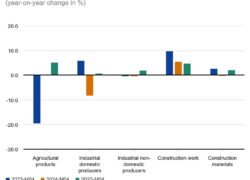
Slovak Producer Prices Edge Higher in August, Agriculture Growth Slows

Producer prices in Slovakia continued to edge higher in August, though agriculture posted its weakest growth so far this year, according to new figures from the Statistical Office.

Industrial producer prices for the domestic market were 0.8 percent higher than a year earlier. Thirteen of the sixteen monitored industrial sectors reported increases, with transport equipment and food, beverages and tobacco rising by up to 4 percent. The energy sector again exerted downward pressure, with prices 1.5 percent lower than in August 2024. For the first eight months of the year, domestic industrial prices averaged 0.5 percent higher than a year earlier, with a 1.3 percent rise recorded in August compared with July.

Prices charged to foreign markets showed stronger momentum, increasing by 1.9 percent year-on-year and by 0.3 percent month-on-month. Between January and August, non-domestic industrial producer prices were 1 percent above their 2024 level.

Agriculture showed a more subdued trend. Producer prices rose by 5.2 percent in August compared with a year earlier, marking the lowest increase of 2025 so far. Crop production gained only 2.3 percent, while animal products rose by 12.4 percent. Within crops, cereals, oilseeds and fruits increased by up to 5 percent, and fruits and nuts surged almost 13 percent. By contrast, potatoes were nearly 10 percent cheaper, while fresh vegetables and legumes slipped by about 2 percent. Among animal products, eggs climbed by more than a third year-on-year, raw cow’s milk was up almost 18 percent, and cattle and sheep saw double-digit growth. Pig prices, however, remained under pressure, down 8.3 percent compared with last August.

Construction costs also remained firm. Prices in the sector were 4.8 percent higher year-on-year in August, and for the January–August period they rose 5 percent compared with a year earlier. The cost of materials used in construction increased by 2.1 percent in August and by 2 percent across the first eight months.

The latest figures confirm a stabilisation of price dynamics compared with the volatility seen in 2023, when agricultural products had slumped by nearly 20 percent year-on-year and industrial producers faced marked declines. By April 2025, agricultural prices were already up 5.2 percent compared with the same month in 2024, while industrial producers selling to domestic and non-domestic markets posted moderate gains.

The Statistical Office underlined that since January 2024 all production price data has been recalculated under a revised methodology, reflecting a new base period and updated classifications of economic activities.

Source: Statistical Office Slovakia

Netanyahu Clashes with UK and Allies Over Palestinian Recognition

Diplomatic tensions escalated this week as Britain formally recognised Palestine, joining a group of Western governments that includes France, Canada and Australia. Prime Minister Keir Starmer framed the move as a step toward reviving prospects for peace, arguing that recognition should serve as a lever to bring both sides back to negotiations.

Israel’s response was swift and forceful. Before leaving for the United Nations General Assembly, Prime Minister Benjamin Netanyahu promised to directly call out Starmer and other leaders who had endorsed Palestinian statehood. He characterised the decisions as rewarding violence and pledged to present Israel’s case in uncompromising terms during his speech in New York.

The timing is significant. More than 140 countries worldwide already acknowledge Palestinian statehood, but until now few of the world’s wealthiest nations had joined that list. Britain’s shift is notable both because of its influence within the G7 and its historic role in the Middle East. Observers describe it as one of the clearest signs of frustration in Western capitals with the lack of progress toward a political solution.

At the UN, Netanyahu delivered a combative address reiterating his opposition to unilateral recognition. He argued that statehood without direct agreement would imperil Israel’s security and embolden militants. His remarks drew sharp reactions in the chamber, with some delegations walking out in protest. Critics accused him of ignoring the humanitarian crisis in Gaza while doubling down on a military-first message.

The Israeli leader’s stance enjoys near-unanimous backing at home, where both coalition and opposition parties reject recognition outside of a negotiated framework. Analysts suggest Netanyahu is also under pressure from international legal proceedings, with warrants issued by the International Criminal Court against senior Israeli figures over the Gaza conflict. That legal backdrop may be reinforcing his determination to confront moves he sees as undermining Israel’s legitimacy.

For supporters of recognition, the recent wave of announcements represents an attempt to break years of stalemate. Advocates argue that without concrete action, the prospect of a viable Palestinian state will continue to erode amid settlement expansion and entrenched control. Symbolic recognition, they contend, at least affirms Palestinian political rights and signals impatience with Israel’s current trajectory.

Critics counter that recognition risks being hollow, since Israel retains decisive control over borders, security and territory. Without enforceable commitments on both sides, they warn, the declarations could raise expectations while changing little on the ground. Some also argue that unilateral moves give militants rhetorical victories and reduce incentives for compromise.

The debate within the UK reflects these tensions. Public opinion is mixed, with surveys showing both significant support and opposition to recognition, often depending on how the question is framed. Within Starmer’s Labour Party, the decision has been welcomed by some as a historic correction, while others fear it could complicate relations with allies and alienate segments of the electorate.

What is clear is that Britain’s step has emboldened similar moves elsewhere in Europe. Portugal and France have issued supportive statements, while Canada and Australia made their own announcements almost in tandem with London. This clustering of recognitions signals a broader diplomatic shift, one that places Netanyahu increasingly at odds with partners Israel has long relied on for political support.

The coming weeks will show whether the move generates new momentum for peace talks or hardens positions further. For now, it highlights the widening gulf between Israel’s insistence on negotiated statehood and a growing number of Western governments willing to formalise recognition as a political tool.

Starbucks Prunes Stores in Global Reset While Europe’s Café Market Grows

Starbucks is embarking on a global restructuring that will see hundreds of jobs cut and a selection of cafés closed, with North America bearing the brunt and parts of Europe also affected. The company has confirmed that underperforming sites in the United States and Canada will be shut down, amounting to about one percent of its stores in those markets, alongside roughly 900 job losses in office and support roles. In Britain, a consultation is under way to identify which locations will be closed, while stores in Austria and Switzerland are also expected to disappear from the portfolio.

Executives stress that the move is not a retreat but a pruning exercise aimed at re-focusing on quality and consistency. Many of the cafés selected for closure are those that struggle financially or cannot deliver the kind of customer experience the brand wants to reinforce. At the same time, Starbucks has pledged to remodel more than a thousand outlets globally over the next year, promising shorter queues, refreshed interiors, and a warmer atmosphere that emphasizes the traditional coffeehouse feel over minimal pickup formats.

The shift comes after six consecutive quarters of declining same-store sales in the U.S., the company’s largest market, where competition is intense and consumer price sensitivity has grown. Rivals at both ends of the spectrum are exerting pressure: value-driven chains compete on price and convenience, while independent cafés and third-wave specialists pull customers toward higher-end quality and atmosphere. Analysts note that large chains like Starbucks face a trust gap when long lines, inconsistent service, or high prices leave customers feeling short-changed.

Europe presents a more mixed picture. The branded coffee shop market across the continent is still expanding, with the total number of outlets rising by nearly five percent in 2025 to more than 51,000—its fastest growth in years. Operators remain under strain from high input costs, but consumer demand for cafés is proving resilient. In Central and Eastern Europe, Starbucks operates largely through the licensee AmRest, which runs more than 430 outlets in eight countries. The group continues to open new sites while trimming others, suggesting a strategy of optimization rather than contraction.

Country-by-country, the outlook varies. In Germany, where Starbucks maintains a mix of company-run and licensed outlets, there has been no announcement of widespread closures. France and Spain also continue to host a substantial number of cafés, with changes appearing to be limited to routine portfolio management. Italy, where Starbucks has always faced a challenging cultural and competitive environment, has not been singled out for major cuts, though high rents in some prime cities continue to test the model. In Britain, closures are confirmed but the exact number is not yet known.

The wider retail backdrop matters. In the UK, overall high-street footfall fell in 2024, weakening the environment for cafés that rely on heavy pedestrian traffic. By contrast, footfall data in the U.S. suggests visits to coffee establishments remain above pre-pandemic levels, but consumers are spending differently, often splitting their loyalty between big chains and independents. Smaller operators have shown surprising resilience, with many reporting stable or improved revenues in the past year by leaning into quality, local ties, and community engagement.

Starbucks itself is rebalancing its strategy. In recent years, it leaned heavily into drive-throughs and mobile-only pickup points, but the company now admits that approach went too far. It is gradually phasing out those formats in favor of more welcoming cafés where customers are encouraged to linger. This reflects a recognition that coffee culture is evolving: while convenience remains important, many consumers still want a space to sit, socialize, or work.

Globally, the coffee shop sector continues to expand, with forecasts pointing to steady growth through the next decade and even faster gains for specialty outlets. The question for Starbucks is how to position itself in that environment—balancing scale with experience, and automation with hospitality.

The closures announced in North America and Europe are significant in symbolic terms, but relatively modest in scale compared with the company’s 18,000-plus cafés in the region. The broader strategy is about re-investment and reset: cutting weaker sites, upgrading many more, and trying to recover the mix of quality, efficiency, and environment that originally made the brand dominant.

Whether that strategy succeeds will depend on how well Starbucks adapts to a coffee culture that is no longer defined solely by convenience, but also by expectations for authenticity, service, and atmosphere.

LATEST NEWS