HSF System Completes Multifunctional Hall and Office Building for TESLA KARLÍN in Prague

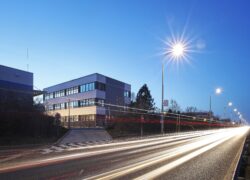
Construction company HSF System, a member of the PURPOSIA Group, has completed a new multifunctional hall and administrative building for TESLA KARLÍN, a.s. in Prague’s Hostivař district. The project, valued at around CZK 94 million, provides new storage, assembly, and office facilities to support the company’s operations.

The main structure is a single-storey industrial hall with a two-storey extension, designed to house assembly and logistics areas, as well as offices and staff facilities. The hall’s reinforced concrete frame and sandwich-panel façade combine durability with thermal efficiency. Grey-white cladding with blue accents reflects TESLA KARLÍN’s corporate identity, while glazed window strips on the north and south sides ensure natural lighting.

According to Tomáš Hess, Commercial Director of HSF System, the project demonstrates the company’s ongoing focus on functional and energy-efficient industrial buildings. “The modern design allows for flexibility and operational efficiency to meet the client’s long-term needs,” he said.

The project also included the installation of engineering networks, retention tanks, service roads, and paved areas within the Hostivař site. TESLA KARLÍN’s Vladimír Kurka, a member of the board of directors, noted that the new facilities would expand production and logistics capacity while providing better working conditions for employees.

In addition to the hall, HSF System delivered a three-storey administrative building with space for up to 77 employees. The building measures approximately 24.7 × 12.7 metres and offers a total usable area of 816 m². Interior layouts are designed for flexibility, featuring plasterboard and glass partitions that can be adapted for different tenants. The structure incorporates external insulation and strip windows with opening and tilting sashes to improve light and ventilation.

The project reinforces HSF System’s role as a consistent contractor in industrial and administrative developments across the Czech Republic, combining technical precision with adaptable design for long-term use.

Police Target Rising Cases of Forced Labour with New National Awareness Drive

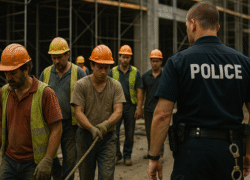
Czech authorities are stepping up efforts to address a growing number of cases involving forced labour and human exploitation. Investigators from the National Headquarters Against Organized Crime (NCOZ) report that both foreign workers and vulnerable Czech citizens are increasingly being drawn into exploitative work arrangements resembling modern slavery.

According to senior officials, offenders often avoid direct violence, instead maintaining control through debt, withheld wages, or the confiscation of personal documents. Many victims live in employer-provided accommodation and depend entirely on their exploiters for food and basic needs. Such dependency, combined with a lack of awareness of rights, makes it difficult for victims to seek help.

The problem is particularly visible in construction, agriculture, cleaning services, and domestic work, where informal recruitment agencies and intermediaries operate in low-regulation environments. Victims are frequently promised legal employment but end up working long hours for little or no pay. Some are citizens living in poverty, while others are foreign workers from Ukraine, Romania, or Bulgaria who are deceived or pressured into illegal arrangements after arrival.

Police statistics record only a few dozen confirmed cases each year, but investigators believe the true scale is much larger. Each major investigation typically involves several perpetrators and dozens of victims. Experts say that while the Czech Republic’s laws prohibit human trafficking and forced labour, enforcement remains difficult because many victims are afraid to report abuse or do not recognize themselves as being exploited.

To increase awareness, the NCOZ has launched a new information campaign titled “Work in Chains.” The initiative aims to help the public and potential victims identify signs of forced labour and know where to seek assistance. Educational videos, produced in cooperation with the Ministry of the Interior and the NGO La Strada Czech Republic, are available in several languages including Czech, English, Ukrainian, Romanian, Bulgarian, and Russian.

La Strada will act as a partner organization, offering confidential support and a 24-hour helpline for victims. The campaign also includes training for police officers, social workers, and municipal staff to better recognize cases of labour exploitation during inspections and routine contact with the public.

Czechia remains both a destination and transit country for exploited labour. International studies, including the Global Slavery Index, estimate that tens of thousands of people in the country may be working under coercive or exploitative conditions. The Council of Europe’s GRETA monitoring body has urged stronger prevention and better victim identification, noting that most detected cases involve foreign nationals in low-wage sectors.

NCOZ Director Jiří Mazánek said that the campaign’s purpose is not only to inform but also to build trust. Many victims, particularly from abroad, hesitate to approach the police due to experiences of corruption or indifference in their home countries. “We want to show people that they can turn to Czech officials directly and receive help without fear,” he said.

The police emphasize that forced labour does not always involve physical abuse. It often hides behind everyday workplaces—on construction sites, in kitchens, or in private homes—where people may appear to work voluntarily but in reality have no freedom to leave. Through its new campaign, law enforcement hopes to make those invisible forms of exploitation visible.

Essen Office Market Faces Slowdown as Leasing Volumes Fall Below Average

Essen’s office property market continued to show subdued activity through the third quarter of 2025, with leasing momentum easing after a stronger start to the year. Total take-up by the end of September reached roughly 45,000 square metres, marking a decline compared to the same period last year and falling well below the city’s long-term average, according to market research from BNP Paribas Real Estate and corroborated by analysts at JLL and Colliers.

The slowdown is largely due to a lack of medium-sized transactions, traditionally a key driver of the market. While smaller leases under 500 square metres and a few large-scale lettings have helped sustain activity, the absence of deals in the 2,000–5,000 square metre range has weighed heavily on overall results. The City of Essen itself accounted for several of the largest agreements this year, including a notable 13,000-square-metre lease in the Weststadt district — the most active submarket to date.

Average rents have continued to edge upward despite weaker leasing volumes, reflecting the limited availability of modern, high-quality space. Prime rents currently stand just below €19 per square metre, with the Southern Quarter achieving the highest rates. Average rents across the city are reported to have climbed toward €15 per square metre, supported by rising fit-out standards and a shortage of new completions.

Public institutions remain a dominant source of demand, representing about half of total leasing activity so far this year — significantly above long-term averages. The private services sector follows, though with fewer large commitments than in previous years.

Vacancy across the Essen office market has risen modestly, now estimated at around 8%, though availability of modern, ESG-compliant offices remains limited. Only a small share of the existing vacant stock meets current standards, while ongoing projects under construction are already largely pre-let. New development activity has declined sharply, with construction pipelines down by more than a third year-on-year.

Market observers expect a mild improvement in the final quarter, encouraged by stabilising sentiment in the wider German economy. However, the full-year leasing total is unlikely to reach last year’s levels unless several large transactions are concluded before December.

Despite short-term headwinds, analysts suggest Essen’s fundamentals remain intact. The city’s transformation from a traditional industrial hub to a diversified service and administrative centre continues, supported by steady public-sector demand and gradual modernisation of its office stock.

Corruption and Financial Crime Still Among the Main Challenges for Czech Law Enforcement

Corruption remains one of the most persistent forms of organized crime in the Czech Republic, with investigations continuing to focus on the misuse of public funds, manipulation of contracts, and financial misconduct within state institutions and the private sector. According to the latest findings from the National Headquarters Against Organized Crime (NCOZ), economic and corruption-related offences once again represented the majority of serious cases handled last year.

The NCOZ’s newly released annual report shows a continued rise in complex investigations, particularly those involving tax and customs fraud, international financial networks, and investment scams. In 2024, the unit opened dozens of new cases and referred more than fifty for prosecution. Over one hundred of its ongoing investigations were classified as economic or corruption-related, reflecting a steady trend from previous years.

Officials noted that corruption remains especially entrenched in sectors linked to large public budgets—such as construction, healthcare, and information technology—where public tenders and procurement processes are often vulnerable to manipulation. In some regional administrations, NCOZ investigators say they repeatedly uncover similar offences every few years, suggesting that preventive measures have not been fully effective.

The report also highlights the growing sophistication of criminal activity. Organized networks now frequently combine corruption with financial or cyber elements, using complex ownership structures, shell companies, and digital channels to obscure money flows. Investigators say that international cooperation has become increasingly necessary, as many schemes cross borders through intermediaries and offshore accounts.

Although the Czech Republic does not stand out in Europe for the overall level of corruption, the persistence of such offences underscores structural weaknesses in oversight and public accountability. Data from Transparency International’s most recent corruption perception index place the country mid-table within the European Union, with only modest progress in recent years.

Meanwhile, NCOZ investigators secured billions of crowns in seized assets last year, a record figure for the unit. Yet experts caution that the volume of recovered funds still covers less than half of the total losses caused by economic crime. Officials admit that while enforcement capacity has improved, systemic prevention and transparency reforms remain essential to reduce opportunities for graft.

Real estate transactions and property ownership were not listed as a separate crime category in the 2024 report, though officials note that property assets frequently appear in corruption and money-laundering cases. In particular, real estate is often used to conceal or reinvest illicit profits rather than as the direct focus of fraud itself.

Overall, the NCOZ’s work reflects a growing emphasis on tracing financial flows and uncovering the networks that link corrupt public contracts to private enrichment. As one senior officer summarized, the forms of crime may evolve, but the underlying motives — profit, influence, and access to public resources — remain much the same.

CEVA Logistics Expands Digital Capabilities with Manhattan Cloud Systems

CEVA Logistics has started a phased global rollout of Manhattan Associates’ warehouse and order management software as part of its plan to modernize contract logistics operations. The initiative will introduce Manhattan Active® Warehouse Management (WMS) and Order Management (OMS) systems into CEVA’s technology ecosystem, which currently supports around 800 sites and 11 million square metres of warehouse space worldwide, including in Poland.

The project marks the next stage in CEVA’s broader innovation programme, focused on automation, artificial intelligence, and data-driven process efficiency. The Manhattan tools will be integrated with CEVA Matrix®, the company’s in-house warehouse management platform, creating a unified structure that allows logistics operations to be scaled or adapted more quickly for individual customers.

According to Chris Walton, Senior Vice President for Global Contract Logistics at CEVA, the company’s strategy is to enhance flexibility and operational responsiveness through technology. He said the use of connected systems such as wearables, robotics, and AI-based analytics is expected to increase productivity and improve customer visibility into warehouse performance.

The new software, built on a cloud-native SaaS platform, offers continuous uptime and is designed to handle large transaction volumes across multiple regions. It will support faster onboarding of new clients and the setup of additional facilities while maintaining service continuity. Customers will also gain access to detailed performance dashboards through CEVA’s MyCEVA portal.

The initial implementation will take place at selected sites in North America and Europe, followed by a gradual expansion to other global markets. Once complete, the Manhattan platform will operate in more than half of CEVA’s contract logistics facilities, with the rest continuing to use CEVA Matrix®.

Eric Clark, Chief Executive Officer of Manhattan Associates, said both companies share a focus on using technology to improve customer outcomes. He noted that the collaboration is intended to provide CEVA with a resilient foundation for responding to market shifts and managing supply chain disruptions more effectively.

The deployment of Manhattan’s cloud solutions forms part of CEVA’s longer-term digital transformation programme, which aims to streamline global logistics operations and prepare the company for the next phase of growth in contract logistics.

New Chapter for Bratislava Skyline: Ister Tower Project Moves Forward

Bratislava’s evolving downtown district is preparing for another major addition to its skyline as the Ister Tower development receives final approval for construction. The project, positioned on Landererova Street near the city’s modern riverfront, has cleared its last administrative hurdle after years of preparation and review. The newly granted building permit allows work to start once the decision becomes legally effective, provided construction begins within two years of that date.

Developed by The Galata Group with financial backing from DRFG Investment Group, the complex is expected to break ground soon. Both parties have indicated that planning for the initial construction phase is already under way, signaling that visible progress could come in the near term.

The design calls for a tall central tower supported by two smaller residential buildings, forming a unified ensemble intended to reflect contemporary urban living. The main tower is expected to rise around one hundred meters, positioning it among the tallest residential structures in Slovakia. Across the development, approximately five hundred apartments will be built, ranging from compact one-bedroom units to larger duplexes and penthouses. Many of these will feature private terraces, rooftop gardens, and landscaped green courtyards designed to soften the project’s vertical profile and bring natural elements into the urban setting.

Residents will have access to shared facilities such as wellness and fitness areas, private lounges, and underground parking, while the ground level will host retail and leisure spaces to create an active streetscape. The project aims to combine comfort and exclusivity with easy access to the city center, aligning with the broader transformation of Bratislava’s new downtown into a high-density, mixed-use neighborhood.

The idea for Ister Tower first surfaced several years ago, completing environmental assessments in 2019 and receiving zoning consent in 2022. With the construction permit now in place, the development is positioned to become a new benchmark for residential high-rises in the city. If construction begins as anticipated, the project could soon join Eurovea Tower and Klingerka as part of the defining skyline of a capital that is increasingly looking upward.

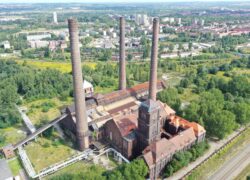
Historic Szombierki Power Plant in Bytom to Undergo €115 Million Revitalisation with EU Support

The long-abandoned Szombierki Heat and Power Plant in Bytom, one of Upper Silesia’s most iconic industrial monuments, is set to be transformed into a major cultural, leisure, and business complex. The project, led by Arche S.A., has been awarded EU funding under the Just Transition Fund and will breathe new life into the century-old site while preserving its historic character.

According to official data from the Silesian Voivodeship and Bytom City Hall, the total investment value is estimated at PLN 505 million, of which approximately PLN 84 million (€19 million) will be financed through EU grants. The funds come from the programme Fundusze Europejskie dla Śląskiego 2021–2027, designed to support post-industrial regions transitioning away from coal-based economies.

The project will convert the former power plant — which ceased operation in 2011 — into a multi-functional destination for sport, recreation, hospitality, and cultural events. Plans include a pool complex, squash and badminton courts, an outdoor gym, and accessible facilities for people with disabilities. The wider complex will feature a 200-room hotel, gastronomic and retail zones, a conference and exhibition centre, and flexible spaces for concerts, fairs, and business meetings.

Local authorities say the redevelopment will create at least 150 new jobs within the complex and additional employment in supporting services such as hospitality, logistics, and crafts. “The revitalisation of Szombierki will not only preserve one of Upper Silesia’s architectural landmarks but also open new opportunities for sustainable tourism, entrepreneurship, and cultural exchange,” said Bytom Mayor Mariusz Wołosz when announcing the EU grant.

Developer Arche S.A., known for repurposing historic sites across Poland, confirmed that the project will combine heritage conservation with modern, energy-efficient design principles. The company’s EU funding disclosure states that the redevelopment will include environmental and digital innovation measures, such as improved energy efficiency, re-use of materials, and the application of smart management technologies. The architectural concept was prepared by Bulak Studio.

A dedicated sub-project titled “Creation of Public Sports and Recreation Infrastructure as Part of the Revitalisation of the Szombierki Power Plant Complex in Bytom” received a separate EU grant of PLN 46.4 million, according to Arche’s official EU project register.

While the EU funding decision confirms the project’s selection for support, Arche S.A. notes that the formal financing agreement is still being finalised before disbursement begins. Construction works are expected to start following the signing, with phased implementation over the next several years.

The revitalisation is expected to position the Szombierki complex as a new landmark for Upper Silesia, combining industrial heritage, sustainable redevelopment, and community-focused facilities.

Last Apartments and Penthouses Now Available at Radimova Residence in Prague 6

The final phase of sales is underway at Radimova Residence, a residential development by Geosan Development located in Prague 6–Břevnov. The project, known for its architectural quality and panoramic views across the city including Prague Castle, now offers only a few remaining properties — two penthouses and one large apartment.

“We designed the penthouses at Rezidence Radimova for clients seeking generous living spaces with lasting design and quality craftsmanship,” said Eliška Koderová, Head of Sales at Geosan Development. “They have drawn interest particularly from families looking for functional and refined urban homes.”

The two remaining penthouses, Elegant and Majesty, each feature distinct layouts. Penthouse Elegant includes five rooms, three bedrooms, a study, three bathrooms, and a loggia connected to a terrace accessible from all main rooms. Penthouse Majesty is designed around a large outdoor terrace suitable for a pergola, jacuzzi, and garden area, offering extensive views over Prague’s historic centre. Both units include underfloor heating, air conditioning, heat recovery systems, outdoor blinds, and connections to winter gardens or terraces. Each comes with two parking spaces and a storage unit.

One additional luxury apartment, finished and ready for immediate move-in, is also part of the offer. It features multi-layer oak flooring, large-format Taj Mahal stone in the bathrooms, and Laufen sanitary fittings. The apartment was showcased at this year’s LeadingRE Global Symposium in Prague as an example of high-quality urban living.

Geosan Development provides buyers with optional financing and interior design services through selected partners. “This allows clients to adapt their homes to their preferences from the very beginning,” Koderová noted.

Located in Prague 6 – Břevnov, the Radimova Residence benefits from a quiet residential setting combined with full urban amenities. Nearby parks such as Kajetánka and Ladronka, as well as schools, shops, and sports facilities, contribute to the area’s appeal. The city centre and Ruzyně Airport are both easily accessible.

“Radimova Residence stands out for its location and scale,” added Koderová. “Apartments of this size with panoramic city views are rare in Prague, making this a limited opportunity within the premium segment.”

Daniel Libeskind to Shape Prague’s Future Skyline on Rohan Island

The transformation of Rohan Island in Prague is gaining momentum, with an ambitious new phase designed by world-renowned architect Daniel Libeskind. The project, developed by Sekyra Group, aims to turn a long-abandoned riverside site into a vibrant new district combining housing, leisure, and green public space.

The development, known as Rohan City, will stretch along the Vltava River between Karlín and Libeň, replacing what was once an industrial area with modern buildings and landscaped parks. At its heart will stand four distinctive residential towers created by Libeskind’s studio in New York. Their dynamic form will define the skyline and serve as the focal point of a new central square dedicated to Simone Weil, continuing the district’s theme of naming streets and parks after great thinkers.

The wider plan envisions a mixed community with homes, offices, shops, cafés, and cultural facilities surrounded by open green areas. The riverfront promenade will connect to existing parks and cycle routes, creating a continuous path along the Vltava. Nearly half of the entire site is planned as open space, making greenery a central part of the district’s design.

Local and international architecture firms are contributing to different phases of the project, each responsible for residential or mixed-use blocks that will form part of the evolving neighbourhood. Among them are Jakub Cigler Architekti, edit! architects, and Podlipný Sladký Architekti, who are designing a new section with several hundred apartments overlooking the river.

Construction on the site has been advancing gradually since the first buildings were approved, with completion of the full district expected by 2035. Once finished, Rohan City will provide homes for more than 10,000 people, transforming a neglected part of the capital into a modern, sustainable extension of the inner city.

Sekyra Group describes the development as a model for contemporary Prague — a place that connects architecture with the natural landscape while offering new spaces for culture and community life. Libeskind’s design will give the area a distinctive identity, marking one of the most significant additions to the city’s skyline in years.

Photo: Rohan City – Sekyra Group

Germany’s Poverty Risk Remains High for Refugees and the Unemployed Despite Years of Economic Growth

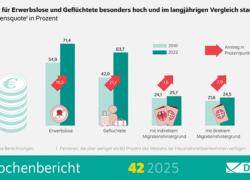
Germany’s long-running prosperity narrative continues to conceal deep divisions. According to updated research from the German Institute for Economic Research (DIW Berlin) based on the Socio-Economic Panel (SOEP), the overall risk of poverty has barely changed since 2020, holding steady at around 17 percent of the population. Yet among refugees and the unemployed, the rates remain three to four times higher — a structural imbalance that economic growth alone has failed to resolve.

“It is clear that work protects against poverty,” said DIW economist Markus M. Grabka, who leads the annual evaluation of wage and income data. “But integration into the labour market and a fair transfer system are essential. As it stands, increases in working hours have little effect on the wallets of those in the lower income bracket.”

The DIW findings show that while hourly wage inequality has narrowed in recent years—thanks in part to the minimum wage and improved pay in eastern Germany—the real purchasing power of households has eroded under the weight of high inflation in 2021–2022. Statistisches Bundesamt confirmed that real incomes fell for the first time in nearly a decade, a setback that hit low-income groups hardest.

The share of people facing financial insecurity has stagnated since the pandemic period. Among those without a migration background, the poverty risk remains below 13 percent, but for people with a migration background, it hovers around a quarter of the population. For refugees, the picture is starker. The IAB-BAMF-SOEP Refugee Survey, which tracks their economic situation, estimates that as many as 60 percent of refugee households live below the poverty threshold — an improvement from earlier years, yet still alarmingly high.

“The good news is that since 2020, the poverty risk among refugees has fallen slightly, which is likely due to increasing labour market integration,” Grabka told DIW Berlin’s Distribution Report.

Experts note that the income gap in Germany is not widening further but remains “stuck” at a high level. Studies from DIW Berlin and Destatis suggest that stagnant wage mobility, part-time work, and limited access to full employment continue to trap many households at the lower end of the income scale.

The data reveal what analysts describe as a “two-speed” Germany: a stable middle-income majority and a growing minority struggling with rising costs, insecure jobs, and limited prospects for advancement. DIW Berlin concludes that stronger policies to promote full-time employment and reform the benefits system could help translate economic growth into real income gains for all.

“Germany’s economy is still growing, but not everyone feels the benefit,” Grabka warned. “Reducing inequality and poverty will require more than a good labour market—it demands structural change.”

Source: DIW Berlin

LATEST NEWS