REWE Green Farming Berlin: Sustainability Meets Digital Construction Innovation

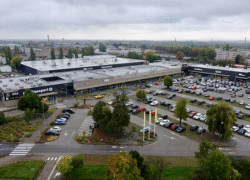
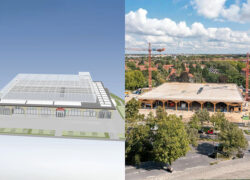
A new generation of supermarket construction is taking shape in Berlin’s Lankwitz district, where REWE Group is building its second Green Farming Market — a project that combines sustainable urban agriculture with advanced digital planning. Scheduled to open in spring 2026, the development is the first REWE property to be entirely planned and executed using Building Information Modeling (BIM), a method that creates a digital twin of the building to optimize efficiency and reduce errors during construction and operation.

The supermarket features a 2,150-square-metre market hall topped by what will become Berlin’s largest rooftop farm. Operated by ECF Farmsystems, the hydroponic facility will produce up to 900,000 salad portions annually, using rainwater from a cistern and heat recovered from the store below. The timber structure of the market, built from around 1,450 cubic metres of locally sourced softwood, is designed for recyclability and carbon storage, aligning with REWE’s broader sustainability goals.

Thomas van der Broeck, Head of Digital Construction & Processes at REWE Group, explained that the BIM-based planning process transforms how the company manages its projects. “Instead of working from static plans, we now build digitally first. Every component is modeled in 3D, allowing all trades to coordinate in real time and identify conflicts before construction starts,” he said. This approach improves data quality, transparency, and efficiency, while reducing costly adjustments on-site.

Once completed, the digital twin will continue to serve during the building’s operational phase. It records the specifications of all materials and systems installed, helping maintenance teams pinpoint issues remotely and prepare for repairs more accurately. “In the future, a technician will know exactly which unit needs servicing and what tools or parts to bring before arriving on site,” van der Broeck noted, adding that such methods reduce time, costs, and environmental impact.

The Berlin Green Farming project builds on the model first implemented in Wiesbaden and is part of REWE’s long-term plan to replicate the concept across Germany. It combines locally produced food, energy-efficient design, and a circular use of resources — from renewable materials to waste heat recovery.

Construction is being led by REWE’s in-house team in cooperation with regional partners. The project has also become a testing ground for integrating new technologies and processes that REWE intends to apply to future developments. “We want to move away from paper-based processes and isolated systems toward a fully digital property portfolio,” van der Broeck said. “Digitization allows us to address both cost pressures and the shortage of skilled labor in the construction industry.”

With its combination of digital innovation and sustainable design, the REWE Green Farming Berlin project represents a step toward a more efficient and environmentally responsible model of retail development — one that may soon become standard across the group’s future properties.


City Point Okęcie pioneers use of low-carbon construction panels in Poland

City Point Okęcie, a logistics and office complex developed by Peakside Capital near Warsaw’s airport, has become the first building in Poland to use Ruukki® LowCarbon sandwich panels, a new generation of construction materials designed to reduce carbon emissions. The project was delivered in cooperation with Ruukki Polska and Depenbrock Polska, which managed the installation of the cladding system.

The panels were manufactured at Ruukki’s Oborniki plant using SSAB Zero™ steel, produced entirely from recycled scrap and processed with renewable biogas and fossil-free electricity. According to the manufacturer, this method lowers the carbon footprint of the panels by around 42% compared to conventional products, a claim verified by environmental product declarations (EPD).

The 11,000-square-metre City Point Okęcie development is a build-to-suit logistics and office facility designed to meet high environmental standards. It incorporates energy-efficient materials, modern building management systems, and prefabricated structural components. “Delivering a project of this scale requires precision from design through completion,” said Marcin Popek, Project Manager at Depenbrock Polska. “The technologies used ensure both operational efficiency and sustainability.”

Ruukki’s regional director for Central and Eastern Europe, Waldemar Szostak, described the initiative as a model for future industrial construction. “The use of low-carbon materials represents a major step toward sustainable building. It reflects a shift in the industry toward considering the entire life cycle of materials and structures,” he said.

Peakside Capital has incorporated sustainability principles throughout the investment, aligning the project with EU Taxonomy requirements and aiming for BREEAM and LEED certification. The company emphasised that the partnership with Ruukki supports its broader environmental goals. “Using panels made from fully recycled steel with a reduced carbon footprint is consistent with our commitment to circular economy principles,” noted Katarzyna Krześniak, ESG Project Manager at Peakside Capital. “Their lighter colour also helps limit heat absorption, improving energy efficiency and extending the lifespan of the building’s façade.”

City Point Okęcie’s completion marks another step in Poland’s shift toward lower-emission construction methods. As more developers integrate renewable materials and energy-saving technologies, the project serves as a case study in how industrial buildings can meet both operational and environmental performance goals.

Brno Launches Shared Housing Pilot for Students in City Centre

The City of Brno is introducing a new shared housing initiative aimed at university students, transforming one of its larger municipal apartments in the city centre into accommodation for young residents. The move marks the first time the municipality has adapted its shared living model—previously used successfully for senior citizens—for students.

The apartment, measuring just under 120 square metres, will be offered to a group of three to six students under the age of 30 who are enrolled in full-time university studies. Monthly rent has been set at 96 CZK per square metre, and applications will open in November. Tenants will be chosen through a public draw.

A condition of the lease requires new residents to register their permanent address at the property within two months of moving in. The city emphasises that this measure not only ensures administrative transparency but also benefits Brno’s municipal finances, as tax allocations from the state are linked to the number of officially registered residents.

Mayor Markéta Vaňková explained that the city decided to convert the large apartment after finding it difficult to rent out similar-sized units as standard municipal flats. The building’s layout—situated on the second floor with access only via a narrow spiral staircase—made it unsuitable for senior living, prompting the city to explore a student-focused alternative.

Deputy Mayor for Housing Karin Podivinská said the initiative is part of a broader effort to make public housing more accessible to younger people. “We want to show that municipal housing can also serve students and young professionals, offering them an affordable and stable start while studying or beginning their careers,” she noted.

The shared apartment model for seniors, first introduced several years ago, has already proven successful in addressing isolation among older residents while maintaining independent living. City officials hope the student version will have a similar social and economic impact, helping retain young talent in Brno while easing pressure on the city’s increasingly competitive private rental market.

The program complements Brno’s existing starter housing schemes for young individuals and couples and may serve as a pilot for future student-oriented municipal housing projects if successful.

Source: CTK

Europe’s Real Estate Debt Market Shows Signs of Recovery as Financing Gap Narrows

The European real estate debt market is showing clear signs of stabilisation, with new research from AEW indicating that the region’s credit financing gap is shrinking. The firm’s latest report estimates that between 2026 and 2028, the gap between maturing loans and available refinancing will amount to €74 billion, an 18% decline from the previous forecast. The data suggests that improved lending conditions and the return of investor confidence are helping to ease refinancing pressures across Europe.

According to AEW’s Head of Research & Strategy for Europe, Hans Vrensen, the current market reflects “a significant improvement in refinancing conditions,” driven by steady interest rates and rising loan activity. Over the past year, both lenders and borrowers have become more confident, supported by stabilised yields and better loan-to-value ratios. This has encouraged a modest return of risk appetite, particularly in eurozone markets, where financing remains cheaper than in the UK.

The report highlights that debt financing is becoming more accessible as competition among lenders intensifies. Margins for loans on office properties, once under pressure from high vacancy rates, are now converging with those in the logistics and residential sectors. Lending terms are loosening slightly, with higher leverage levels and lower borrowing costs being observed, especially in countries with robust collateral markets such as France and Germany.

Across Europe, the overall refinancing challenge now affects around 12% of outstanding real estate loans—down from 13% a year earlier. The improvement is not evenly distributed: France faces the highest level of refinancing pressure, with roughly one in five loans issued since 2017 at risk of difficulty, largely due to slower capital value recovery in its office and logistics segments. By contrast, Germany, Spain, and Italy have seen marked progress, with refinancing risks dropping to 16%, 10%, and 8% respectively. The UK remains the most resilient market, with only 6% of loans facing potential shortfalls.

The largest share of outstanding debt exposure lies in the office sector, representing 41% of the total gap, followed by retail (21%), residential (19%), and other property types accounting for the remainder. While office and retail remain under pressure, the logistics and housing sectors continue to attract lenders seeking stable, long-term income.

A notable trend shaping the current recovery is the growing role of private credit funds, which now manage roughly €110 billion in European property loans. These funds are increasingly using so-called “loan-on-loan” financing, known as back-leverage, to provide liquidity where traditional banks remain cautious. AEW notes that while these structures help bridge short-term financing gaps, they may pose risks to long-term market stability if left unregulated.

Overall, the outlook for defaults and losses has improved. The proportion of commercial property loans at risk of default has fallen from 7.1% to 5.8%, and expected losses have eased to 1.6%—well below the levels recorded during the 2008 financial crisis. Although refinancing challenges persist for some older, lower-quality assets, the broader picture suggests that Europe’s property debt market is regaining balance.

AEW concludes that stabilising interest rates, competitive lending, and the return of non-bank capital are supporting a gradual normalisation of the sector. While investors remain cautious, the report signals that Europe’s commercial property market is entering a more sustainable phase—one defined by selective risk-taking, disciplined lending, and renewed access to financing.

Amundi Completes Sale of Forum Karlín and Ibis Hotel to Patria from ČSOB Group

The investment company Amundi Czech Republic has completed the sale of two high-profile Prague properties — the Forum Karlín complex and the Ibis Hotel on Na Poříčí Street — to Patria, a member of the ČSOB Group. The move marks the beginning of the final phase of Amundi’s KB2 Real Estate Fund, which is preparing to return profits to its investors after several years of activity in the Czech market.

The transaction amount has not been disclosed. Amundi originally acquired Forum Karlín in late 2018 for around €52 million, and market analysts now estimate that the current value could be in the low billions of Czech crowns, reflecting both the property’s prime location and sustained demand for quality real estate in Prague.

The Forum Karlín complex is one of Prague’s most recognisable multifunctional venues. It includes a large concert and conference hall, a modern office section, and a restored historic building that once served as a boiler house. The property previously housed the offices of Economia, publisher of Hospodářské noviny, and is now home to the communications agency Knowlimits.

The sale also includes the Ibis Hotel Prague Old Town, a mid-sized hotel on Na Poříčí Street close to the city centre, adding a hospitality component to the transaction.

Amundi stated that the sale is part of a planned divestment process and a natural step in the fund’s lifecycle. The KB2 fund still owns two Prague office properties — Keystone in Karlín and Polygon House in Prague 4 — which are expected to be sold in the coming months. The fund’s full closure is planned for mid-2026.

According to Amundi’s management, strong interest from local institutional investors continues to shape the Czech real estate market, even as some foreign funds have reduced their presence. “Domestic capital has taken on a leading role in the investment landscape, and demand for high-quality assets remains strong,” said Jozef Murza, from Amundi’s property division.

Amundi continues to manage several other Czech real estate funds, including KB3 and KB4, the latter focused on residential and mixed-use projects such as senior housing, student accommodation, and hotels. Its earlier KB1 fund, which ran for over a decade, delivered a total return of 68 percent, according to the company’s previous reports.

The sale underscores a broader trend in the Czech property market, where long-term investors are rebalancing their portfolios amid changing interest rates and economic conditions, while local buyers — including banks and investment groups — are taking a stronger position in key assets.

Ozimska Park in Opole Completes Expansion with New Retail Section

Developer Redkom Development has completed the expansion of the Ozimska Park retail complex in Opole, adding 1,200 square metres of new leasable area and bringing the total gross leasable area (GLA) to over 18,000 square metres. The completion marks another stage in the gradual development of what is now the largest retail park in Opole and its surrounding region.

The expansion follows the full delivery of the project in late 2023 and the subsequent sale of the complex in 2024 to Newgate Investment, which now owns and manages the property. The newly added section introduces several new tenants, including CCC, Worldbox, and Dr Materac, expanding the retail mix and reinforcing the site’s regional significance.

“The timely completion of the expansion reflects effective coordination between design and construction teams,” said Mateusz Miszczyk, Project Manager at Redkom Development. “The new section was designed to align visually and functionally with the existing complex, ensuring architectural cohesion while meeting the operational requirements of tenants and visitors.”

The project’s general contractor was Fuste Sp. z o.o., and the design was prepared by MODO Architektura, which also developed the original architectural concept.

An opening event for the new section took place on 18 October, featuring music, family activities, and a street food area. The event marked the handover of the expanded area to tenants and visitors, concluding another development phase for the property.

Located on Ozimská Street, one of Opole’s main thoroughfares, Ozimska Park benefits from high visibility and convenient access. Its tenant mix combines established retail and service brands with grocery and fitness operators, including Kaufland, Media Expert, Jula, Sinsay, Pepco, X-treme Fitness, and Woolworth.

“The commercialization process for the new section went smoothly, confirming the site’s growing importance in the local retail market,” said Robert Dudziński, Head of Asset Management at Newgate Investment. “With its strategic location and balanced tenant portfolio, Ozimska Park continues to attract strong footfall and remains a key retail destination in the region.”

Czech Highway Boom Redraws Industrial Map and Spurs Policy Response

The rapid expansion of the Czech Republic’s motorway network is reshaping the country’s industrial geography and solidifying its role as a key European logistics corridor. New sections of the D3, D52, and D0 motorways are cutting travel times between Prague, Brno, Vienna, and Linz, while simultaneously transforming cities such as Olomouc, Jihlava, and Liberec into new regional logistics and manufacturing hubs.

According to research by Colliers, more than 300 kilometres of new expressways are expected to be completed by the end of the decade, connecting the Czech Republic more directly to Germany, Austria, Poland, and Slovakia. This will reduce freight travel times between Prague and Vienna to roughly three hours and make Linz reachable in two and a half. The enhanced accessibility is attracting developers and manufacturers seeking affordable space and reliable transport links.

“What were once long-term plans are now tangible projects,” said Josefína Kurfürstová, senior consultant at Colliers. “The Czech Republic is evolving into a logistical bridge connecting Central European economies. Industrial developers are following the new corridors as the motorway network expands.”

Cities once considered peripheral are gaining momentum. Locations such as České Budějovice, Přerov, and Jihlava now record indicative industrial rents between €5.40 and €5.90 per square metre per month, compared with €7.00 to €7.50 in Prague. Analysts say this emerging regional diversification could relieve pressure on the capital’s crowded logistics market while generating new employment outside traditional hubs.

At present, nearly 1.7 million square metres of warehouse space is under construction across 171 logistics parks, with the Prague and Central Bohemian regions accounting for about 26 percent of total activity. Other strong regions include Moravia-Silesia with 19 percent and Karlovy Vary with 18 percent, the latter buoyed by the ongoing construction of a 200,000-square-metre automated logistics facility in Cheb.

The Czech government has acknowledged the country’s growing role as a strategic transit route and is pursuing measures to ensure the boom benefits domestic regions rather than turning the nation into a bypass for international freight. The Transport Policy to 2027, approved earlier this year, focuses on creating a high-quality, reliable, and sustainable transport network that links regional centres while aligning with the EU’s Trans-European Transport Network. The government is also reviewing freight toll regimes to discourage heavy transit traffic that provides limited economic benefit locally.

Officials say upcoming toll reforms will extend charges to additional motorway segments and are part of a broader effort to direct freight flows toward routes that support local development. The Ministry of Transport is simultaneously preparing measures to attract value-added logistics operations—such as warehouse processing, light manufacturing, and service hubs—to regional cities.

These policy adjustments reflect a growing awareness that logistics growth must generate local economic returns rather than simply facilitate cross-border transit. A ministry spokesperson noted that infrastructure investment cannot only make the country faster, but also stronger in terms of regional employment and competitiveness.

With connections improving in all directions, the Czech Republic is increasingly seen as the central junction of continental supply chains. The country now links northern ports in Poland and Germany with southern gateways in Austria and the Adriatic, enabling faster movement of goods between Europe’s industrial heartlands. As Kurfürstová observed, “Where highways end, new hubs begin. The Czech Republic’s logistics future is not just about transit—it’s about creating new economic centres connected by infrastructure built for the next generation of trade.”

Financial Institutions Brace for EU’s 2027 Anti-Money Laundering Rules as Readiness Gaps Emerge

A new Deloitte study assessing Europe’s financial sector readiness for the EU’s updated Anti-Money Laundering and Countering the Financing of Terrorism (AML/CFT) framework reveals a cautious optimism tempered by significant implementation challenges. The Navigating the EU AML/CFT Landscape 2025 report surveyed 103 financial institutions across 20 countries, offering an early look at how banks, insurers, and investment firms are preparing for the sweeping regulatory overhaul.

According to Deloitte, 84% of institutions believe the new AML/CFT Package will strengthen the fight against financial crime. However, 74% express concern about its operational impact, particularly the expanded supervisory role of the new EU Anti-Money Laundering Authority (AMLA), which will oversee implementation from July 2027.

The report highlights that most institutions are still in the early stages of preparation. About 84% have begun internal work, but the majority are either defining their approach or outlining basic strategies. Only a small proportion have detailed project plans. Banks are generally more advanced than insurers or fintech firms, while the second line of defense (compliance and risk management teams) leads most implementation efforts.

Despite this, confidence in resources remains high: 94% of respondents believe they have the capacity to meet compliance obligations, and 81% say they understand the new framework. Yet, one-third of organizations admit difficulty staying current with evolving technical standards and EU guidance ahead of the 2027 deadline.

The most significant operational gaps identified include client data management, innovation, and Know Your Customer (KYC) processes. Over half of respondents foresee moderate to major challenges in updating and maintaining client data, while 56% cite innovation shortfalls, especially in deploying advanced technologies such as artificial intelligence in compliance systems. Banks report larger compliance gaps than insurers, and smaller firms tend to feel more confident in their existing frameworks.

The AML/CFT Package, approved in June 2024, aims to unify financial crime controls across the EU. It introduces a directly applicable Anti-Money Laundering Regulation (AMLR) and establishes AMLA as a central supervisory authority to harmonize enforcement. It also mandates tighter coordination among Financial Intelligence Units (FIUs), with 85% of survey participants agreeing these changes will improve the effectiveness of suspicious transaction reporting.

Deloitte’s findings suggest that while the EU’s financial institutions broadly support the reforms, success will depend on execution and collaboration. As AMLA prepares to publish binding technical standards and guidance through 2026 and 2027, institutions face a narrowing window to align systems, governance, and data practices with the new framework.

The report concludes that the EU’s AML/CFT transformation represents both a compliance challenge and a strategic opportunity. Financial institutions that invest early in automation, data quality, and cross-border coordination will be better positioned to meet rising regulatory expectations — and to reinforce public trust in the integrity of Europe’s financial system.

Source: Deloitte

European Commission outlines 2026 work programme focused on security, competitiveness, and social resilience

The European Commission has presented its Work Programme for 2026, setting out a roadmap aimed at strengthening Europe’s independence, economic competitiveness, and social stability amid ongoing geopolitical and technological shifts. Titled “Europe’s Independence Moment,” the plan outlines 43 new initiatives and several key legislative priorities intended to consolidate the EU’s position as a global actor capable of delivering growth, security, and sustainability.

The 2026 agenda reflects continuity with the Union’s strategic goals under the European Green Deal and Digital Decade, while placing renewed emphasis on economic resilience, defence cooperation, and technological sovereignty. The Commission proposes measures to reduce dependency on external supply chains, boost clean energy investments, and modernise the EU’s industrial and innovation framework.

According to the accompanying staff document, the new programme builds on more than 90% of legislative proposals already agreed under the current mandate and focuses on implementation and delivery rather than expansion. The Commission will prioritise initiatives that reinforce Europe’s competitiveness, such as the Industrial Innovation Act, which aims to accelerate technology adoption in key sectors including clean tech, semiconductors, and digital infrastructure.

Another central pillar of the 2026 strategy is security and defence cooperation. The Commission plans to strengthen coordination across member states in critical areas such as cyber defence, strategic raw materials, and infrastructure protection. Efforts will also focus on enhancing the EU’s preparedness against hybrid and disinformation threats.

Social policy and equality remain integral to the programme. New initiatives will seek to advance social dialogue, ensure fair working conditions in the evolving digital economy, and expand education and training schemes under the European Skills Agenda.

In environmental policy, the Commission reaffirms its commitment to the 2040 climate targets, with updates to the EU Emissions Trading System and the launch of a “Circular Industry Transition” roadmap aimed at scaling recycling and low-carbon manufacturing.

The work programme also introduces initiatives to streamline governance within EU institutions, improve rule-of-law monitoring, and enhance citizen engagement through the European Democracy Action Plan.

Overall, the 2026 Work Programme positions the EU to move from crisis response to long-term transformation. By balancing strategic autonomy with global engagement, the Commission seeks to prepare Europe for an era defined by digitalisation, sustainability, and security — a vision encapsulated in its overarching message: ensuring “a resilient, sovereign, and competitive Europe.”

Source: European Commission

EU carbon prices fell 22% in 2024 as weaker demand and higher supply reshaped the market

The European Securities and Markets Authority (ESMA) has reported a year of adjustment in the EU carbon market, with emission allowance prices dropping sharply in 2024 due to lower demand from power producers and a rise in auctioned volumes. Despite this, trading activity expanded significantly, driven by financial institutions, while the overall market remained stable and transparent.

According to ESMA’s EU Carbon Markets Report 2025, the average price of EU emission allowances (EUAs) fell by 22%, averaging €65 per tonne of CO₂, compared with €83 in 2023. Prices reached a low of €51 per tonne in February before recovering slightly and stabilising between €60 and €75 for the rest of the year. The fall reflected the ongoing shift toward renewable energy, which cut emissions from electricity generation by 12% and pushed verified emissions under the EU Emissions Trading System (ETS) down 5% overall.

At the same time, auction volumes rose 15% to 599 million allowances, generating €39 billion in revenue. The increase was part of the EU’s REPowerEU programme, which accelerates funding for energy transition projects. All auctions were oversubscribed, though the average cover ratio fell to 172% (down from 202% in 2023), showing less competitive pressure as supply expanded. Around 90% of all allowances were acquired by just ten firms, mostly financial intermediaries, with German entities leading purchases.

Trading volumes grew 35% year-on-year, reaching 13.7 billion tonnes of CO₂-equivalent exchanged across 4.7 million transactions. Most activity took place on regulated exchanges such as ICE Endex and the European Energy Exchange, while over-the-counter (OTC) trading remained steady at about 10% of total volume. Investment firms and banks dominated the market, handling about 63% of total trading, up seven percentage points from the previous year.

Derivative markets remained crucial to the functioning of the EU ETS, supporting the transfer of allowances from financial players to companies with compliance obligations. Futures contracts represented three-quarters of all trades, while options grew modestly. Open interest in derivatives rose sharply toward the end of 2024, peaking at around €200 billion before December contract expirations.

The report also highlights growing sophistication among non-financial participants. Utility companies held the largest long positions, mainly as hedges for emissions compliance, while commodity trading firms engaged more actively in short-term speculative trading. Transportation companies and industrial producers continued to rely on bilateral contracts for emissions coverage.

ESMA found no evidence of market manipulation or integrity breaches during the reporting period. However, it reiterated its call for greater transparency through the wider adoption of Legal Entity Identifiers (LEIs) within the EU ETS registry. Only 16% of new account holders introduced the identifier in 2024, which ESMA says limits effective monitoring of cross-border trades and counterparty risk.

The regulator also urged progress on aligning data reporting standards under the MiFIR and EMIR frameworks, aiming to simplify compliance and improve data consistency across markets.

While the carbon market experienced its sharpest price correction since the pandemic, ESMA noted that structural trends — such as continued decarbonisation, renewable investment, and a maturing derivatives segment — are laying the groundwork for longer-term stability.

LATEST NEWS