PohlCon GmbH expands in Northern Germany with new logistics property in Lüneburg

Logivest has brokered the lease of a 2,700-square-metre logistics property in Lüneburg to PohlCon GmbH. The property, located at Elso-Klöver-Straße 9 – 9a, is owned by the local Porth Group.

PohlCon GmbH, an international construction industry company, sought a location in northern Germany with modern office facilities and an efficient delivery area. The property includes a 2,300-square-metre warehouse and 400 square metres of office space. Features such as a ground-level roller shutter door over four metres wide, a floor load capacity exceeding five tonnes, and ample exterior space align with the company’s operational needs.

The site offers direct access to the B209 and B216 federal highways, as well as proximity to the A39 motorway, ensuring convenient connections to Hamburg and Bremen. “Lüneburg is becoming increasingly relevant for the logistics real estate market in northern Germany,” said Marvin Hesse, Head of Industrial & Logistics Letting at Logivest. He highlighted the area’s multimodal connectivity, including the Lüneburg port, the Hamburg-Hanover railway line, and regional motorway links.

PohlCon GmbH is expected to take occupancy of the property in May 2025.

INTREAL reports moderate growth in fourth quarter of 2024

IntReal International Real Estate Kapitalverwaltungsgesellschaft mbH (INTREAL) recorded steady growth in the final quarter of 2024 despite a challenging market environment. The company’s assets under administration (AuA) reached approximately €66.6 billion by 31 December 2024, reflecting a year-over-year increase of €909 million (1.4%). Compared to the nine-month figures of 2024, AuA grew by €171 million (0.3%).

At the end of the year, INTREAL managed 321 funds, up from 305 in 2023. The number of properties under administration increased by 76 over the year, reaching a total of 2,737, with 20 added in the fourth quarter. The company’s workforce expanded slightly, with 528 employees across its offices in Hamburg, Frankfurt, and Luxembourg (2023: 520 employees).

Camille Dufieux, Managing Director of INTREAL, described the company’s 2024 performance as stable despite market challenges. He noted that while recovery in the real estate market has been gradual, activity is expected to increase in 2025. Institutional investors remain focused on indirect real asset investments, with growing transaction volumes suggesting a narrowing gap between buyer and seller price expectations. Dufieux also pointed to recent interest rate developments as a potential positive factor for real estate fund investments.

The Partner Funds division remained INTREAL’s largest business unit, managing 156 funds with AuA of approximately €36.2 billion, accounting for 54% of the company’s total AuA. The division’s AuA increased by €118 million in the fourth quarter and €848 million over the full year. This unit provides fund administration services to asset managers and property developers without their own AIFM licenses.

The AIFM Services division managed 165 funds with AuA of approximately €30.4 billion at the end of 2024, adding 14 new funds over the year. This division provides administrative support to licensed AIF management companies, including reporting, fund accounting, and risk management.

INTREAL expects stable demand for its services in 2025, with continued investor interest in real estate fund structures and administrative solutions.

KINGSTONE Real Estate appoints new leadership for advisory board

KINGSTONE Real Estate (KRE) has announced changes to the leadership of its advisory board. Benedikt Gabor, head of the real estate department at Nordrheinische Ärzteversorgung, has been appointed as chairman, succeeding Dr. Eckart John von Freyend, whose term has ended. Martin Führlein, CEO of Pegasus Capital Partners, has joined the advisory board and will serve as deputy chairman.

The advisory board, established in 2019, provides strategic guidance to KRE. Gabor, who had been deputy chairman since 2023, will continue to oversee the German institutional investors segment. His previous roles include positions at Deutsche Rückversicherung AG, VöV Association of German Public Insurers, Catella Real Estate AG, and Deutsche Immobilien Leasing GmbH.

Führlein, taking on the deputy chairman role, brings extensive capital markets experience. In addition to leading Pegasus Capital Partners, he serves on the Supervisory Board of PSD Bank Nürnberg eG and has previously held board positions at GRR AG and GRR Real Estate Management.

KRE’s Managing Partner, Dr. Tim Schomberg, acknowledged the contributions of the outgoing chairman: “We appreciate Dr. Eckart John von Freyend’s leadership and support over the years. We look forward to continuing our collaboration with Benedikt Gabor in his new role and welcome Martin Führlein to the board.”

Other members of the KRE advisory board include Andreas von Buttlar, CEO and founder of Spinone Equity; Prof. Dr. Kerstin Hennig, head of the FS Real Estate Institute at the Frankfurt School of Finance & Management; and Philipp Wehle, former CFO of Global Wealth Management at Credit Suisse.

Major developments and investments reshape London’s office market

The London office market in 2025 is undergoing significant transformations, characterized by strategic shifts among major property owners, evolving tenant preferences, and a dynamic investment landscape.

Landsec, one of the UK’s leading commercial landlords, has announced a strategic pivot from traditional office investments to residential properties. The company plans to divest £2 billion worth of office assets, reducing its office holdings from 65% to approximately one-third of its £10 billion portfolio by 2030. This move aligns with broader industry trends favoring sectors like housing, which offer steady, inflation-linked income streams. Despite maintaining a 98% occupancy rate in its office spaces, Landsec aims to prioritize income growth and mitigate exposure to market cycles by focusing on major residential projects in areas such as Lewisham, Manchester, and North London.

Tenant demand is increasingly polarized, with a pronounced shift towards high-quality, sustainable office spaces. Over 60% of current space under offer comprises newly built or refurbished properties, reflecting tenants’ preferences for modern amenities and flexible layouts. Conversely, lower-quality office spaces face elevated vacancy rates, prompting landlords to consider refurbishments or conversions to alternative uses. This trend underscores the critical role of quality and sustainability in leasing decisions, ensuring continued activity in the Grade A segment.

The investment market is showing signs of recovery, with Central London office investment volumes increasing in January, bringing the 12-month total 16% above the same period last year. Notably, Axa IM Alts has submitted plans for a new 46-storey skyscraper at 63 St Mary Axe, estimated at over £750 million, marking its third skyscraper project in London since the pandemic. This development aims to meet the demand for high-quality office spaces, featuring advanced facilities and eco-friendly features, with completion projected for the 2030s.

Additionally, Aware Super, one of Australia’s largest pension funds, plans to invest up to £1 billion in London’s office sector in partnership with property group Delancey. This move is seen as a significant vote of confidence in the sector amidst high interest rates and uncertainties around post-pandemic demand.

Looking ahead, the London office market is expected to maintain its momentum in 2025, driven by a flight to quality as occupiers seek more space rather than less. Modern occupiers desire ESG-aligned office spaces with terraces and high-quality amenities, leading to intense competition for the best assets, with tenants prepared to pay premium rents. However, challenges persist, including elevated vacancy rates for lower-quality stock and stricter EPC regulations requiring minimum ratings of C by 2027 and B by 2030, which will pressure landlords to refurbish or retrofit their properties. This regulatory landscape, combined with hybrid working patterns, is expected to widen the gap between Grade A and Grade B spaces, further reinforcing the two-tier market.

In summary, the London office market in 2025 is characterized by strategic repositioning among major landlords, a clear tenant preference for high-quality, sustainable spaces, and a cautiously optimistic investment environment, all of which are reshaping the future of the city’s commercial real estate landscape.

Sources: FT and The Times

London office market rebounds with strong leasing activity amid supply constraints

The London office market experienced a notable resurgence in the latest quarter, with leasing activity reaching 2.87 million sq ft, marking a 30.45% increase quarter-on-quarter. This significant growth reflects a rebound in occupier demand, particularly for high-quality Grade A spaces. However, despite the uptick in activity, the figure remains 4.33% below the 10-year quarterly average of 3.0 million sq ft, underscoring the lingering impact of macroeconomic uncertainty and hybrid working patterns.

A key factor behind this leasing revival is the sustained flight to quality, as businesses continue to prioritize modern, sustainable, and well-located office spaces. Both the City and West End submarkets remain at the forefront of this trend, with occupiers seeking premium office environments that align with ESG commitments and evolving workplace expectations.

While challenges such as hybrid work models and stricter EPC (Energy Performance Certificate) regulations persist, a tightening supply of newly built and refurbished spaces has supported rental growth. This supply-demand imbalance, coupled with growing investor confidence, is fostering a cautiously optimistic outlook for 2025.

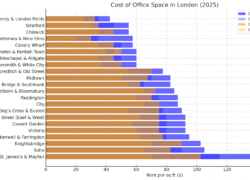
The limited availability of best-in-class office spaces has driven further increases in London’s prime office rents, with the West End core reaching £150 per sq ft—a new benchmark for the area. Other key submarkets also recorded growth, with the City at £85 per sq ft, while Shoreditch and Victoria saw their rental rates rise in response to demand.

By the end of 2024, prime rents across London continued their upward trajectory, supported by sustained occupier demand and a lack of premium stock. In the City core, prime rents edged up to £87.50 per sq ft, while Farringdon and Midtown recorded £95 per sq ft and £80 per sq ft, respectively.

These trends illustrate the emergence of a two-tier market, where demand for sustainable, high-quality spaces continues to drive rental appreciation, while lower-grade stock faces increasing pressure to modernize and align with evolving occupier preferences. As businesses place greater emphasis on ESG credentials and premium amenities, landlords of secondary office spaces must consider significant refurbishments or risk prolonged vacancies.

The financial sector emerged as the dominant force in London’s office market, accounting for 31% of total take-up in the most recent quarter. This was bolstered by major transactions such as Legal & General’s pre-let of 186,648 sq ft at Woolgate, EC2, demonstrating the industry’s ongoing commitment to securing prime, sustainable office locations.

The professional services sector followed closely, contributing 29% of total take-up. A standout transaction in this segment was BDO LLP’s 218,496 sq ft lease at The M Building, which marked the largest-ever letting in Marylebone and reinforced the sector’s preference for high-quality, centrally located developments.

The Technology, Media, and Telecommunications (TMT) sector remained a key driver of demand, accounting for 15% of overall leasing activity. Meanwhile, the public sector maintained its steady presence in the market, representing 8% of total take-up.

As London’s office market enters 2025, the flight to quality will continue to shape demand, with occupiers favoring buildings that offer top-tier sustainability credentials, premium amenities, and strategic locations. While challenges such as rising operating costs, regulatory pressures, and evolving workplace dynamics remain, the market is expected to maintain strong momentum, particularly in the prime and newly developed office segments.

With a tightening supply of premium office stock and increasing rental growth in core submarkets, landlords and investors who adapt to shifting occupier preferences will be best positioned to capitalize on London’s evolving commercial real estate landscape.

Source: oktra

Commercial Real Estate in 2025: Navigating Market Shifts and Financial Pressures

The commercial real estate (CRE) market is entering 2025 under significant pressure, facing a landscape shaped by rising interest rates, shifting work dynamics, and financial uncertainty. While the sector has already endured a period of turbulence, experts predict that the full impact of CRE loan losses will materialize gradually over the coming years rather than in a sudden crash. This slow unfolding of challenges will be influenced by economic factors, refinancing hurdles, and evolving investor sentiment.

Mounting Refinancing Challenges

One of the biggest concerns looming over the CRE market in 2025 is the wave of loan maturities set to come due. Many borrowers will be forced to refinance under financial conditions that are much less favorable than when their original loans were secured. Interest rates have risen significantly, making it unlikely that new financing will match the low-cost debt that fueled the sector’s expansion in previous years.

This situation presents a double challenge for property owners. Higher borrowing costs mean increased debt service, which could squeeze already tight cash flows. Additionally, lenders have become more selective, with many tightening credit standards or reducing exposure to certain CRE asset classes, particularly office properties. For some borrowers, access to refinancing may be limited or unavailable, increasing the risk of loan defaults and distressed asset sales.

Office Real Estate Faces Uncertain Future

Among the most vulnerable segments of the CRE market is the office sector. Despite some stabilization in demand for high-quality, well-located office spaces, the industry continues to grapple with the long-term effects of remote and hybrid work models. Many employees have yet to return to traditional office environments, leaving a significant portion of older office buildings underutilized or even obsolete.

The bifurcation in the office market is becoming more pronounced. Premium, modern office spaces with amenities that cater to evolving workforce preferences continue to attract tenants. However, older and less adaptable buildings face declining occupancy rates and falling valuations. With investors and lenders becoming more cautious about underwriting office loans, property owners of these struggling assets could face increasing financial distress.

The Impact of High Interest Rates and Valuation Adjustments

The sustained period of elevated interest rates has fundamentally altered the investment landscape for commercial real estate. Higher borrowing costs not only make refinancing difficult but also put downward pressure on property valuations. This is particularly evident in sectors that were already struggling with weaker fundamentals, such as office and certain retail assets.

As valuations adjust to the new interest rate environment, property owners and investors must navigate a changing market where deals that once made financial sense may no longer be viable. Cap rates have been rising across several asset classes, forcing sellers to either accept lower prices or hold onto properties in hopes of a future market rebound. Meanwhile, investors are taking a more cautious approach, focusing on assets with strong income potential and resilient demand drivers.

Where Are the Bright Spots?

Despite the challenges facing the broader CRE market, certain sectors are showing signs of resilience and even growth. Industrial real estate continues to benefit from strong demand driven by e-commerce, logistics, and supply chain expansion. Data centers, fueled by the increasing need for cloud computing and AI-driven infrastructure, are also attracting significant investor interest.

The multifamily sector, while facing its own set of affordability and regulatory challenges, remains a favored asset class for many institutional investors due to the persistent demand for rental housing. Similarly, niche property types such as life sciences facilities and medical office buildings are proving to be more insulated from the broader market downturn.

Outlook for 2025 and Beyond

Looking ahead, commercial real estate in 2025 will be shaped by a combination of economic forces, policy decisions, and evolving market dynamics. The ability of the sector to “weather the storm” will depend on how borrowers, investors, and lenders adapt to the new financial realities. While some distress is inevitable, it is also likely to create opportunities for well-capitalized players to acquire assets at attractive valuations.

The key themes for 2025 will revolve around refinancing risk, shifting property values, and the continued evolution of the office sector. Investors and market participants who can navigate these complexities strategically will be best positioned to capitalize on the opportunities that emerge in the next phase of the CRE cycle.

Source: comp.

Women in Master’s and PhD Studies in the EU: A Closer Look at Gender Representation

In 2022, women accounted for a significant majority of students pursuing master’s degrees across the European Union, while their representation at the doctoral level remained slightly below parity. According to recent data, out of 1.5 million master’s students in the EU, 905,678 were women, making up 58.6% of the total. At the doctoral level, however, female students represented 48.5% of the 99,204 enrolled candidates.

Women Dominate Master’s Studies in Most EU Countries

Women formed the majority of master’s students in nearly all EU countries, with one exception—Luxembourg—where gender parity was observed, with women making up 49.8% of students. The highest proportions of female students at this level were recorded in Cyprus (74.2%), Poland (67.3%), and Lithuania (66.1%).

At the doctoral level, gender representation varied significantly across member states. The lowest shares of women in PhD programs were recorded in Luxembourg (42.3%), Austria (43.3%), and Czechia (44.1%). In contrast, the highest proportions were found in Latvia (59.6%), Cyprus (58.0%), and Lithuania (57.4%).

Trends Over the Past Decade

Between 2013 and 2022, the proportion of women in master’s studies across the EU saw a slight decline of 0.4 percentage points. This drop was driven by decreases in 12 EU countries, with Latvia (-3.4 pp) and Hungary (-3.6 pp) registering the most significant reductions.

Conversely, the representation of women in doctoral programs rose by 1.0 percentage point over the same period, with 19 EU countries experiencing an increase in female PhD students. Cyprus recorded the most notable growth, with an 8.0 percentage point rise between 2013 and 2022.

Education: A Leading Field for Women

In terms of academic disciplines, women were overwhelmingly represented in education studies, comprising 75.6% of master’s students and 66.9% of doctoral students in 2022.

At the master’s level, other fields with a high proportion of female students included generic programs and qualifications (73.7%), arts and humanities (69.5%), and social sciences, journalism, and information (68.7%).

For doctoral studies, the most popular fields among women after education were health and welfare (60.9%), agriculture, forestry, fisheries, and veterinary sciences (57.5%), social sciences, journalism, and information (57.3%), and arts and humanities (53.3%).

Persistent Gender Gaps in STEM Fields

Despite their strong presence in education and social sciences, women remained underrepresented in STEM fields. In information and communication technologies (ICT), women accounted for just 26.2% of master’s students and 22.6% of PhD candidates. Similarly, in engineering, manufacturing, and construction, female representation stood at 33.4% at the master’s level and 32.7% at the doctoral level.

As efforts to bridge the gender gap in higher education continue, these figures highlight both the progress and the persistent disparities in academic fields across Europe.

Source: Eurostat

Czech employment rate rises to 75.6% in January 2025 while unemployment drops to 2.7%

The employment rate in the Czech Republic reached 75.6% in January 2025, reflecting a 0.1 percentage point increase compared to the same period in 2024, according to data from the Czech Statistical Office. The male employment rate stood at 81.1%, while the female employment rate was 69.8%.

The general unemployment rate, measuring the proportion of unemployed individuals within the economically active population, was 2.7% in January 2025. This marks a year-on-year decrease of 0.3 percentage points. The unemployment rate for both men and women remained equal at 2.7%.

Dalibor Holý, Director of the Labour Market and Equal Opportunities Statistics Department at the Czech Statistical Office, noted that the labour market remains stable, with the employment rate benefiting from increased female workforce participation.

The economic activity rate, which measures the proportion of economically active individuals aged 15–64, stood at 77.5% in January 2025, representing a 0.3 percentage point decrease compared to the previous year. The male economic activity rate was 83.0%, exceeding the female rate of 71.7% by 11.3 percentage points.

The data presented in the report are seasonally adjusted and derived from the Labour Force Sample Survey (LFSS), which is conducted by a network of interviewers in households. The LFSS methodology differs from administrative data collected by the Labour Office of the Czech Republic on registered job applicants. The survey follows internationally recognized definitions set by the International Labour Organization (ILO), ensuring comparability with data across EU member states.

The Czech Statistical Office regularly submits LFSS data to Eurostat, which publishes monthly unemployment reports for EU countries. In the broader 15–74 age group, the unemployment rate in the Czech Republic was 2.6% in January 2025.

The survey is conducted exclusively in private households, excluding collective accommodation facilities and temporary shelters. Historical data on employment and unemployment trends, starting from 1993, are available in the accompanying tables.

Source: Czech Statistical Office

Czech real estate prices rise in Q4 2024, apartments lead with 7% increase

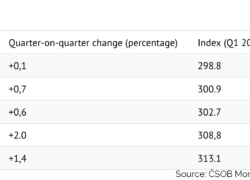
Real estate prices in the Czech Republic increased at the end of 2024, with apartments experiencing the highest growth. According to data from the ČSOB Housing Index, apartment prices rose by seven percent year-on-year in the fourth quarter. Family home prices increased by 4.8 percent, while land prices climbed by 6.4 percent compared to the last quarter of 2023. Prices also rose on a quarterly basis, with apartments seeing the largest increase of 3.4 percent, houses rising by 1.9 percent, and land by 1.4 percent compared to the third quarter.

Martin Vašek, CEO of ČSOB Hypoteční banka, stated that the Czech real estate market returned to growth in 2024, with a notable rise in demand for both newly built and older apartments in the fourth quarter. He noted that the average time required to sell an apartment has decreased to 3.8 months, reflecting stronger market activity.

The highest quarterly increase in apartment prices was recorded in the Moravian-Silesian Region, where prices rose by 4.6 percent. The Ústí nad Labem and Hradec Králové regions also saw an increase of four percent. Apartment prices in Central Bohemia and Prague grew by slightly less than four percent. Vašek attributed the rise in apartment prices to strong demand for homeownership, combined with a limited supply of available properties, which has driven price growth.

The index also indicated that the supply of older apartments declined, while new apartments from development projects have begun to re-enter the market. There was above-average interest in smaller apartments of up to 45 square meters. Rental prices have also increased, with an average year-on-year growth of 15 percent, the highest in the Olomouc Region.

Demand for houses remained lower than for apartments, and sales activity was still below pre-pandemic levels. The index noted that house sales were particularly slow in areas affected by September floods, as buyers wait for infrastructure repairs. The highest concentration of new house construction was in the Central Bohemian Region and near Brno, with construction activity supported by slowing growth in building costs.

Land prices continued their steady rise, as demand consistently exceeded supply. The index pointed to outdated zoning plans and limited utility capacity as factors constraining land availability, leading buyers to search for plots further from major cities.

Source: ČSOB Housing Index and CTK

Czech state budget deficit rises to CZK 68.6 billion in February

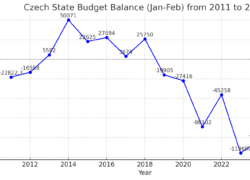
The Czech Republic’s state budget deficit increased to CZK 68.6 billion at the end of February, up from CZK 11.2 billion in January, according to data released by the Treasury Department. This marks the fourth-largest budget deficit since the country’s establishment. Finance Minister Zbyněk Stanjura (ODS) noted that despite the deficit, the year-on-year decline in the shortfall is a positive development, as the deficit in the first two months of last year reached CZK 102.5 billion.

State budget revenue amounted to CZK 296.5 billion at the end of February, an increase of 8.6% compared to the previous year. Meanwhile, budget expenditures declined by 2.8% year-on-year to CZK 365.1 billion. The finance minister explained that February is traditionally the weakest month of the year due to advance payments for education and the absence of revenue from quarterly tax advances. He emphasized that overall tax revenue is growing, reflecting wage increases and adjustments in tax allocation.

Raiffeisenbank analyst Martin Kron described the budget result as relatively positive but cautioned that it is too early to determine whether the full-year deficit target of CZK 241 billion will be met. He noted that upcoming months will be crucial in assessing the impact of the government’s fiscal consolidation package and the overall performance of the Czech economy. He also highlighted the long-term challenge of financing increased defense spending.

Komerční banka analyst Jaromír Gec indicated that if the full-year budget deficit aligns with government projections, the public deficit would stand at approximately 2.3% of GDP, an improvement from last year’s 2.7% and a figure significantly better than the EU average.

Tax revenues, including social insurance contributions, were the primary drivers of budget revenue growth in February. The collection of consumption and energy taxes increased, bringing in CZK 28 billion, a 14.9% year-on-year rise, partly due to stockpiling of tobacco products ahead of an excise tax increase. Personal income tax revenue rose by 10.6% to CZK 29.6 billion, largely due to wage growth. Value-added tax (VAT) remained the largest contributor to state revenue, generating CZK 66.1 billion, an increase of 8.7% year-on-year.

Total state expenditure fell by 2.8%, largely due to a reduction in energy subsidies, which cost the state CZK 12.5 billion less than in the first two months of 2024. Social benefits remained the largest expenditure category, amounting to CZK 155.3 billion, a 1.7% increase from the previous year, with pension payments accounting for CZK 121.2 billion.

Capital expenditures decreased by 16.7% year-on-year to CZK 17.4 billion, which the Ministry of Finance attributed to irregular financing of EU and Czech joint programs. The ministry also pointed out that capital expenditures tend to be low in the early months of the year, with investment activity typically increasing in the latter half.

For 2025, the state budget is set with revenues of CZK 2.086 trillion and expenditures of CZK 2.327 trillion, resulting in a planned deficit of CZK 241 billion. In 2024, the budget ended with a deficit of CZK 271.4 billion, the lowest since the start of the COVID-19 pandemic but still the fifth-largest in Czech history.

Source: CTK

LATEST NEWS