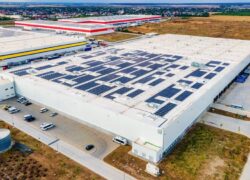
WDP to develop 54,000 sqm distribution centre at Bucharest – Ștefănești Park

WDP will launch the development of a 54,000 sqm sustainable distribution centre at WDP Park Bucharest – Ștefănești, Romania. The facility, which is being built for an existing client, is scheduled for completion by the end of 2026 and will be leased on a long-term triple-net contract with a minimum term of 15 years. The project reflects WDP’s ongoing partnership with an international retail operator and forms part of its broader strategy to utilise existing land reserves for scalable logistics developments.

The project, located on a 15-hectare site, includes the potential to expand the gross lettable area by an additional 20,000 sqm. The warehouse will be designed to meet high environmental standards, with the goal of securing BREEAM Outstanding certification. Planned features include photovoltaic panels and other energy-efficient technologies.

The investment budget is approximately €40 million, with projected returns aligned with WDP’s target thresholds for new developments in Romania. WDP Park Bucharest – Ștefănești already includes over 400,000 sqm of developed space and is positioned with direct access to Bucharest’s ring roads and key transport routes serving the wider region.

WDP continues to expand its portfolio of pre-let projects as part of a long-term approach to earnings growth. Since the beginning of the year, the company has added 150,000 sqm of new pre-let developments across its land reserves, reinforcing its focus on consistent portfolio renewal and strategic growth.

Futureal Energy launches international expansion under new brand

Futureal Group’s energy division is expanding into international markets under a new brand, Futureal Energy Partners. The move marks a shift from a domestic focus to a broader strategy aimed at supporting renewable energy investments across Europe. Daniel Szentirmai, recently appointed as CEO of the international platform, will lead the expansion and oversee strategic partnerships. The Hungarian operations will continue under the direction of Márk Balástyai.

Futureal Energy Partners will focus on investments in renewable energy projects, including onshore wind, solar, and energy storage. The goal is to support energy developers contributing to Europe’s shift toward carbon neutrality. The new platform was co-founded by Futureal Group’s founder and shareholder, Gábor Futó, and Daniel Szentirmai.

Szentirmai brings significant industry experience. He previously served as co-founder and senior principal at Renewable Power Capital, managing a renewable portfolio across six countries. Prior to that, he worked at GE Energy Financial Services, leading energy project acquisitions and sales in Europe and other regions.

The creation of Futureal Energy Partners builds on Futureal Group’s broader investment experience, aiming to diversify its portfolio by entering the energy sector on a European scale. The company states that it will continue to engage with renewable energy developers and invest in projects aligned with EU climate targets.

HSF System enters Austrian construction market

The international construction group HSF System, part of the European investment group PURPOSIA, has expanded into the Austrian market with the establishment of HSF System AT. Based in Enzesfeld near Vienna, the new company will focus on general construction, engineering, roofing and cladding services, as well as renovation work. This move aligns with HSF System’s broader strategy for growth across European markets.

HSF System has previously completed several projects in Austria, including developments for CTP, Hagleitner, and Hornbach, covering over 75,000 square metres in total. The new Austrian branch will formalise and expand these activities. Current work includes a project for Gebrüder Weiss. Country Manager Stefan Jansch brings 15 years of experience in the Austrian construction industry, having led both new construction and renovation projects for clients such as the Billa retail chain.

Founded in the Czech Republic in 2002, HSF System has grown to become one of the leading construction firms in both the Czech and Slovak markets. In 2024, it recorded revenues of €95.5 million in the Czech Republic and €59.8 million in Slovakia. The group’s combined annual turnover exceeds €160 million. It is supported by PURPOSIA Group, a holding of 42 companies including HSF System, with a focus on diversification and international expansion.

The group has been recognised with several industry awards, including the Czech National Award for Social Responsibility and Sustainable Development, the National Quality Award under the Excellence 2024 programme, and the Building of the Year award in 2020. Its founders, Jan Hasík and Tomáš Kosa, were national finalists in the EY Entrepreneur of the Year competition.

HSF System works with major investors and developers such as Panattoni, Erste Group Immorent, Contera, Arete, and Accolade. The company has acted as general contractor for Austrian firms including KIKA, DHL, and Gebrüder Weiss in both the Czech and Slovak markets.

In addition to its construction activities, the group has implemented sustainability practices in line with BREEAM and DGNB certifications and has adopted ESG reporting in accordance with upcoming EU regulations. It is also investing in digitalisation and automation of construction processes.

HSF System supports educational, cultural, and social initiatives across the regions in which it operates. These include university partnerships, a competition for secondary school students, and sponsorship of cultural events such as the Colours of Ostrava festival and the Karlovy Vary International Film Festival, along with various local organisations.

Paul Schockemöhle doubles space at ELI Opole, becomes largest tenant

European Logistics Investment (ELI) has announced a lease renewal and expansion at its logistics park in Opole, Poland. Paul Schockemöhle Logistics Polska has extended its existing lease and taken on additional space, bringing its total occupancy to approximately 10,000 sqm and making it the largest tenant in the park.

The facility, located on Partyzancka Street, comprises two modern warehouses with a gross lettable area of around 38,500 sqm. The park holds BREEAM certification at the “Very Good” level and offers Grade A logistics space. The additional leased space will support Paul Schockemöhle’s warehousing operations, with areas dedicated to rack storage to meet growing customer demand.

Paul Schockemöhle Logistics Polska specialises in storage and logistics services. The expansion reflects the company’s ongoing growth and its need for flexible and scalable warehouse solutions.

According to Pieter Prinsloo, CEO of ELI, the expansion underscores the strategic importance of the Opole park. He noted that ELI’s ongoing investment in quality infrastructure and its ability to respond to tenant requirements continues to attract leading logistics operators across the Polish market.

The park’s location offers strong transport connectivity. It is close to the A4 motorway, providing access to international airports in Wrocław and Katowice, and is also near the S11 expressway. Its proximity to downtown Opole and regional hubs, along with nearby public transport links, ensures accessibility for staff and suppliers.

Germany: Hands-on management boosts productivity in small businesses

Small business owners who actively engage in key management tasks can significantly improve their company’s productivity, according to a new study by the German Institute for Economic Research (DIW Berlin). The study, based on data from the Socio-Economic Panel (SOEP), is the first systematic analysis of how management practices in Germany’s small and micro enterprises influence business performance.

The findings show that many small business owners, particularly solo self-employed individuals, often focus primarily on operational tasks such as production and sales due to time and capacity constraints. As a result, activities like monitoring competitors or managing supply chains are frequently overlooked, which limits productivity potential. In contrast, business owners who take on a broader range of management responsibilities—including strategic planning and supply chain coordination—achieve noticeably higher productivity levels.

According to the study, when an entrepreneur in a small business performs one additional management task each day that was not previously part of their routine, productivity can increase by nearly 12%. Among solo self-employed individuals, the productivity gain is even higher, at around 14%.

“Professional management is not just relevant for large companies,” said Alexander Kritikos, DIW Executive Board member and head of the Entrepreneurship Research Group. “Structured and forward-looking management also provides clear benefits for small businesses.”

The study’s authors—Alexander Kritikos, Knarik Poghosyan, and Alexander Schiersch—emphasize the importance of improving management competencies in the small business sector. They call on business associations and chambers of commerce to provide more targeted support and training to address the specific challenges small businesses face.

“Better management skills can unlock significant productivity gains,” said Schiersch. “More focused initiatives from support organizations are needed to help small business owners develop these capabilities.”

Czech public wants greater state investment in affordable housing over transport

A recent survey conducted by residential developer Central Group reveals that 85% of Czech citizens believe the state should invest in affordable housing at least as much as it does in transport infrastructure. However, this sentiment contrasts sharply with current public spending. While approximately CZK 110 billion is being invested in transport projects this year, only a few billion crowns are allocated to public rental housing construction.

The survey, which gathered responses from 500 people across the Czech Republic, was presented at the Construction Industry Leaders Meeting. It shows that 51% of respondents believe housing and transport should receive equal investment priority, while 34% think affordable housing should be the higher priority.

Central Group founder Dušan Kunovský, citing these findings, criticised the imbalance in state investment, arguing that housing affordability remains one of the country’s most pressing challenges. He noted that despite public demand, government policy continues to focus disproportionately on transport. He warned that this imbalance could become a decisive issue in upcoming elections.

Central Group alone is currently investing over CZK 25 billion into residential projects in Prague, building more than 3,000 new apartments. This investment is more than three times the CZK 9 billion the state has allocated nationwide through the State Investment Support Fund and the National Development Bank. The developer also plans to begin construction on over 1,000 additional apartments this year.

The company argues that meaningful improvement in housing availability requires increased public sector involvement, not just in funding but also in organisational capacity. Unlike transport, which benefits from the support of the Transport and Energy Construction Authority (DESÚ), large-scale residential development lacks a similar institutional framework.

Kunovský advocates for a more collaborative model involving the private sector. One example is the DESIGN-BUILD system from the Initiative for Affordable Housing, which uses standardised designs to support efficient and scalable public construction.

He emphasises that new public housing projects alone are not enough. Speeding up permitting processes, reforming spatial planning, and reducing overregulation in the construction industry are also essential. Without these systemic changes, progress in improving housing affordability will remain limited.

Central Group has long called attention to the worsening housing situation and identifies four main areas requiring reform: faster and simpler permitting processes, reduced construction regulation, improved spatial planning to unlock more building land, and stronger municipal involvement in affordable housing development. These priorities align with recommendations made by the National Economic Council of the Government (NERV).

According to Kunovský, these steps are necessary to address the long-standing imbalance between demand and supply, which continues to push home ownership and rental costs out of reach for many residents across the country.

CTP begins construction of first two-storey industrial building in the Czech Republic

CTP has started construction on a two-storey industrial and logistics building at CTPark Brno Líšeň, marking the first development of its kind in the Czech Republic. Located on the former Zetor complex, the building will provide nearly 50,000 sqm of production, logistics, and service space when completed at the end of 2025.

This project follows a similar model used by CTP in the Netherlands and aims to address space limitations in urban areas by building vertically. Each floor will have separate freight access, allowing for independent operations and a more flexible layout. The structure is designed to handle high loads and accommodate a range of production technologies.

Sustainability measures are integrated into the project, including the use of waste heat from the nearby SAKO Brno incinerator, green infrastructure, electric vehicle charging stations, and recycled materials from the site’s previous buildings. More than 40% of the space has already been pre-leased. Preliminary earthworks are underway, with full completion expected by the end of next year.

The project is part of a wider redevelopment plan for the former industrial site. Alongside the new double-storey building, other areas are also being revitalized. A former forge is being replaced with a custom facility for a specific client, with demolition set to finish by August and new construction continuing through the end of 2025. Existing buildings are also being used temporarily; one has been converted into a cultural and creative community space with music studios, workshops, and small business facilities.

The development includes plans for public infrastructure such as a pedestrian and bicycle link to the nearby Stránská skála public transport stop and a parking area with over 300 spaces. CTPark Brno Líšeň currently hosts 22 companies and over 1,300 employees, with further growth expected.

The location has a long industrial history tied to the Zetor brand, which produced engines and gearboxes on the site since 1946. The new development seeks to maintain this heritage while providing updated facilities and infrastructure to meet current and future needs.

Romanian office demand stabilizes amid cost and uncertainty

Nearly 40% of office tenants now require employees to work from the office two to three days per week, while 1 in 8 occupiers is planning to expand its leased space, according to Cushman & Wakefield’s latest global survey, What Occupiers Want 2025. The report reflects a shift in workplace strategies as companies move from reactive downsizing to more structured portfolio management.

After two years in which approximately two-thirds of tenants reduced their footprint, the trend toward contraction is slowing. Only 32% of respondents anticipate further reductions. Average lease sizes have increased by 13% over the past two years, pointing to a cautious rebound in office demand.

Occupancy rates have also begun to stabilize, with usage now averaging between 51% and 60%. Although still below pre-pandemic levels of 65–75%, the trend indicates a gradual return to office-based work. Regional variations remain: while 20% of organizations in the Americas report occupancy rates above 50%, over 40% of EMEA and APAC-based firms report similar levels.

Cost continues to be the dominant factor in real estate decisions. Real estate leaders across sectors identify financial efficiency as their top business concern, with strategic choices increasingly tied to key financial indicators. However, ongoing uncertainty—including economic volatility, evolving workplace behavior, and challenges in measuring return on investment—continues to hinder long-term planning.

The report notes a decline in the perceived importance of ESG at a global level, with its strategic priority falling from fifth to eighth place compared to previous years. Nonetheless, ESG remains a higher priority in the EMEA and APAC regions, where many larger organizations continue to rank it among their top two concerns. In Romania, newer commercial buildings offer a comparative advantage for investors focused on sustainability, as modernization costs are lower. Additionally, new non-financial reporting requirements and tenant expectations are encouraging landlords to align properties with ESG standards despite cost constraints.

Another key trend is rising tenant expectations. Beyond high-quality space, occupiers increasingly seek enhanced amenities, services, and community-oriented features. According to the survey, 85% of tenants expect greater engagement from landlords, and 46% are willing to pay a premium for improved facilities.

Despite these changes, the core function of the office remains consistent—supporting collaboration, interpersonal relationships, and company culture. Yet only around 60% of employees feel their current workplace effectively supports these goals.

Commenting on the findings, Mădălina Cojocaru, Partner Office Agency at Cushman & Wakefield Echinox, noted: “Cost pressure stems directly from rising competition for high-quality and well-located office space. Accessibility and proximity to transportation remain critical, but surrounding amenities are increasingly seen as part of the value proposition. Today’s real estate strategies go beyond square meters—they must respond to employees’ needs. Romania’s modern office stock is well-positioned to support this shift, especially as sustainability becomes a greater focus in investment decisions.”

The What Occupiers Want 2025 report surveyed over 235 corporate real estate leaders representing companies with a combined global workforce of 8.1 million and more than 32 million square meters of office space. The study explores evolving decision-making priorities, location preferences, and shifts in how organizations approach workplace strategy.


Savills Czech Republic expands its valuation team with new appointments

Savills has expanded its valuation team through a combination of new hires and internal promotion. Daniel Duchek has joined the firm as a Senior Valuer, Alena Arnoldová has been appointed Junior Valuer, and Ivana Horáková has been promoted to Valuer. The team, led by Marek Pohl, now comprises seven consultants providing valuation services across various property sectors, including commercial, residential, hospitality, healthcare, leisure, and land.

Daniel Duchek brings a decade of experience in real estate valuation, particularly in the banking and financing sectors. He previously worked as an internal valuer at Fio Bank, focusing on development finance collateral in the Czech and Slovak markets, and at Moneta Money Bank, where he contributed to the development of automated valuation models and worked on a range of asset types.

Alena Arnoldová joins as a Junior Valuer after holding roles at RSM CZ as an International Contact Partner and Business Development Specialist. She also has experience in compliance and internal controls at Cofidis and began her career as an internal auditor at the investment company AVANT. She is currently studying Real Estate Valuation at the University of Economics in Prague.

Ivana Horáková has been promoted within the team, which continues to support clients with valuations that reflect current market conditions and regulatory requirements.

Union Investment secures long-term lease renewal and expansion with HIL in Bonn-Hardtberg

Union Investment has extended and expanded its lease agreement with HIL Heeresinstandsetzungslogistik GmbH for office space in Bonn-Hardtberg, reinforcing a long-standing tenant relationship. The agreement includes a ten-year extension on 8,680 square metres of existing office space and an additional lease of 2,170 square metres for the same term, addressing HIL’s growing space requirements.

HIL has occupied the property at Josef-Wirmer-Strasse 2–8 since 2005. The building has been part of the UII GermanM special real estate fund portfolio since 2016. With the new agreement in place, the total lease term for HIL could reach up to 30 years, marking a significant milestone in the fund’s asset management strategy.

Sven Lintl, Head of Asset Management Germany at Union Investment, commented on the deal: “The successful renewal and expansion of this lease highlights the value of stable, long-term partnerships in high-performing office properties. It also demonstrates the effectiveness of sustainable asset management and the importance of maintaining strong tenant relationships.”

Located in the western part of Bonn, the property sits in a district known for its concentration of office buildings and proximity to various federal ministries. The city centre is approximately 15 minutes away by car, adding to the property’s strategic appeal.

HIL GmbH, a federal government-owned company, provides planning, management, and execution of maintenance services for most of the Bundeswehr’s land-based military systems. Headquartered in Bonn-Hardtberg and employing around 3,000 people, HIL has supported the Bundeswehr since 2005, working closely with military logistics teams, defence technology firms, and SMEs in the sector.

LATEST NEWS