Union Investment sells Finsbury Circus House to Delancey and Aware Super joint venture

Union Investment has completed the off-market sale of Finsbury Circus House in London to DARE, a joint venture between Delancey and Australian investor Aware Super. The transaction represents one of the first significant prime office deals in the City of London in recent months, indicating renewed interest in high-quality office properties.

Union Investment initially acquired Finsbury Circus House in 1992 for its open-ended real estate fund, UniImmo: Deutschland. The property, originally leased in full to the Bank of Tokyo, underwent a redevelopment into a multi-tenant building in 2012 and 2013 following the tenant’s departure.

According to Union Investment, the sale is part of its strategy to optimize its portfolio and manage future capital expenditure risks. The company noted that the property’s location near Liverpool Street station and its quality were important factors in attracting interest from buyers. The sale proceeds will allow Union Investment to pursue new investment opportunities in London, which remains a key market for the firm.

DARE plans to incorporate Finsbury Circus House into its portfolio of prime central London offices. Delancey stated that the building’s location, close to transport links such as the Elizabeth Line and amenities, aligns with the types of assets sought by businesses looking for central London offices.

Aware Super, which has partnered with Delancey on the acquisition, sees opportunities to enhance the property’s value through sustainability-focused upgrades. The fund indicated that investments in prime central London offices, where market activity has been slower than occupational demand, remain a strategic focus for delivering returns to its members.

Following this transaction, Union Investment continues to hold eight office and hotel properties in London, valued at around €1.9 billion, alongside investments in other major UK cities and Dublin. Union Investment has operated an office in London since 2022 to support its UK and Ireland investment activities and is considering expanding into the UK residential market.

Advisers on the transaction included Travers Smith and CBRE for Delancey and Aware Super, and DLA Piper and JLL for Union Investment.

Poland unveils comprehensive plan for Ukraine’s reconstruction, eyes role for domestic companies

As Ukraine continues its daily struggle against Russian aggression, the international community is increasingly focused not only on immediate support but also on long-term plans for rebuilding the war-torn nation and integrating it with the European Union. At the recent Ukraine Recovery Conference held in Rome, Polish Prime Minister Donald Tusk presented a detailed vision for Poland’s role in this effort, positioning reconstruction as both a humanitarian duty and an economic opportunity for collaborative projects with mutual benefits. Discussions are already underway for Poland to host next year’s edition of the conference.

Since the outset of the Russian invasion, Poland has been one of Ukraine’s key allies, contributing more than 25 billion euros in humanitarian, military, and refugee aid. Building on this commitment, Prime Minister Tusk outlined a model for Poland’s engagement in Ukraine’s reconstruction, centered on the development of transport, trade, and investment. He emphasized that the reconstruction effort is not only about physical rebuilding but also about connecting Ukraine more closely with Europe, paving the way for its future EU membership.

In the area of infrastructure, Poland plans to enhance its road, rail, and communication networks. Currently, about 90 percent of military supplies headed for Ukraine transit through Polish routes. These same corridors are expected to carry the materials and goods necessary for Ukraine’s post-war reconstruction in the years ahead.

Tusk highlighted that while Poland remains firmly committed to supporting Ukraine in its conflict with Russia, it is also determined to ensure that Polish businesses can play a significant role in the reconstruction efforts and benefit from this extensive undertaking. He described ongoing discussions as promising for Polish enterprises looking to participate in rebuilding projects.

Poland already plays a crucial role in trade with Ukraine, accounting for 30 percent of the European Union’s exports to the country. As trade volumes grow, so too do opportunities for investment, underscoring the economic potential tied to the reconstruction process.

During the Rome conference, Tusk engaged in multiple bilateral and multilateral meetings. He participated in discussions with leaders from the United Kingdom, France, Italy, Germany, Denmark, and Ukraine, as well as officials from the European Commission and NATO. He also met separately with Italian Prime Minister Giorgia Meloni and Ukrainian President Volodymyr Zelensky. These conversations addressed potential facilitation for large projects involving Polish state-owned companies like Orlen and LOT, as well as banks and private enterprises that may require government support to engage in Ukraine.

Tusk explained that he and President Zelensky agreed on the need for a joint approach to certain business initiatives, allowing for simplified procedures and coordinated strategies between the two governments. He also held talks with Odile Renaud-Basso, President of the European Bank for Reconstruction and Development, to discuss financing prospects for projects in Ukraine.

Parallel discussions in Rome involved Polish ministers responsible for state assets, finance, development, and technology, who met with Ukrainian Deputy Prime Minister Yulia Svyrydenko and representatives of the Polish Development Fund (PFR Group). These talks focused on providing direct support for Polish companies planning to invest in Ukraine.

A significant outcome of the conference was the signing of a joint declaration between Poland and the United Kingdom to deepen cooperation in Ukraine’s reconstruction. The declaration outlines close collaboration in investments, reforms, and modernization efforts, and includes plans for a business forum to be held in Rzeszów, Poland.

Poland is now in discussions to host the 2026 edition of the Ukraine Recovery Conference. Tusk noted that holding the event in Poland would reflect the country’s key role in regional stability and its tangible contributions to Ukraine’s support infrastructure. He emphasized that Poland’s assistance to Ukraine goes beyond military or humanitarian aid, encompassing vital infrastructure such as roads, railways, the logistics hub in Rzeszów, and the Jasionka airport, all of which are critical to Ukraine’s current defense and future reconstruction.

The Ukraine Recovery Conference remains the leading international forum focused on Ukraine’s post-war rebuilding. It brings together representatives from governments, financial institutions, international organizations, businesses, local authorities, and NGOs to identify Ukraine’s reconstruction needs and develop practical solutions. Previous conferences have taken place in Lugano in 2022, London in 2023, Berlin in 2024, and Rome in 2025.

Source: gov.pl

Poland prepares for major changes to work seniority rules in 2026

Significant changes to Poland’s employment landscape are set to take effect in January 2026, with new regulations poised to redefine how work experience is calculated for millions of workers. The reform will extend seniority recognition to up to five million people, including those who previously worked under civil law contracts or operated as sole proprietors.

Experts from Personnel Service have analyzed the impact of the upcoming changes and highlighted several challenges facing employers and human resources departments. These include the need to review historical employment records and to update HR and payroll systems. For many workers, however, the changes offer an opportunity to reclaim years of work experience previously excluded from formal employment histories and to qualify for new employment benefits.

A report by the Ministry of Finance titled “Selected Aspects of Business Activity for 2019” indicates that sole proprietorships (JDG) remain the most popular form of business in Poland, accounting for over 80 percent of all business activities. At the end of September 2024, more than 2.4 million people in Poland were engaged under civil law contracts, with nearly half of them combining this work with other forms of professional activity.

According to Krzysztof Inglot, labour market expert and founder of Personnel Service, the reform represents a significant step toward equalizing employment rights. For many years, workers employed through civil law contracts or as sole proprietors lacked certain benefits, such as longer annual leave or severance pay. The new rules will allow them to have these years of work recognized, effectively recovering time that had previously gone uncounted.

The upcoming changes could allow many employees to surpass the critical threshold of ten years of professional experience, making them eligible for 26 days of paid annual leave. The revised rules might also affect notice periods and entitlements to benefits like severance payments during individual or group layoffs.

Beyond financial implications, the reform is expected to expand professional opportunities for individuals who have not met the experience requirements for positions in public administration or state institutions. The ability to document previous work periods outside of traditional employment contracts could grant more candidates access to recruitment processes that were once restricted to those with formally documented full-time work histories.

For employers, the new regulations signal a period of considerable organizational change. HR departments will need to begin auditing past employment records to identify workers who might now qualify for seniority recognition. Companies will also need to adapt their HR and payroll systems to accommodate the additional data and implement procedures for verifying documents submitted by employees. Training staff responsible for managing these processes and developing internal communications to inform employees will be essential.

The reform may also result in higher labour costs, not only because of potential increases in holiday entitlements or severance pay but also due to the administrative burden associated with processing claims for previously uncounted work periods. Employers will need to factor these changes into recruitment processes, particularly in cases where seniority influences eligibility for roles or determines pay scales and job levels. Many organizations will be required to adjust their existing operational standards to reflect the new legal framework.

Krzysztof Inglot emphasized that although the changes present significant challenges for employers, early preparation will be key to avoiding disruption when the regulations take effect. He suggested viewing the reforms as an opportunity for businesses to streamline processes, enhance transparency, and strengthen workplace culture, benefiting both employees and employers in the long term.

Source: Personnel Service

Global real estate markets show mixed results in early 2025

Global real estate markets delivered mixed performance through the first half of 2025, reflecting regional economic differences and shifting investor sentiment, according to the latest scorecards published by S&P Dow Jones Indices covering the first and second quarters of the year.

U.S. Real Estate Performance Softens in Q2

The U.S. real estate sector lagged behind global counterparts in the second quarter of 2025. The Dow Jones U.S. Real Estate Index slipped 0.4% in Q2 after modest gains earlier in the year. Despite the quarterly decline, the index posted a 10.3% gain over the past 12 months. Data Centers emerged as the strongest U.S. property segment in Q2, rising 7.0%, followed by Hotels with a 3.5% increase. However, Factory Outlets and Apartments declined sharply, dropping 8.7% and 7.0%, respectively .

Over the first quarter, the U.S. market showed modest positive returns. The Dow Jones U.S. Real Estate Index rose 3.5% in Q1, driven by strength in sectors like Health Care (+16.2%) and Industrial (+6.3%), while Data Centers and Hotels experienced negative returns .

Europe and Asia Lead Global Gains

Outside the U.S., real estate markets posted notable gains, especially in Europe and Asia. The Dow Jones Europe Select RESI Index surged 18.6% in Q2, while the Asia/Pacific Select RESI Index climbed 10.4%. Strong performance was observed in European offices and diversified sectors, while Asian gains were more broadly distributed .

In Q1, non-U.S. markets were more subdued, with indices such as the Dow Jones Europe Select RESI up only 5.1% and the Asia/Pacific Select RESI rising 7.3%. Still, these regions fared better than U.S. counterparts during the early part of the year .

Emerging Markets Show Strength

Emerging markets saw substantial advances in Q2. The S&P Latin America Property Index posted a significant gain of 19.3% for the quarter and an even higher 35.6% year-to-date return. The S&P Emerging REIT Index rose 12.5% in Q2, driven by gains in Latin America and parts of Asia. Key sectors like Retail and Office Space in emerging markets also delivered double-digit growth .

Earlier in Q1, the emerging markets were less consistent. The S&P Emerging Property Index declined 1.7%, reflecting weakness in Asia-Pacific, although Latin America began to show signs of recovery .

Sustainability and ESG Trends

Sustainable real estate investments continued to gain traction globally. ESG-focused indices, such as the Dow Jones Global Select ESG RESI, delivered positive results in both quarters. In Q2, the ESG RESI rose 2.5%, following a similar 2.4% gain in Q1. The data highlights investors’ sustained interest in ESG-oriented real estate strategies despite broader market volatility  .

Sector Highlights
• Data Centers showed divergent performance: strong in Q2 (+7.0% in the U.S. and +14.4% globally) after steep declines in Q1.
• Hotels rebounded slightly in Q2 (+3.5% in the U.S.) after negative returns in Q1.
• Industrial real estate faced headwinds in both periods, posting negative quarterly returns.
• Health Care remained a relatively stable sector, maintaining positive performance, particularly in Q1 with gains above 14% in some indices  .

Outlook

The scorecards indicate a real estate market that remains sensitive to interest rate movements, economic growth prospects, and investor appetite for both traditional and sustainable assets. While U.S. real estate showed mixed signals, international and emerging markets offered stronger returns in Q2, underscoring the global diversity of real estate investment performance so far in 2025.

Source: S&P Dow Jones Indices

EU population grows for fourth consecutive year

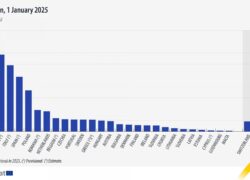
The population of the European Union reached an estimated 450.4 million people on 1 January 2025, reflecting an increase of just over one million compared with the previous year, according to data released by Eurostat. This marks the fourth consecutive year of population growth following a decline in 2021 linked to the impact of the COVID-19 pandemic.

The recent increase is largely attributed to higher levels of migration in the post-pandemic period. Since 2012, natural population change in the EU has been negative each year, with more deaths than births, but this has been offset by positive net migration flows.

Over the longer term, the EU’s population has expanded significantly, rising from 354.5 million in 1960 to 450.4 million in 2025, an increase of nearly 96 million. However, growth has slowed in recent decades. Between 2005 and 2024, the EU population grew by an average of about 0.9 million people per year, compared with roughly three million per year during the 1960s.

As of the start of 2025, Germany remained the EU’s most populous member state, with 83.6 million residents, representing 19 percent of the total EU population. France and Italy followed with 15 percent and 13 percent shares, respectively. Together, these three countries accounted for nearly half of the EU’s population.

While the overall EU population grew, eight member states recorded population declines over the past year. Latvia experienced the steepest drop, with a crude rate of change of minus 9.9 per 1,000 people, followed by Hungary, Poland, and Estonia.

Among member states with growing populations, Malta reported the highest increase at 19.0 per 1,000 people, ahead of Ireland at 16.3 and Luxembourg at 14.7.

Source: eurostat

Poland’s inflation expectations ease as future index continues decline

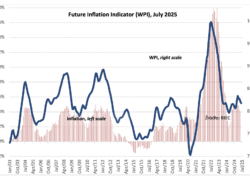
Poland’s Future Inflation Index (WPI), which signals expected movements in consumer prices over the coming months, fell by 0.3 points in July compared to June. This marks the fourth consecutive monthly decline, although the pace of decrease was slightly slower than in the previous month. The trend reflects lower readings in the country’s consumer price index (CPI).

Short-term factors, including modest increases in crude oil and certain metal prices on global markets, contributed to the slower decline in the WPI. Nonetheless, underlying conditions remain favorable for a further easing of inflation pressures. Analysts point to subdued economic activity, which is prompting businesses to maintain cautious pricing strategies, as well as relatively low commodity prices overall.

Inflation expectations among both consumers and managers in manufacturing continue to decline. While a majority in both groups still anticipate price increases, the gap between those expecting higher prices and those expecting stable or lower prices has narrowed in recent months. In June, the difference among managers was under four percentage points, down from over thirteen percentage points at the beginning of the year. This shift is visible in producer pricing trends, with the Producer Price Index (PPI) remaining negative for the past two years.

Similar sentiment is observed among consumers. Since January, the proportion of individuals anticipating higher inflation has decreased by nearly four percentage points. More consumers now expect price increases to slow rather than accelerate. Contributing factors include seasonally slower growth in fruit and vegetable prices and the continued cap on household energy prices, which is set to remain in place until the end of the year.

Global commodity prices have generally been declining since the start of 2025. However, recent days have seen increases in oil and certain metal prices, particularly copper, driven in part by new tariff measures announced by U.S. President Donald Trump. The Polish zloty has strengthened against the U.S. dollar over the past month, offsetting some of the dollar-denominated cost increases. Analysts note that markets appear more accustomed to fluctuations stemming from U.S. trade policies, which could help limit volatility in commodity prices moving forward.

DL Invest Group secures €350 million in debut Eurobond issue

DL Invest Group has raised €350 million through its first public Eurobond issuance, a significant step for the Polish commercial real estate developer and investor. Investor demand exceeded the offering volume by more than 60 percent, prompting a reduction in allocations. The bonds, which mature in five years, will be listed on the Luxembourg Stock Exchange. Citi acted as sole global coordinator, bookrunner, and ratings advisor for the transaction.

According to Dominik Leszczyński, Founder and CEO of DL Invest Group, proceeds from the bond issue will be used to support the company’s expansion in logistics, industrial real estate, and data centers, as well as to fund acquisitions of new projects in Poland and the wider Central and Eastern European region.

DL Invest Group operates a portfolio exceeding €1 billion in value, with assets spanning logistics and warehouse facilities, mixed-use complexes, retail parks, data centers, and renewable energy projects. The company manages properties occupied by more than 400 tenants and reports a portfolio occupancy rate of approximately 97 percent.

The company’s development strategy focuses on selective investment locations and projects tailored for long-term cooperation with tenants. It maintains integrated operations across development, construction, asset management, and property management, allowing it to adapt projects to tenant requirements and market demands.

DL Invest Group collaborates with various global corporations and institutional investors, including DHL, Inditex, Hutchinson, DPD, Avio GE, Emira Property Fund, Invesco Real Estate, Macquarie Capital, and the European Bank for Reconstruction and Development. Its financial partnerships extend to banks such as BNP Paribas, Santander, ING, and mBank.

In preparation for the bond issuance, the group obtained credit ratings from Fitch Ratings and Standard & Poor’s, which it says reflects the company’s financial stability and positions it for further activity in international capital markets.

Leszczyński noted that the Eurobond issuance underscores growing confidence in the Polish commercial real estate market and the broader economy, which he described as maintaining strong growth momentum within Europe.

DL Invest Group continues to pursue projects across logistics, office, and retail segments, emphasizing architectural quality, functionality, and rigorous execution standards. Its integrated business model enables it to oversee projects from design and development through to active asset and property management.

225-metre outdoor art gallery unveiled around Dornych construction site in Brno

The perimeter fencing around the Dornych construction site near Brno’s main railway station has been transformed into an open-air gallery stretching 225 metres. Over the past several days, thirty street artists from the Czech Republic, the Netherlands, and New Zealand have painted the solid barrier surrounding the site. The initiative was organised by the developer Crestyl in collaboration with the local association Panto Graff. The project required more than 1,800 cans of spray paint to cover the extensive OSB board wall.

The public can participate in selecting the best artworks by voting through the Streetart.Dornych Instagram account until 15 September. The top three artists will receive materials for future work valued at CZK 40,000 and an opportunity to create a special piece on the construction fence in Úzká Street.

Viktor Peška, sales and marketing director at Crestyl, explained that the goal was to avoid standard advertising fencing and instead enhance the site visually, involve the local community, and reduce the risk of non-artistic graffiti.

Ondřej Vítek, chairman of Panto Graff, described the project as a collaborative effort between Panto Graff, Crestyl, and construction firm GEMO, turning a previously grey wall into a canvas for artists. Each artist was assigned a space measuring 7.5 by 1.85 metres. All artworks were required to relate to the themes of the local area, Brno, trains, or construction.

Artists participating in the project include wosk, oliver, furie, pauser, guilty, spord, silver, trip, ding, rwek, 8Rox, mello, scim, noee, lotr, maroko, tofee, veud, keim, duroy, rhak, inlove, part, optik, miser, traum, robot, dose, and sklon. GEMO, alongside Crestyl and Panto Graff, also contributed to the initiative.

The Dornych project itself involves the redevelopment of the former department store area into a mixed-use space covering 25,000 square metres. The plan includes six smaller buildings that will accommodate the NYX Hotel Brno with 170 rooms, 186 rental apartments, and approximately 50,000 square metres of offices, restaurants, shops, and services. Notable tenants will include the EUC clinic, offering medical services and two pharmacies across 6,000 square metres, and Scott.Weber Workspace, which will establish the largest flexible office and co-working centre in the South Moravian Region on 5,200 square metres, including facilities for 600 employees and a private terrace of 500 square metres. The development will also feature 5,000 square metres dedicated to restaurants, bars, and cafés.

The buildings will range from seven to eight floors and include underground parking. The project will integrate with the existing street network and the underpass beneath the railway station, creating a link between Brno’s historic city centre and the planned South Quarter. The total investment exceeds seven billion Czech crowns. The project’s architectural design is led by international firm MTDI, headed by Marek Tryzybowicz, in cooperation with Brno’s Arch.Design studio. RUBY Project Management is overseeing the entire development process, while GEMO is handling demolition, excavation, and structural works.

GCC Fixed Income Market Faces Shifts Amid Global Uncertainty

The Gulf Cooperation Council (GCC) fixed income market is navigating a complex landscape in 2025, shaped by global monetary policy shifts, geopolitical tensions, and evolving investor sentiment, according to the latest GCC Fixed Income Market Update from Kamco Invest.

Global Volatility Shapes Outlook

Global debt markets hit record highs in the first half of 2025, with issuances reaching $6.4 trillion despite an 8% quarter-on-quarter drop in Q2. High-grade issuances dominated, while high-yield activity remained flat. Notably, green bond issuances fell to a three-year low of $267.7 billion in the first half.

In the U.S., treasury yields have fluctuated, with the 10-year yield declining from May highs of 4.6% to around 4.3% by July. The Federal Reserve remains cautious on rate cuts, with decisions hinging on the inflationary impact of new tariffs. Meanwhile, Europe has moved in the opposite direction, with the European Central Bank cutting rates four times this year to support a slowing economy.

GCC Market Adapts to Global Dynamics

GCC central banks largely mirror U.S. monetary policy due to currency pegs, though Kuwait, whose dinar is pegged to a basket of currencies, has charted a more conservative path. While other GCC nations cut rates by 100 basis points in 2024, Kuwait opted for a modest 25-basis-point cut.

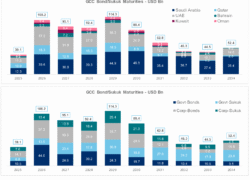
Economic prospects in the GCC remain supported by resilient non-oil sectors and stable oil prices around $70 per barrel. However, the region faces significant debt maturities. Sovereign and corporate maturities across the GCC are projected to total nearly $449 billion between 2025 and 2029, with Saudi Arabia leading at $166 billion.

Issuances Decline, But Outlook Remains Solid

Primary market issuances in the GCC totaled $100.3 billion in H1-2025, a 22% drop from the same period in 2024. Government issuances halved to $36.6 billion, while corporate issuances rose to $63.7 billion, partially offsetting the decline. Sukuk issuance saw a sharper contraction, falling nearly one-third to $39.4 billion.

Country-wise, the UAE posted slight growth in issuances, while Saudi Arabia, Qatar, and Oman witnessed significant declines. Saudi issuers remained dominant, accounting for half of the region’s issuance despite a steep year-on-year decrease.

Green instruments maintained momentum in the region, with $8.7 billion issued in H1-2025. Saudi Arabia led the segment with $5.6 billion in green debt, underscoring the region’s gradual pivot toward sustainable financing.

Rate Cuts Expected to Shape Second Half

Looking ahead, Kamco Invest forecasts that GCC central banks will likely mirror any U.S. Federal Reserve rate cuts later this year. Issuance volumes are anticipated to pick up in the second half, as issuers seek to lock in lower rates amid growing expectations of monetary easing.

Moreover, Kuwait has announced plans to issue $6 billion in bonds on international markets, which could further bolster regional issuance figures.

Despite near-term headwinds from global economic shifts and geopolitical tensions, the GCC fixed income market appears poised to maintain stability, underpinned by robust sovereign credit profiles and steady economic fundamentals.

Churchill Square adopts drone technology for facade cleaning

The method of cleaning building facades and windows is undergoing significant changes, with drones beginning to replace traditional suspended platforms and chemical-based cleaning solutions. This new approach has the potential to reduce costs by nearly half, improve safety conditions for workers, and lower environmental impact. The trend has started to appear in the Czech Republic, including in historic city areas where commercial buildings owned by Českomoravská Nemovitostní (ČMN), such as Churchill Square and Mezi Vodami, are being cleaned using drone technology.

The cleaning process involves drones spraying demineralized water heated to 70°C, which removes dirt without relying on aggressive chemicals. This method is particularly suitable for historic buildings where chemical cleaning agents could damage delicate plasterwork or building materials.

Petra Vondrová, Senior Property Manager of the Churchill building, noted that her team is always exploring new ways to enhance services. After learning about drone-based cleaning, they decided to test it on the Churchill building due to its large facade surface area. According to Vondrová, the results were positive, with tenants expressing satisfaction and passersby taking an interest in the operation of the drones.

Cost efficiency is one of the main advantages of using drones, as the process requires fewer workers and can be carried out more quickly than traditional methods. Dita Lawn, Senior Property Manager at the Mezi Vodami building, explained that initial reservations about the technology were quickly overcome once they observed its effectiveness and cost benefits, allowing for future investments in other innovations.

Safety is another significant factor influencing the move towards drone cleaning. Traditional methods involving workers suspended at height carry inherent risks, whereas drone operations involve a team of just two individuals—a pilot and a safety technician—reducing potential hazards and associated costs.

Environmental considerations also play a role, especially in historic city areas where maintaining the integrity of building materials is crucial. The absence of harsh chemicals in the drone cleaning process helps prevent damage to facades, making it an appropriate solution for sensitive sites.

Encouraged by the successful pilot cleaning, ČMN plans to implement drone cleaning technology across other properties in its portfolio. CBRE, which also took part in the testing phase, has begun introducing the method in some of its own buildings.

Although drone-based facade cleaning is not yet a standard practice, companies such as ČMN are helping to increase its adoption. The combination of environmental benefits, reduced costs, and improved safety suggests that drone technology could play a larger role in building maintenance in the years to come.

LATEST NEWS