PORR reports higher earnings and record order backlog in first half of 2025

Construction group PORR posted stronger results across key metrics in the first half of 2025, highlighting improved earnings, a larger project pipeline, and record levels of orders.

The company reported EBIT of €48.7 million, up 15.5% compared with €42.2 million a year earlier. Revenue rose slightly to €2.96 billion, while production output increased by 1.8% to €3.17 billion. The EBITDA result also grew by 3.6% to €153.4 million, supported in part by lower costs for external services.

Order intake expanded by 25.4% year-on-year to €4.05 billion, driving the company’s order backlog to a historic high of €9.42 billion, an increase of 10%. Infrastructure projects continue to account for the majority of work, representing more than 60% of the backlog.

CEO Karl-Heinz Strauss noted that PORR has secured several major projects, including a €425 million rail line in Romania between Craiova and Caransebeș and Poland’s longest rail tunnel in Łódź, valued at about €400 million. Other recent wins include healthcare and industrial facilities in Poland, Germany, and Austria, as well as educational projects in Germany. “Infrastructure expansion in our home markets has gained momentum, and we are also seeing renewed activity in building construction,” Strauss said.

Within its international operations, the company reported a 19.6% rise in infrastructure output, supported by large-scale tunnel and energy projects such as the ElbX tunnel in Germany and hydro storage facilities. PORR continues to focus on its seven core European markets, which together generate over 98% of group output.

From a financial perspective, PORR’s balance sheet remains stable. As of June 30, 2025, total assets stood at €4.27 billion. Equity rose to €855 million, lifting the equity ratio to 20% compared with 19.4% a year earlier. Net debt decreased by 7.9% year-on-year to €301 million. Earnings per share improved by 17.8% to €0.53.

Looking ahead, PORR expects moderate growth in both revenue and profit for the full year, with management guiding for an EBIT margin between 2.8% and 3.0%. By 2030, the company is targeting an EBIT margin of 3.5% to 4.0%.

Strauss pointed to growth opportunities in European infrastructure related to the energy transition, digitalization, and transport networks. At the same time, he cautioned that ongoing geopolitical risks could weigh on economic activity and project development.


Steve Toy, CEO of Memrise: “We’re creating structured immersion powered by AI”

In a recent Q&A with CIJ EUROPE, Steve Toy, CEO of Memrise, discussed how the company is reshaping language learning through AI-driven tools, immersive video, and personalized study paths. He also outlined Memrise’s evolving approach to community-created content, its decision to remain focused on language learning, and the early impact of its latest AI integrations.

Q: How are the new features – like AI chatbots, immersive video, wordlists, and “My Journey” – enhancing learners’ ability to speak confidently in real life?

“Our new features work together to mirror the natural immersion experience that occurs when someone moves to a foreign country – but in a structured, accessible way through technology,” Toy explained.

He highlighted the role of AI-driven chatbots, powered by Memrise’s “Membot” technology, which provide “batting practice” for conversations. Learners can rehearse ordering coffee, asking for directions, or even handling job interviews in a low-pressure environment. “This builds the confidence muscle that’s essential for real-world communication,” he said.

The addition of immersive video content featuring native speakers bridges the gap between memorizing vocabulary and recognizing natural speech patterns. Wordlists allow users to prioritize the vocabulary most relevant to their goals, such as business or travel, instead of following a generic curriculum. Finally, the “My Journey” feature gives learners a sense of progression across Memrise’s three pillars: Learn, Immerse, and Communicate.

“Together, these features create what one could call a structured immersion,” Toy noted. “It’s like being dropped into a foreign country, but with the safety net and progression that technology can provide.”

Q: Why has Memrise shifted emphasis away from community-created courses toward official curated content?

According to Toy, the change is a technical and pedagogical necessity. “To deliver truly personalized, AI-powered language learning, we need a standardized, high-quality dictionary as the foundation,” he said. Community-created courses, though valuable, often lack consistent audio, grammar data, and semantic links, limiting what AI-driven features can offer.

That doesn’t mean community content is gone. Toy described a future integration where user-created word lists will be mapped to Memrise’s standardized dictionaries. “Think of it as building the infrastructure first, then reconnecting the community,” he explained. “A community course about medical Spanish, for example, will soon benefit from our full suite of AI tutors, immersive videos, and adaptive algorithms.”

Q: Could Memrise’s adaptive AI methodology expand into other subject areas?

Toy was clear: not in the near term. “Language learning represents a unique pedagogical challenge that maps perfectly to our expertise and methodology. We’re language learning experts, not generalist educators,” he said.

He contrasted Memrise’s approach with competitors. “Compare this to Duolingo, which prioritizes engagement and gamification over domain-specific pedagogy. They can expand across subjects because their model is content-agnostic. We’ve chosen the opposite path – we prioritize learning efficacy over broad applicability.”

While acknowledging that the company’s AI infrastructure could theoretically support other domains, Toy said this would only happen if Memrise could bring the same level of subject expertise to ensure results.

Q: How has AI integration – chatbots, YouTube content, immersive lessons – impacted user engagement?

“The impact has been remarkable,” Toy said. Since launching Memrise Connect, the company has recorded its highest retention rates in years, both for new and existing users.

Although long-term outcome data takes time to measure, Toy said early signs are promising. “Engagement patterns are extremely positive, and our early cohort data suggests significantly improved progression rates.”

WING’s hospitality strategy expands through adaptive reuse and brand partnerships

As international travel continues its rebound across Central Europe, Hungarian developer WING is expanding its hospitality portfolio with a focus on adaptive reuse, brand diversification, and airport hotel development. CIJ Europe conducted a Q&A with Dr. Ernő Takács, Deputy CEO of Hotels & Commercial Properties at WING, examining how the company is positioning itself in response to evolving travel trends and market dynamics.
WING’s hospitality activity in Hungary now includes more than 1,000 completed hotel rooms across multiple brands. The company’s most recent projects include the ibis & TRIBE Budapest Stadium and the TRIBE Budapest Airport Hotel—developments that reflect a broader push to introduce global brands and sustainable standards to the local market. Both projects are targeting BREEAM Excellent and Access4you Gold certifications.

“The performance of these hotels has been steady, and we’re seeing improved guest feedback as tourism continues its post-pandemic recovery,” said Dr. Takács. “Budapest remains competitive due to its infrastructure and pricing, but still has room for growth compared to other cities in the region.”

WING is also preparing to open Hotel Indigo Budapest Andrássy, a 103-room property that will feature food and beverage services in the premium segment. The project involves the conversion of an existing office building on Andrássy Avenue and is slated for completion in 2027.

Airport-related developments have emerged as a priority. WING opened the ibis Styles Budapest Airport Hotel in 2018, followed by the adjacent TRIBE Budapest Airport Hotel, developed in partnership with Accor and Budapest Airport. Takács notes that airport traffic is expected to reach 20 million annual passengers in the coming years, supporting continued investment in this subsegment.

Looking ahead, WING is exploring new developments and acquisitions across several categories. These include lifestyle hotels, extended-stay concepts, and select opportunities in the luxury market. In addition to ground-up construction, the company is assessing existing properties for conversion and modernization.

“Our partnerships with international hotel brands provide access to established systems and recognition, but we also remain open to alternative models,” said Takács. “Flexibility is key when aligning project goals with operator expectations.”

As adaptive reuse becomes increasingly relevant in urban development, WING’s hotel division appears poised to integrate architectural repurposing with broader sustainability and commercial goals—although full execution and market impact remain to be seen.

Photo: Dr. Ernő Takács, Deputy CEO of Hotels & Commercial Properties at WING

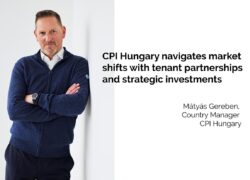
CPI Hungary navigates market shifts with tenant partnerships and strategic investments

In a Q&A interview with CIJ EUROPE, Mátyás Gereben, Country Manager at CPI Hungary, shared insights into the company’s current market position, strategic focus areas, and future plans amid a challenging economic climate.
CPI Hungary remains one of the leading real estate owners and asset management firms in Hungary, managing a portfolio valued at over €1.3 billion and comprising approximately 650,000 sqm of gross leasable area across office, retail, and hotel segments. Gereben emphasised that the company’s efforts are balanced across these asset classes, with a strong emphasis on forging deeper partnerships with tenants. Instead of maintaining a traditional landlord-tenant relationship, CPI Hungary aims to understand and align with tenants’ needs, creating mutual benefits and longer-term stability.

Addressing shifting market dynamics, particularly in the office and retail sectors, Gereben highlighted CPI’s proactive approach to environmental, social, and governance (ESG) goals and evolving workplace trends. CPI Hungary has long positioned itself as an environmentally conscious player in the market. The company has implemented various initiatives to enhance its ESG performance, including 360-degree selective waste management, consumer-side electricity optimisation, adaptive building management systems, a 100% LED lighting programme, and the expansion of green spaces. Notably, nearly 70 percent of CPI’s office tenants have signed green leases, reflecting a shared commitment to sustainability and collaborative thinking for long-term success.

Economic and regulatory changes in Hungary have presented significant challenges for the real estate sector. Gereben noted that Hungary currently faces the highest economic and political risk levels in the Central and Eastern European region, which has implications not only for investments and development decisions but for the broader business environment. The relocation of approximately 500,000 sqm of government institutions from commercial office space into state-owned properties has contributed to increased vacancy in the office sector, complicating new development prospects. Despite these challenges, CPI Hungary maintains a cautiously optimistic outlook, seeking opportunities where long-term business cases remain viable. Recently, the company completed a comprehensive refurbishment of a downtown hotel and is preparing to commence development of a retail park in north-eastern Hungary in the coming weeks.

Looking at future initiatives, Gereben confirmed that CPI is actively working on repositioning parts of its portfolio in response to current market demands. This strategy includes converting some Class B office buildings into hotels or residential units, reflecting a flexible approach to asset management and market realities.
Over the next 12 to 18 months, CPI Hungary’s priorities will centre on tenant retention, portfolio optimisation, and sustainable capital expenditure. The company has established the CPI Club, an initiative designed to enhance tenant relationships and provide complex services tailored to tenants’ evolving needs. In addition, CPI remains focused on generating long-term value through smart and sustainable investment strategies, while also considering the repositioning or disposal of non-core assets to refine its portfolio and strengthen its market position.

Through this combination of adaptability, tenant-centric management, and sustainable investment, CPI Hungary is positioning itself to navigate both the immediate challenges and future opportunities within Hungary’s real estate market.

Source: CIJ EUROPE

Rising labor costs and staff shortages drive interest in process outsourcing in Poland

Poland’s labor market continues to show signs of strain as wages rise and companies struggle to fill vacancies, particularly in logistics and manufacturing. According to data from the Central Statistical Office (GUS) and the Gi Pro 2025 salary report, the average gross salary in the enterprise sector has now exceeded PLN 8,900, while the median salary in the national economy is above PLN 6,800. At the same time, the logistics sector’s vacancy rate stands at 1.16%, underscoring the persistent difficulty employers face in maintaining operational continuity.

The Gi Pro 2025 report highlights ongoing challenges across industries. In logistics, 44% of companies said job candidates withdrew during the recruitment process, and 41% reported skill mismatches. Manufacturing firms most frequently cited excessive wage demands and difficult working conditions as key obstacles, with 36% pointing to these issues. Despite these barriers, demand for workers remains high. At the end of the first quarter of 2025, there were over 21,600 vacancies in manufacturing and more than 10,000 in logistics, with strong demand for machine operators, packers, warehouse staff, forklift operators, and fitters.

Employers are also reporting high turnover in entry-level positions, with some companies experiencing double-digit monthly rates. Seasonal workload peaks add further strain, and many businesses admit they cannot meet all orders. Despite this, 82% of surveyed manufacturing and logistics companies say they do not plan to expand permanent employment, citing economic uncertainty and the limited pool of available candidates.

Official statistics show wages rising rapidly, with GUS reporting a 9% year-on-year increase in June 2025. At the same time, employment in the enterprise sector fell by 0.8% year-on-year, suggesting that firms are unable to expand full-time headcount in proportion to their needs. The costs of absenteeism, recruitment, and onboarding are also increasing, leading some employers to question the sustainability of a traditional full-time hiring model.

“In many companies, the full-time model is no longer viable, not only financially but also operationally,” said Jakub Kizielewicz, CEO of the Opteamic Group, a process outsourcing provider. “Hiring permanent staff for seasonal or unpredictable tasks is increasingly seen as a risk. More companies are asking us to take over the process itself, deliver the results, and relieve them of managing daily operations.”

Process outsourcing differs from temporary staffing in that the service provider assumes responsibility for an entire operational process. This includes building team structures, managing supervision, ensuring quality control, and delivering results based on agreed performance metrics. The client does not manage individual workers but instead receives outcomes such as on-time deliveries or completed production runs.

This model is particularly attractive in industries with seasonal or project-based fluctuations, including logistics, contract manufacturing, food processing, and distribution. Companies adopting process outsourcing can achieve greater predictability and reduce the burden on internal teams, allowing management to focus on business development rather than day-to-day operations.

According to the Gi Pro 2025 salary report, firms are increasingly evaluating employment costs in a broader sense – not just wages, but also indirect expenses linked to turnover and inefficiencies. In this environment, models that prioritize flexibility, standardization, and accountability for results are expected to play a growing role.

First lease signed at renovated PRISMA office building in Frankfurt

Sonar Real Estate has signed the first lease at PRISMA, a major office redevelopment project in Frankfurt’s Lyoner Quartier. IT consulting firm adesso SE has committed to around 6,500 square metres of office space, marking the beginning of the active leasing phase for the building.

The office space is scheduled for occupation in spring 2026, once the fit-out is completed. According to adesso SE, the decision to remain in Lyoner Quartier was based on both the building’s flexible design and its sustainable refurbishment.

PRISMA comprises approximately 50,000 square metres of gross floor area, including 44,000 square metres of office space. The property, acquired in 2022 by Sonar Real Estate together with a fund advised by Patron Capital Advisers, was previously occupied by Deka Bank. The building has since undergone a comprehensive renovation designed by Holger Meyer Architekten, focusing on energy efficiency, flexibility, and ESG compliance.

Sonar reports that primary energy consumption has been reduced by 55%, allowing the building to meet the KfW 55 standard. Projected CO₂ emissions are under three kilograms per square metre per year, equivalent to 42% lower emissions compared with a conventional new build. The project is targeting DGNB Platinum and BREEAM Excellent sustainability certifications.

A reuse approach has also been integrated into the refurbishment. Fixtures, materials and furniture were evaluated for reusability, with many items reintegrated into the building or redirected into the material cycle.

Beyond office space, PRISMA will include a 3,000-square-metre atrium accessible to the public, with facilities for catering, co-working, conferences, and exhibitions. Additional amenities include a planned restaurant, fitness centre, and event space.

The renovation is due for completion by the end of 2025. Sonar says further leasing discussions with potential tenants are ongoing.

Savills advised the owner, JLL acted for the tenant, and Gowling WLG provided legal counsel.

Poland absent from Washington meeting on Ukraine amid internal power dispute

Poland was notably absent from a high-level meeting at the White House in Washington on 18 August, where U.S. President Donald Trump hosted Ukrainian President Volodymyr Zelenskyy and several European leaders to discuss Ukraine’s security guarantees. Neither President Karol Nawrocki nor Prime Minister Donald Tusk were present, sparking criticism and debate within Poland.

President Nawrocki later said that the “coalition of the willing” — a group of 33 countries backing Ukraine — participated via video on 17 August, with Foreign Minister Radosław Sikorski representing Poland in that call. He also emphasized that it was Zelensky who extended invitations to European leaders, implying no formal invitation was issued to Poland for the Washington meeting.

Georgette Mosbacher, a former U.S. ambassador to Poland, attributed responsibility to the president’s administration, stating: “They were waiting for an invitation to the White House.” She also highlighted the symbolism of Nawrocki’s upcoming White House visit in September, affirming Poland’s important role to the U.S.

Sources further confirmed that President Nawrocki is scheduled to meet President Trump at the White House on 3 September, with the invitation having been extended via a congratulatory note following his inauguration.

At the same time, Prime Minister Tusk remains focused on coordinating support for Ukraine through European Union mechanisms, including engaging in what he described as a “coalition of the willing” for unified political and military backing. These overlapping approaches have exposed a growing rift in how Poland executes foreign policy, with both leaders sending conflicting signals, and critics warning of a divided national voice.

Source: Warsaw Enterprise Institute (WEI)

Savills warning: Energy performance certificates fail to reflect real building efficiency in Prague

A recent internal survey by Savills covering numerous office buildings in Prague findings reveal that, on average, only 14% of properties hold Energy Performance Certificates (EPCs) rated A or B. Most buildings fall into class C or lower, or lack EPC data entirely. Older buildings, which are less likely to share their energy credentials, are frequently missing documentation and are the ones most in need of modernization to meet future legislative standards.

Jan Jurčíček, Head of Building & Project Consultancy at Savills, emphasized the limits of relying solely on EPCs. “The situation is further complicated by the fact that energy performance certificates (EPCs) often have limited informative value. For older buildings, the EPCs are either overestimated—due to outdated methodology—or underestimated if post-certificate improvements haven’t been reflected,” he said. He noted that EPCs are based on model conditions—such as set indoor temperatures and standard operating hours—that often do not match real-world usage. “Actual energy consumption of office buildings can exceed EPC figures by tens of percent,” Jurčíček added.

EPCs are often treated as guarantees of sustainability, a practice Savills warns against. “Energy Performance Certificates are often mistakenly considered a guarantee of sustainability or a low-carbon footprint. In reality, they only assess the building’s energy performance against legislative requirements, and do not always reflect the overall carbon footprint or operational efficiency,” stated Barbora Jansová, ESG Consultant & Project Manager at Savills. She highlighted that EPC standards vary across versions and jurisdictions, making comparison difficult. Nonetheless, EPCs remain relevant from a regulatory standpoint. “For financing institutions, an EPC is certainly a valuable and measurable input within their ESG strategy, but it is by no means the only factor,” Jansová said.

In parallel, the revised Energy Performance of Buildings Directive (EPBD) introduces mandatory requirements that signal a shift from voluntary measures to binding regulations. According to EU sources, it must be transposed into national laws by 29 May 2026, and requires member states to renovate the worst-performing 16% of non-residential buildings by 2030, and 26% by 2033. New constructions from 2030 must be zero-emission buildings. Additionally, the directive introduces digitalized EPCs and Building Renovation Passports to guide staged energy upgrades. The EPBD’s intent is to decarbonize the EU’s building stock by 2050, reducing energy consumption while at the same time promoting transparency and financial support structures for sustainable renovation efforts.

Savills warns that outdated EPCs are becoming increasingly insufficient tools. With legislation approaching, property owners must go beyond historic certificates. They should consider carbon footprint analyses, CRREM risk assessments, or EU Taxonomy alignment to manage long-term environmental risks and maintain asset value.

West Group completes acquisition of iResidence project in Northern Bucharest

West Group has concluded the full acquisition of the iResidence residential project in northern Bucharest, a location noted for its convenient access to major traffic routes, business centers, retail hubs, and reputable schools. The transition was completed under legally agreed commercial terms, ensuring that construction continues uninterrupted and maintains its existing quality standards.

“We have completed the transfer of the project company and kept the construction site in normal operation. Through this acquisition, we bring clarity, financial discipline and additional resources to deliver iResidence at the quality level promised to our clients,” said Dan Crăciunescu, founder of West Group.

The iResidence development will feature 520 apartments, each including at least one parking space and a storage unit within a two-level underground area. In the first phase of construction, the structural framework for 260 apartments is complete. Detailed progress across site buildings includes exterior joinery completed in building B3, masonry work concluding in B1, and upcoming electrical and plumbing installations at B3. Window installation for buildings B1 and B2 is scheduled for later this autumn.

So far, 105 apartments and two commercial units have been sold, amounting to approximately €17.5 million in total sales . The project is backed by a balanced financing structure: €18.8 million in equity, €5 million from banking loans, and around €7.7 million from client down payments. Additional financing is being negotiated to accelerate progress.

Mr. Crăciunescu added, “Buyer interest in iResidence apartments remains steady, and the financing structure gives us confidence to maintain progress and communicate transparently. In the Pipera area, monthly mortgage payments can be about 25% lower than rents for comparable properties, making ownership a more attractive long-term option”.

West Group is also offering attractive purchasing terms, including a 1% down payment upon signing the pre-contract, a 10% discount from listed prices, and a payment schedule tied to construction milestones—30% after installing exterior joinery, 30% at façade completion, 30% following screed pouring, and the remaining 9% upon signing the final sales contract.

The project is designed as a sustainable, inclusive residential community. It will include a 15,000 m² private park featuring playgrounds and bike paths, a wellness center with a swimming pool and gym, a retail gallery, and aims to achieve BREEAM certification for environmental performance.

July sees record apartment sales in Romania ahead of VAT increase, report finds

Romania’s residential market experienced a pronounced surge in July, recording unusually high apartment sales in Bucharest and other major cities as buyers rushed to secure purchases under the reduced VAT rate before it increased from 19% to 21% on 1 August.

In Bucharest, slightly more than 5,000 homes changed hands—marking the third strongest monthly performance in the past two and a half years—especially concentrated in Sectors 3 and 6, reinforcing their status as development hotspots . Cluj-Napoca emerged as another market with pronounced activity, where July saw over 1,000 transactions, the highest level in approximately three and a half years . In contrast, Timișoara posted modest gains, and Iași experienced a noticeable slowdown in sales.

Comparing the first seven months of 2025 with the same period in 2024 reveals diverging trends: Bucharest recorded a 7% decline, Timișoara slipped by 3%, and Iași dropped sharply by 25%, while Cluj-Napoca posted a robust 14% year-on-year increase. On aggregate, the national market remains broadly on par with the previous year.

Colliers attributed the July surge to buyers and developers accelerating transactions ahead of the VAT shift. Pre-contracts signed by 1 August enabled buyers to retain eligibility for the reduced VAT, provided the properties are delivered by 1 August 2026.

Real estate analysts warn that the VAT hike may put upward pressure on housing prices, though actual pricing outcomes will depend on the supply-demand balance. Some developers have indicated they may absorb some or all of the increase, at least temporarily, to maintain sales momentum. Nevertheless, environmental factors—such as new taxes, higher property levies, rising energy costs, and a weakening economic backdrop—may weigh on demand in the coming months.

Additional data from the property sector highlights a significant year-on-year jump in national apartment sales for July: a 16.7% increase compared to July 2024, with strong regional growth—Cluj up 20.2%, Iași up 27.3%, and Timiș up 15.4% . Experts noted that this surge exceeded even previous record-setting years like 2021 and 2022.

LATEST NEWS