Slovak Exports Rise 3% in July, Trade Surplus Maintained

Slovakia recorded a 3% year-on-year increase in exports in July 2025, supported mainly by trade with EU countries and stronger automobile shipments, according to preliminary data from the Statistical Office of the Slovak Republic.

Goods worth EUR 8.4 billion were exported during the month, while imports rose by 1.1% to EUR 8.2 billion. Despite both indicators falling to their lowest values so far this year, the foreign trade balance remained positive at EUR 246.5 million, up EUR 153.8 million compared with July 2024.

Machinery and transport equipment, which includes vehicles, remained the driving force of Slovakia’s trade, accounting for nearly 60% of exports and 47% of imports. Exports in this category grew by 4%, bolstered by a more than 10% increase in shipments to EU member states. Overall, exports to the EU rose by 6.6%, making up 79% of the total, while exports to non-EU countries fell by 8.6%.

On the import side, growth was led by a nearly 10% increase in miscellaneous industrial products. Imports from the EU increased by 4%, while those from non-EU countries fell by 3.8%. This left Slovakia with a EUR 1.3 billion surplus in trade with EU states, offset by an almost EUR 1.1 billion deficit with non-EU countries.

For the January–July 2025 period, exports grew by 3.9% year-on-year to EUR 63.9 billion, while imports rose by 6% to EUR 62.6 billion, resulting in a trade surplus of EUR 1.4 billion. However, this is significantly lower than the surplus of more than EUR 2.5 billion recorded in the same period of 2024.

The Statistical Office also introduced expanded reporting from July 2025, providing trade data under both the SITC and BEC classifications, as well as more detailed breakdowns between EU and non-EU partners. This extension aims to give policymakers, analysts, and businesses earlier and more comprehensive insight into foreign trade trends.

Number of Active Enterprises in Poland Rises 4.4% in Q2 2025

The number of active enterprises in Poland reached 2.85 million in the second quarter of 2025, up 4.4% year-on-year, according to data released by Statistics Poland (GUS).

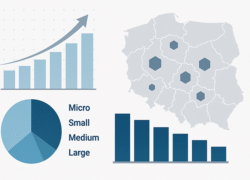
Micro-enterprises, employing up to nine people, continued to dominate the business landscape, accounting for 95.8% of all active firms. Their number rose by 4.6% compared to the same period in 2024. In contrast, the number of small firms (10–49 employees) fell by 0.2% and medium-sized firms (50–249 employees) by 0.8%. Large enterprises, with more than 250 employees, remained stable, with a marginal increase of three entities.

By sector, the largest share of enterprises operated in trade and repair of motor vehicles (17.4%), followed by construction (15.2%) and professional, scientific and technical activities (13.7%). The smallest proportions were found in mining and quarrying (0.1%) and energy supply (0.3%). Year-on-year, the biggest increases were recorded in administrative and support services (+13.9%), education (+9.6%), and other service activities (+7.6%).

The Mazowieckie voivodship, which includes Warsaw, remained the country’s business hub, hosting 20% of all active enterprises. Other major concentrations were in Wielkopolskie (10.3%), Śląskie (10.3%), and Małopolskie (10.0%). The smallest share was in Opolskie (1.9%). The strongest regional growth was observed in Małopolskie (+5.5%), Mazowieckie (+5.4%), and Pomorskie (+5.1%).

At the local level, the highest number of enterprises was registered in Poznański powiat (47,008), followed by Piaseczyński (26,855) and Krakowski (25,291). By contrast, only around 1,000 enterprises were active in the smallest counties, such as Gołdapski, Węgorzewski, and Sejneński.

When measured against population, Mazowieckie again led with 103.5 active enterprises per 1,000 residents, followed by Wielkopolskie (84.4), Pomorskie (84.1), Małopolskie (83.0), and Dolnośląskie (81.2). The lowest density was recorded in Podkarpackie (56.6).

Statistics Poland emphasized that microbusinesses remain the backbone of the Polish economy, while growth in education and administrative services highlights diversification beyond traditional trade and construction sectors.

Czech Economy in July: Construction Expands, Industry Strengthens, but Trade Balance Slips

The Czech economy delivered a mixed performance in July, with strong gains in construction and industry offset by the country’s first monthly trade deficit of the year, according to data from the Czech Statistical Office (CZSO).

Construction output rose by 10.1% year-on-year, maintaining double-digit growth for a second month. Compared with June, activity increased by 1%. Building construction expanded by 9.2% and civil engineering by 11.5%. The value of building permits surged 37.9% to CZK 54.2 billion, supported by approvals for large transport infrastructure projects. However, residential activity softened: housing starts fell by 9.2% to 2,628 units, while completions declined by 13.4% to 2,353.

Industrial production grew by 1.8% year-on-year and 0.8% month-on-month, driven mainly by motor vehicle manufacturing, rubber and plastics (particularly tyres), and fabricated metal and electrical equipment. New industrial orders rose by 6.6%, with domestic demand growing faster (+13%) than foreign orders (+2.9%). The automotive sector played a key role, posting a 15% increase in orders. Despite the gains, industry employment fell by 1.9% year-on-year.

Foreign trade, by contrast, ended in a deficit of CZK 1.7 billion, the first negative balance in 2025. Exports rose by 4.7% to CZK 375.2 billion, while imports climbed 3.1% to CZK 376.9 billion. The deficit was largely due to weaker balances in fabricated metal products, agriculture, and basic metals. Motor vehicles and machinery exports provided strong support, contributing more than CZK 12 billion in additional revenue. The cumulative trade surplus for January–July stood at CZK 136.7 billion, down CZK 9.4 billion from last year.

Across the EU27, construction and industry also reported moderate gains in June, though Czech industrial output (+0.2%) trailed the regional average. Eurostat will release July data later in September.

Czech Labour Market Sees Rising Employment and Wages in Q2 2025

The Czech labour market showed stronger momentum in the second quarter of 2025, with both employment and wages recording notable year-on-year gains, according to fresh data from the Czech Statistical Office (CZSO).

Average gross monthly wages rose by 7.8% to CZK 49,402, with real wages increasing by 5.3%, reflecting the impact of moderate inflation at 2.4%. The increase marked the strongest real wage growth since early 2024, as employees gradually regain purchasing power lost during the inflationary surge of 2022.

Employment rose by 76,200 people (1.5%) year-on-year, bringing the total workforce to 5.24 million. The growth was driven primarily by women and older workers: the number of employed women increased by 122,600, partly due to Ukrainian refugees entering the labour market, while employment among people aged 60+ expanded significantly, up by 52,200.

The services sector was the key driver of job creation, adding 88,000 positions. Notably, employment in arts, entertainment, and recreation grew by 24.3%. In contrast, jobs in manufacturing, agriculture, and transport continued to decline. Despite ongoing contractions, manufacturing remains the country’s largest employer, with more than one million workers.

Unemployment edged up slightly to 2.8%, affecting 146,100 people, though the rate remains among the lowest in Europe. Regional disparities persist: the Ústecký Region recorded the highest unemployment (4.8%), while Prague and the Středočeský Region had the lowest (1.5%). Long-term unemployment also rose to 44,800, increasingly affecting workers over 60.

In terms of earnings, wage growth varied widely across industries. The fastest increases were in professional, scientific, and technical activities (+12.7%), construction (+11%), and real estate (+10.9%). Workers in information and communication (CZK 87,477) and financial services (CZK 84,702) continued to earn the highest wages, while accommodation and food services remained the lowest-paid sector (CZK 29,270).

The median wage reached CZK 41,115, up 7.2% year-on-year. However, gender disparities persist: men’s median wage stood at CZK 44,465, about 15% higher than women’s at CZK 37,935.

Regional wage differences were narrower, with all areas seeing nominal growth between 5.6% and 8.2%. Prague remained the country’s highest-paying region with an average wage of CZK 62,307, while Karlovy Vary recorded the lowest at CZK 41,944.

Analysts note that if the current pace of nominal wage growth continues and inflation remains subdued, Czech wages could surpass their 2019 real level by the end of this year.

Offices in Poland: Regional Demand Surges as New Supply Stays Scarce

Demand for office space in Poland is rebounding, with regional markets showing especially strong leasing activity while new supply remains limited. Warsaw continues to see the largest inflow of new projects, but recent data suggest that cities such as Kraków, Wrocław and the Tri-City are increasingly competing with the capital in terms of absorption.

According to market trackers, leasing activity across Poland’s eight largest regional markets reached almost 217,400 square metres in the second quarter of 2025, marking a record quarterly result and a year-on-year increase of around 50 percent. In total, nearly 390,000 square metres was leased in regional cities in the first half of the year. Kraków recorded the highest level of activity, with more than 170,000 square metres leased by mid-year, putting it on par with Warsaw in the second quarter. Wrocław saw agreements for more than 80,000 square metres, while demand in the Tri-City exceeded 50,000 square metres. Much of this activity came from renewals, as tenants preferred to extend existing contracts rather than relocate, reflecting both cost considerations and a cautious approach to expansion.

In Warsaw, gross take-up in the first half of the year was close to 300,000 square metres, similar to the level seen a year earlier. Second-quarter leasing amounted to about 155,000 square metres, again dominated by renegotiations. At the same time, new completions in the capital reached approximately 85,000 square metres in the first half of 2025, the highest half-year figure since 2022. The most notable projects included The Bridge, a 47,000 square metre tower delivered by Ghelamco, and Office House, a 27,800 square metre building that forms part of the Towarowa 22 mixed-use complex. With these completions, Warsaw’s vacancy rate has remained stable at around 10.8 percent, with availability in the city centre dropping below 8 percent as tenants continued to favour high-quality, centrally located space.

By contrast, regional markets saw almost no significant new supply during the first half of the year. Only a small project in Poznań was completed, underlining the reluctance of developers to break ground amid high construction costs and vacancy rates that still average more than 17 percent across the regions. Nationwide, around 330,000 to 350,000 square metres of offices are currently under construction, split between roughly 140,000 square metres in Warsaw and 209,000 square metres across regional cities. In Kraków, about 65,000 square metres of new space is underway, while Poznań has more than 50,000 square metres under construction.

Looking ahead, Warsaw is expected to see the delivery of further large projects in the second half of the year, including V-Tower and Studio A, which will add more than 50,000 square metres combined. Other landmark schemes currently underway include Skyliner II, Upper One and additional phases of the Towarowa 22 and VIBE complexes. Outside the capital, the pipeline remains limited, suggesting that supply constraints will support rental stability in prime regional projects even as overall vacancy stays high.

The outlook for Poland’s office sector highlights a two-speed market. In both Warsaw and the regions, occupiers are focusing on prime, ESG-compliant properties in central locations, while older stock in peripheral areas continues to face weaker demand. With leasing led by renewals and expansions from IT and business services companies, the market appears to be stabilising after several years of adjustment. The limited pipeline should allow landlords of top-tier assets to maintain pricing power, while tenants in outdated buildings will continue to hold greater leverage.

Source: comp.

AI Emerges as Key Driver of Energy Efficiency in Real Estate

Artificial intelligence (AI) is playing a transformative role in helping the real estate sector reduce greenhouse gas emissions and improve operational efficiency, according to a new KPMG report.

Buildings account for nearly 40% of global emissions, with heating, cooling, and power consumption making up 27%. As urbanization accelerates – with 68% of the world’s population projected to live in cities by 2050 – the decarbonization of real estate is seen as critical to climate action.

KPMG’s Global Decarbonization Hub highlights that AI-driven solutions, especially human-centric AI, can deliver measurable results. For example, AI-powered software such as “Jenny” has achieved energy savings of more than 240,000 MWh, reduced greenhouse gas emissions by 90,000 tonnes, and generated €26 million in cost savings for real estate managers across 23 countries.

Case studies show how AI can autonomously optimize HVAC systems in commercial properties, making adjustments every 15 minutes based on weather forecasts, occupancy patterns, and energy market fluctuations. In one 10,000 m² office building, AI reduced heating consumption by over 60% while maintaining comfort standards. A shopping center of 60,000 m² achieved a 70% reduction in heating valve use and near 100% indoor climate comfort.

Experts from Tallinn University of Technology, Eduard Petlenkov and Juri Belikov, stressed that AI’s success depends on reliable, explainable systems that prioritize human comfort and trust. “By adhering to human-centric AI principles, building control systems can create healthier, more comfortable, and sustainable indoor environments,” Belikov noted.

The report underscores that AI alone is not enough: strategic energy management (SEM) frameworks are required to maximize impact. SEM integrates organizational change, training, and holistic efficiency planning with technology, enabling up to 30% annual energy savings in some buildings.

“AI is no longer a ‘nice to have,’ it is an essential strategy for cutting emissions, mitigating climate risk, and future-proofing real estate portfolios,” said Francesca Galeazzi, Partner for Real Estate, ESG & Climate at KPMG Germany

GCC Equity Markets Retreat in August as Oil Prices Weigh on Sentiment

Equity markets across the Gulf Cooperation Council (GCC) declined in August, reversing gains from the previous two months, as falling oil prices and sector-specific pressures weighed on investor sentiment, according to Kamco Invest’s latest GCC Markets Monthly Report.

The MSCI GCC index dropped 2.3% during the month, erasing July’s recovery and reducing year-to-date gains to just 1.4%. The downturn was led by Abu Dhabi, where the FTSE ADX Index fell 2.7%, followed by Saudi Arabia’s Tadawul (-2.0%) and Dubai’s DFM (-1.6%). Kuwait’s All-Share Index slipped 1.4%, while Qatar and Bahrain recorded marginal declines. Oman was the only market to post a gain, advancing 5.2% .

The correction came despite positive trends in global equities, with the MSCI ACWI up 2.4% in August on the back of gains in the US, Europe, and emerging markets. However, GCC investors reacted to a 6.1% monthly drop in oil prices, driven by oversupply concerns and slower demand recovery.

At the sector level, performance was mixed. The GCC Materials index gained 4.3%, supported by Saudi heavyweights such as SABIC (+6.0%) and Advanced Petrochemicals (+4.0%). Pharma & Biotech and Diversified Financials followed with increases of 3.9% and 2.7%, respectively. In contrast, Insurance led the losers with a 7.2% drop, while Healthcare and Real Estate fell 3.9% and 2.7%, respectively. Banking stocks were also weaker, down 2.4% .

Saudi Arabia’s Tadawul recorded its sharpest year-to-date decline in the region at -11.1%, reflecting weaker earnings announcements, oil price pressures, and geopolitical uncertainties. Conversely, Dubai remained the strongest performer in 2025 with a 17.5% gain, underpinned by strength in real estate and consumer sectors earlier in the year.

Trading volumes were also lower across several markets. In Saudi Arabia, share trading volumes fell nearly one-third month-on-month, while Abu Dhabi’s traded value dropped 25.6%. Dubai and Bahrain also reported slower activity, whereas Oman saw trading values rise by nearly 13% .

The report underscores ongoing divergence within GCC markets: while Oman and Dubai benefit from localized growth drivers, Saudi Arabia and Abu Dhabi remain sensitive to oil price fluctuations and global risk sentiment.

Sonar Development Secures Permits for Eschborn Residential Conversion

Sonar Development, the project development arm of the Sonar Group, has received building permits for the planned conversion of two vacant office properties in Eschborn into residential accommodation. The permits, covering the sites at Eschborner Hauptstraße 71–79 and 87, were granted without restrictions and within the statutory timeframe.

The project, undertaken on behalf of an institutional investor, will deliver around 200 residential units and contribute to addressing the region’s housing shortage. The development concept emphasizes sustainability, with the existing building structure retained to conserve embodied energy and reduce land consumption. Refurbishment work will target compliance with the KfW 55 energy-efficiency standard.

“The granting of the building permits marks an important milestone for our project,” said Steffen Wittwer, Managing Director of Sonar Development. “We would like to thank the entire planning team for their professional collaboration and the authorities – particularly the City of Eschborn, the Urban Planning Office and the Building Control Authority in Hofheim – for their timely processing. With this momentum, we are now entering the next phase of converting office space into contemporary housing.”

Sonar has appointed Ed. Züblin AG as main contractor for the project. “The conversion of existing buildings into modern housing makes an important contribution to sustainable urban development,” said Mark Simon-O’Sullivan, Project Director in Züblin’s Building in Existing Structures division. “We appreciate the trust placed in our expertise in transforming complex properties.”

Construction is scheduled to begin later in September.

Germany Switches On Europe’s Fastest Supercomputer ‘Jupiter’

Germany has officially launched Jupiter, Europe’s fastest supercomputer, at the Jülich Research Centre in North Rhine-Westphalia. The system is also ranked fourth worldwide on the Top500 list of the most powerful computers, underscoring Europe’s ambition to close the gap with the United States and China in high-performance computing and artificial intelligence.

Chancellor Friedrich Merz described the inauguration as a milestone for Germany’s role in digital technology. “We want Germany to become an artificial intelligence nation,” he said, adding that the 2020s could be remembered as the “decade of artificial intelligence.”

Jupiter – short for Joint Undertaking Pioneer for Innovative and Transformative Exascale Research – is the first European system designed to exceed one exaflop of performance, meaning it can carry out over one quintillion (10^18) calculations per second. This capability makes it vital for training advanced AI models, running complex climate and weather simulations, and enabling new breakthroughs in areas such as medical research and energy systems.

According to Astrid Lambrecht, chair of the Forschungszentrum Jülich board of directors, Jupiter is also the world’s most energy-efficient exascale-class system. “At a time when digitization and AI demand more and more energy, Jupiter shows how sustainable computing can be achieved,” she said. The machine uses advanced water-cooling and modular architecture designed by France’s Atos (Eviden) and U.S.-based NVIDIA, which supplied its cutting-edge Grace Hopper superchips.

The project cost around €500 million, with half the funding provided by the European Union and the remainder split between the German federal government and the state of North Rhine-Westphalia. The investment is part of the EuroHPC initiative, which aims to give Europe sovereign capacity in high-performance computing.

Beyond AI development, the system will be used to improve extreme weather forecasting, such as predicting floods and heatwaves, and to advance neuroscience research by modeling brain function for new therapies.

Jupiter’s launch also highlights Europe’s growing presence in the global supercomputing race. According to the latest Top500 ranking (June 2025), two of the world’s top 10 machines are in Europe: Jupiter in Germany at number four and Leonardo in Italy at number 10. By comparison, the world’s fastest system remains Frontier in the U.S., capable of over 1.1 exaflops.

While acknowledging concerns over AI, Lambrecht stressed that fears of machines gaining human-like consciousness are misplaced. “Large AI models still fail in logical reasoning,” she told DPA. “In the medium term, it is not realistic to expect them to develop their own awareness.”

With Jupiter now online, Europe has taken a major step toward technological sovereignty, giving its scientists and industries access to a tool designed to compete at the very top level of global computing power.

Anthropic to Pay $1.5 Billion to Settle Writers’ Copyright Lawsuit

U.S.-based artificial intelligence company Anthropic has agreed to a $1.5 billion settlement to resolve a class-action lawsuit brought by a group of authors who accused the company of using their books to train its Claude chatbot without permission. The settlement, covering around 500,000 works, would compensate authors with an average of about $3,000 per book. It now awaits approval from a federal court in San Francisco, according to Reuters.

The agreement, first announced in August without details, is expected to be the largest publicly disclosed copyright enforcement settlement involving generative AI to date. Judge William Alsup, who is overseeing the case, scheduled a hearing for Monday to review the terms.

The lawsuit was filed last year by authors Andrea Bartz, Charles Graeber, and Kirk Wallace Johnson. They argued that Anthropic had illegally used millions of books to train its Claude system. In June, Judge Alsup ruled that while Anthropic could use certain materials for training, the company infringed copyright by placing more than seven million books into a central repository not intended solely for training purposes.

The trial had been scheduled for December, but by agreeing to settle out of court Anthropic has avoided what could have been an even more costly judgment.

The case is part of a wider wave of litigation against technology companies such as OpenAI, Microsoft, and Meta, which face lawsuits over the use of copyrighted content to train generative AI systems. These systems, which generate text or images based on large datasets, have surged in prominence since OpenAI’s ChatGPT drew global attention in late 2022.

Anthropic, founded in 2021 by former OpenAI employees, launched its Claude chatbot in 2023. The company has attracted investment from major backers including Amazon and Alphabet. This week, it was valued at $183 billion following a new funding round.

LATEST NEWS