EU mobility in 2023: cars still dominate, air travel’s share rises as rail sets a new record

Cars remained the primary mode of passenger transport in the EU in 2023, accounting for 70.6% of total passenger-kilometres, down 1.8 percentage points from 2022. Air transport’s share increased to 14.7% (+1.6 pp), followed by buses/coaches/trolleybuses at 7.2% (−0.2 pp), rail at 7.1% (+0.3 pp) and sea at 0.4% (unchanged), according to Eurostat’s latest “EU people on the move” update. Country patterns varied widely: car use was highest in Lithuania (85.7%), the Netherlands (77.1%) and Finland (76.4); the air share peaked in Croatia (43.5%), Bulgaria (29.0%) and Cyprus (27.4%); buses were most prominent in Malta (15.8%), Ireland (15.4%) and Estonia (12.0%); rail’s role was largest in the Netherlands (10.9%), Austria (10.5%) and France (9.1%); and sea transport led in Croatia (2.4%), Estonia (2.3%) and Finland (2.1%). 

Eurostat’s modal-split figures reflect shares of total passenger-kilometres rather than absolute volumes, meaning a rising share for one mode can coincide with growth in others. Complementary datasets indicate strong rebounds in the modes most affected by the pandemic: EU air passengers rose to 973 million in 2023, up 19.3% year on year, while rail passenger-kilometres reached a series high of 429 billion in 2023, up 11.2% from 2022. Both trends help explain the modest decline in the car share despite cars remaining dominant. 

Longer-term indicators suggest Europe’s modal mix changes slowly. The European Environment Agency notes that total passenger activity returned to around pre-COVID levels by 2022, while the car share has shifted only marginally over the past few decades outside the pandemic shock. With 2024 and 2025 releases continuing to show robust air traffic and resilient rail demand, policymakers marking European Mobility Week are likely to focus on managing growth in higher-emission modes while sustaining momentum in rail and public transport.
Poland’s State Budget Deficit Reaches PLN 172 Billion by August 2025

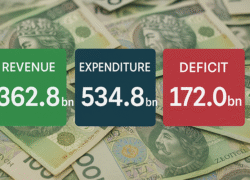
The Polish Ministry of Finance reported that by the end of August 2025, the state budget recorded revenues of PLN 362.8 billion and expenditures of PLN 534.8 billion, resulting in a deficit of PLN 172 billion. This represented 57.3% of planned revenues, 58.0% of planned expenditures, and 59.6% of the deficit limit set in the 2025 budget law.

The fall in revenues compared with last year was primarily due to reforms in the financing of local government units (JST), which redistributed shares of personal income tax (PIT) and corporate income tax (CIT). Without this reform, state budget revenues would have amounted to PLN 484.9 billion, nearly PLN 40 billion higher than in the same period of 2024.

Tax revenues totaled PLN 311.2 billion, down 12.2% year-on-year. VAT receipts grew by 10.5% to PLN 214.6 billion, and excise duty revenues rose 1.9% to PLN 59.1 billion. PIT revenues fell sharply to PLN 11.3 billion due to the transfer of a larger share to local governments, while CIT revenues increased 5.8% to PLN 44.1 billion. Non-tax revenues amounted to PLN 40.7 billion, 5.1% lower than in the same period last year.

Expenditures of PLN 534.8 billion were up 7.4% compared with January–August 2024. Significant outlays included PLN 112 billion for the Social Insurance Institution, PLN 63.2 billion for national defence, PLN 41.6 billion for servicing state debt, PLN 36.6 billion in general subsidies for local governments, and PLN 32.5 billion for health. Transfers included PLN 19 billion in March for repayment of Polish Development Fund bond obligations from the 2020 financial support programme, and PLN 16 billion in July to the COVID-19 Countermeasure Fund for liabilities issued between 2020 and 2023.

Higher year-on-year expenditure was reported in healthcare, social insurance, national defence, debt servicing, transport, EU contributions, internal affairs, and higher education. The health budget alone grew by PLN 19.2 billion, partly due to increased transfers to the National Health Fund and new programmes such as support benefits for people with disabilities and the “widower’s pension.” Defence spending rose by PLN 4.8 billion, reflecting purchases of equipment and armaments.

General subsidies to local governments decreased by PLN 50.3 billion compared with 2024, reflecting structural changes in public finances. Since January 2025, the subsidy has had a complementary role, as JSTs now receive a larger share of PIT and CIT revenues directly.

The Ministry highlighted that despite the deficit increase, revenue shortfalls were largely statistical, caused by the redistribution of PIT and CIT shares, while underlying tax bases, particularly VAT and CIT, continued to grow.

Slovakia’s Inflation Slows in August but Remains at a 20-Month High

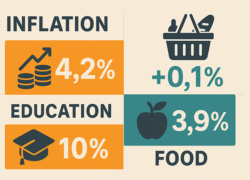
Consumer prices in Slovakia rose 4.2% year-on-year in August 2025, slowing slightly from the previous two months but still marking the highest inflation rate in 20 months, according to the Statistical Office of the Slovak Republic. Month-on-month, prices increased by just 0.1%, the lowest growth so far this year, matching April’s figure.

Transport costs had the strongest impact on monthly inflation, with prices in this category rising 1.9%, driven by higher air and combined passenger transport fares. Food and housing costs, which carry the greatest weight in household spending, remained unchanged after several months of steady increases. Within food, price developments were mixed: vegetables, oils and fats, and dairy products fell, while meat, sugar, and cereals registered modest increases. Restaurant and hotel services rose 0.2%, while telecommunications prices also climbed, reflecting higher charges for phone services.

Five of the 12 main expenditure divisions recorded month-on-month declines. Furniture and furnishings fell the most, down 0.5%, followed by recreation and culture (-0.2%). Alcoholic beverages and tobacco decreased 0.3%, largely due to lower beer and spirits prices. Apparel, footwear, and healthcare also edged lower.

On a year-on-year basis, all 12 expenditure categories posted higher prices. Education recorded the sharpest increase at 10%, followed by restaurants and hotels, alcoholic beverages and tobacco, and miscellaneous goods and services such as insurance, hairdressing, and personal care. Food and non-alcoholic beverages rose 3.9% compared with August 2024, with notable increases in oils and fats, dairy, and fruit, offset by lower prices for meat and vegetables. Non-alcoholic beverages jumped more than 19% year-on-year.

Housing and energy, healthcare, and transport recorded the slowest price growth, each remaining below 3%. Across the first eight months of 2025, consumer prices have increased by an average of 4.1% year-on-year.

Core inflation, which excludes regulated prices and tax-driven changes, stood at 3.5% in August, while net inflation, which further strips out food prices, was 3.2%. Both measures rose 0.1% month-on-month.

The Statistical Office noted that new scanner data sources, covering food, non-alcoholic beverages, alcoholic drinks, and tobacco, have been integrated into inflation calculations since 2024–2025, enhancing coverage and accuracy of price data.

Polish Households Used More Electricity and Gas in 2024 While Heat Energy Sales Declined

Household energy consumption in Poland rose in 2024, according to new data from Statistics Poland. Electricity use in homes increased by 2.1% year-on-year to 30.4 TWh, while consumption of gas from the network rose by 0.9% to 54.6 TWh. At the same time, sales of heat energy to residential buildings fell by 2.7%.

Electricity consumption per household reached 1,832 kWh, up 0.7% from 2023. Urban households used an average of 1,612 kWh compared with 2,269 kWh in rural areas. Per capita use stood at 809 kWh, with rural residents consuming more than their urban counterparts. The number of electricity consumers rose 1.4% to nearly 16.6 million.

The country’s heat supply network grew modestly to almost 25,910 km, with more than 96% located in urban areas. Regional density was highest in Śląskie, followed by Małopolskie and Pomorskie. Total heat energy sales reached 180.5 petajoules, of which 78.5% was delivered to residential buildings. Solid fuels remained the main source of heat production, though gaseous fuels also played a significant role.

The gas supply network expanded by 1.3% to 176,600 km, with connections to buildings rising 2.3% to 3.56 million. Rural areas accounted for 59% of the network length. Household gas consumption increased to an average of 6,162 kWh per consumer, though the number of gas customers declined slightly overall by 0.5%. Rural households used an average of 10,364 kWh compared with 5,254 kWh in urban areas.

The findings highlight shifting patterns in Poland’s municipal energy infrastructure. While demand for electricity and gas grew, heat energy sales contracted, reflecting changing consumption behaviour and the ongoing modernization of energy networks.

Polish Households Used More Electricity and Gas in 2024 While Heat Energy Sales Declined

Household energy consumption in Poland rose in 2024, according to new data from Statistics Poland. Electricity use in homes increased by 2.1% year-on-year to 30.4 TWh, while consumption of gas from the network rose by 0.9% to 54.6 TWh. At the same time, sales of heat energy to residential buildings fell by 2.7%.

Electricity consumption per household reached 1,832 kWh, up 0.7% from 2023. Urban households used an average of 1,612 kWh compared with 2,269 kWh in rural areas. Per capita use stood at 809 kWh, with rural residents consuming more than their urban counterparts. The number of electricity consumers rose 1.4% to nearly 16.6 million.

The country’s heat supply network grew modestly to almost 25,910 km, with more than 96% located in urban areas. Regional density was highest in Śląskie, followed by Małopolskie and Pomorskie. Total heat energy sales reached 180.5 petajoules, of which 78.5% was delivered to residential buildings. Solid fuels remained the main source of heat production, though gaseous fuels also played a significant role.

The gas supply network expanded by 1.3% to 176,600 km, with connections to buildings rising 2.3% to 3.56 million. Rural areas accounted for 59% of the network length. Household gas consumption increased to an average of 6,162 kWh per consumer, though the number of gas customers declined slightly overall by 0.5%. Rural households used an average of 10,364 kWh compared with 5,254 kWh in urban areas.

The findings highlight shifting patterns in Poland’s municipal energy infrastructure. While demand for electricity and gas grew, heat energy sales contracted, reflecting changing consumption behaviour and the ongoing modernization of energy networks.

Poland’s Housing Stock Reached Nearly 16 Million Dwellings in 2024

At the end of 2024, Poland’s housing stock reached almost 16 million dwellings, an increase of 1.2% compared with the previous year, according to Statistics Poland. The total useful floor area expanded by 1.4% to just over 1.2 billion square metres, while the number of rooms rose by 1.1% to 61.2 million.

Urban areas accounted for 10.8 million dwellings with 704 million square metres of floor area, while rural areas had 5.1 million dwellings with 503 million square metres. Growth in new dwellings was more pronounced in urban locations, which saw an increase of 138,900 units (1.3%), compared with 47,600 in rural areas (0.9%).

Housing conditions showed modest improvements. The average dwelling size rose to 75.6 m², and the average space per person increased from 31.6 m² in 2023 to 32.2 m² in 2024. Rural dwellings remained larger, averaging 98.1 m² compared with 64.9 m² in urban areas. There were 426 dwellings per 1,000 residents nationwide, up from 419 a year earlier.

The share of dwellings fitted with modern installations remained high: 97.8% with water supply, 95.3% with lavatories, 93.9% with bathrooms and 59.1% with gas installations. However, disparities persisted, with urban homes better equipped than rural ones.

Ownership patterns continued to be dominated by private individuals, who held nearly 13.1 million dwellings—about 88% of the total floor area. Housing cooperatives accounted for almost 1.9 million dwellings, while municipal stocks declined to around 756,000. State Treasury holdings remained minimal at 29,000 units.

In 2024, close to 91,000 dwellings were sold to private owners, mostly from housing cooperatives and municipal stocks. At the same time, municipalities managed nearly 596,000 rental dwellings, down 1.2% year-on-year, and around 119,000 households remained on waiting lists for municipal housing, a 3.6% decrease compared to 2023.

Housing allowances continued to support households. More than 2.7 million payments were made in 2024, slightly fewer than in 2023, but the total value rose to PLN 898.4 million. The average allowance increased to PLN 329 per month.

Land availability for housing also remained stable. Municipalities held just over 24,000 hectares for housing construction, with almost 63% located in urban areas. More than 80% of plots handed to investors in 2024 were designated for single-family housing.

Poland’s Housing Stock Reached Nearly 16 Million Dwellings in 2024

At the end of 2024, Poland’s housing stock reached almost 16 million dwellings, an increase of 1.2% compared with the previous year, according to Statistics Poland. The total useful floor area expanded by 1.4% to just over 1.2 billion square metres, while the number of rooms rose by 1.1% to 61.2 million.

Urban areas accounted for 10.8 million dwellings with 704 million square metres of floor area, while rural areas had 5.1 million dwellings with 503 million square metres. Growth in new dwellings was more pronounced in urban locations, which saw an increase of 138,900 units (1.3%), compared with 47,600 in rural areas (0.9%).

Housing conditions showed modest improvements. The average dwelling size rose to 75.6 m², and the average space per person increased from 31.6 m² in 2023 to 32.2 m² in 2024. Rural dwellings remained larger, averaging 98.1 m² compared with 64.9 m² in urban areas. There were 426 dwellings per 1,000 residents nationwide, up from 419 a year earlier.

The share of dwellings fitted with modern installations remained high: 97.8% with water supply, 95.3% with lavatories, 93.9% with bathrooms and 59.1% with gas installations. However, disparities persisted, with urban homes better equipped than rural ones.

Ownership patterns continued to be dominated by private individuals, who held nearly 13.1 million dwellings—about 88% of the total floor area. Housing cooperatives accounted for almost 1.9 million dwellings, while municipal stocks declined to around 756,000. State Treasury holdings remained minimal at 29,000 units.

In 2024, close to 91,000 dwellings were sold to private owners, mostly from housing cooperatives and municipal stocks. At the same time, municipalities managed nearly 596,000 rental dwellings, down 1.2% year-on-year, and around 119,000 households remained on waiting lists for municipal housing, a 3.6% decrease compared to 2023.

Housing allowances continued to support households. More than 2.7 million payments were made in 2024, slightly fewer than in 2023, but the total value rose to PLN 898.4 million. The average allowance increased to PLN 329 per month.

Land availability for housing also remained stable. Municipalities held just over 24,000 hectares for housing construction, with almost 63% located in urban areas. More than 80% of plots handed to investors in 2024 were designated for single-family housing.

Data4 Begins Construction of Hanau Mega Campus, Its First German Data Centre Development

Data4, a European data centre operator, has launched construction of its first campus in Germany on the site of the former Großauheim military base in Hanau, near Frankfurt. The project, which covers around 25 hectares, is planned to deliver up to 180 megawatts of capacity, making it one of the largest data centre sites in Europe.

The company, which already operates ten campuses in six countries including France, Italy, Spain, Poland and Greece, has raised its projected investment in the Hanau site from €1 billion to over €2 billion. According to Data4, the development is intended to meet growing demand for cloud computing and artificial intelligence infrastructure in the Rhine-Main region, one of Europe’s key digital hubs.

Construction is scheduled in phases, with the first modules expected to come online by 2025 and full completion extending into the next decade. Data4 states that the campus will be powered entirely by decarbonised energy sources. Plans include a substation and potentially a combined heat and power plant, alongside measures to capture and reuse waste heat for local district heating. Materials from the demolition of former military buildings are being recycled for use in the project, reflecting the company’s sustainability strategy.

Data4 has emphasised the broader role of its facilities in supporting Europe’s digital sovereignty. “We want to transform the new campus in Hanau into one of the most powerful, sustainable and innovative data centre locations in Europe, contributing to the development of the continent’s digital future,” said Olivier Micheli, President and CEO of Data4.

Local officials anticipate the project will generate several hundred jobs over time, both during construction and through long-term operations. Comparable to Data4’s Marcoussis campus in France, which supports daily employment for up to 1,000 people, the Hanau site is expected to bring economic and technological benefits to the region.

In Poland, where Data4 operates a campus near Warsaw, demand for colocation and cloud services has grown steadily. “Our Warsaw campus is a strategic hub for connections between Western Europe, Eastern Europe and Scandinavia. With awareness of the benefits of professional colocation increasing, further investment in digital infrastructure is essential,” noted Adam Ponichtera, Director of Data4 Poland.

Across its network, Data4 has advanced pilot projects in sustainable operations. At Marcoussis, the company launched an initiative to convert waste heat from servers into biomass in collaboration with the Université Paris-Saclay Foundation, a model it aims to replicate in other locations.

The Hanau campus strengthens Germany’s position as a key European digital infrastructure market, while highlighting the growing importance of data centres in enabling artificial intelligence applications and cloud services. With construction now underway, the development signals Data4’s long-term commitment to expanding its footprint in one of Europe’s most competitive regions.

Czech Producer Prices Mixed in August as Agriculture Climbs but Industry Falls Year-on-Year

Producer price trends in Czechia showed mixed movements in August, according to the Czech Statistical Office (CZSO). Agricultural producer prices declined by 1.2 percent month-on-month but remained 11.4 percent higher than a year earlier. Industrial producer prices were stable compared to July but fell 0.8 percent year-on-year, continuing a trend of annual declines.

Construction work prices increased by 0.3 percent from July and were 2.6 percent higher than in August 2024. Service producer prices in the business sphere rose 0.8 percent month-on-month and 4.4 percent year-on-year, supported by higher costs in advertising, broadcasting, and employment services.

Within agriculture, the monthly drop reflected lower prices for potatoes, fruit, cereals, fresh vegetables, pigs for slaughter, and oilseeds, while cattle, poultry, and milk recorded increases. Compared with August 2024, crop production prices rose by 4.6 percent, and animal production prices surged 18.9 percent, with sharp gains in eggs, cattle, milk, and poultry.

In industry, monthly prices were unchanged overall, with higher energy costs offset by declines in refined petroleum and some food categories. Compared with a year earlier, industrial producer prices fell 0.8 percent, driven by decreases in refined petroleum, chemicals, coal, and electricity, while dairy products, meat products, and wood products showed notable increases. Energy prices fell 3.6 percent year-on-year, while durable and non-durable consumer goods were both higher.

Construction prices remained stable, with a slight monthly rise in work prices offset by marginally lower material costs. Year-on-year, construction work prices were up 2.6 percent, while materials rose 1.1 percent.

Service producer prices rose sharply in some segments, particularly advertising and market research (up 9.7 percent month-on-month), programming and broadcasting (7.8 percent), and information services (2.1 percent). Over the year, service prices increased by 4.4 percent, led by broadcasting services, advertising, and security.

At the EU level, Eurostat preliminary data showed industrial producer prices in July increased by 0.6 percent month-on-month and by 0.4 percent year-on-year. Romania, Bulgaria, and Slovakia recorded the largest monthly increases, while Germany and Poland posted slight declines. Year-on-year, Bulgaria, Denmark, and Romania saw the strongest gains, while Estonia, Luxembourg, and Portugal experienced the largest decreases.

Czech Producer Prices Mixed in August as Agriculture Climbs but Industry Falls Year-on-Year

Producer price trends in Czechia showed mixed movements in August, according to the Czech Statistical Office (CZSO). Agricultural producer prices declined by 1.2 percent month-on-month but remained 11.4 percent higher than a year earlier. Industrial producer prices were stable compared to July but fell 0.8 percent year-on-year, continuing a trend of annual declines.

Construction work prices increased by 0.3 percent from July and were 2.6 percent higher than in August 2024. Service producer prices in the business sphere rose 0.8 percent month-on-month and 4.4 percent year-on-year, supported by higher costs in advertising, broadcasting, and employment services.

Within agriculture, the monthly drop reflected lower prices for potatoes, fruit, cereals, fresh vegetables, pigs for slaughter, and oilseeds, while cattle, poultry, and milk recorded increases. Compared with August 2024, crop production prices rose by 4.6 percent, and animal production prices surged 18.9 percent, with sharp gains in eggs, cattle, milk, and poultry.

In industry, monthly prices were unchanged overall, with higher energy costs offset by declines in refined petroleum and some food categories. Compared with a year earlier, industrial producer prices fell 0.8 percent, driven by decreases in refined petroleum, chemicals, coal, and electricity, while dairy products, meat products, and wood products showed notable increases. Energy prices fell 3.6 percent year-on-year, while durable and non-durable consumer goods were both higher.

Construction prices remained stable, with a slight monthly rise in work prices offset by marginally lower material costs. Year-on-year, construction work prices were up 2.6 percent, while materials rose 1.1 percent.

Service producer prices rose sharply in some segments, particularly advertising and market research (up 9.7 percent month-on-month), programming and broadcasting (7.8 percent), and information services (2.1 percent). Over the year, service prices increased by 4.4 percent, led by broadcasting services, advertising, and security.

At the EU level, Eurostat preliminary data showed industrial producer prices in July increased by 0.6 percent month-on-month and by 0.4 percent year-on-year. Romania, Bulgaria, and Slovakia recorded the largest monthly increases, while Germany and Poland posted slight declines. Year-on-year, Bulgaria, Denmark, and Romania saw the strongest gains, while Estonia, Luxembourg, and Portugal experienced the largest decreases.

LATEST NEWS