Thursday, 24 September 2026
The economic impact of trade sanctions depends not only on their scale but also on how easily the targeted country can replace lost trading relationships, according to new research by the German Institute for Economic Research (DIW Berlin).
The study analysed 748 cases of trade sanctions imposed between 1962 and 2020, examining how different forms of trade restrictions affect economic performance. Its findings suggest that measures targeting imports from sanctioned countries can, in many cases, have a stronger economic effect than restrictions on exports to those countries, particularly when the affected economy relies heavily on a limited number of trading partners or commodity exports.
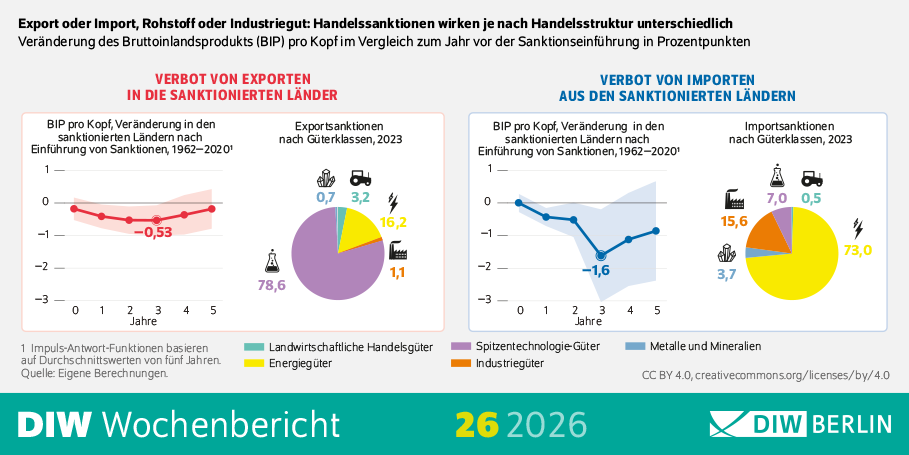
Researchers estimate that when trade restrictions affect flows equivalent to around 1% of a country’s gross domestic product, economic output per person may decline by between 0.5 and 1.6 percentage points during the first three years after sanctions are introduced. The actual impact varies depending on the structure of the targeted economy and its ability to adapt.
According to the analysis, restrictions on imports often affect sectors such as energy, agriculture and industrial goods, reducing export revenues for the targeted country. Export controls, meanwhile, are frequently designed to limit access to advanced technologies, machinery and specialised industrial products that are important for manufacturing and long-term economic development.
A country’s trade structure plays a decisive role in determining how disruptive sanctions become. Economies with diversified export markets and multiple trading partners are generally better positioned to redirect trade and reduce the impact of restrictions. By contrast, countries that depend heavily on a small number of export markets or on raw materials sold to a limited group of buyers face greater challenges when sanctions interrupt established trade flows.
The research also highlights the importance of trade diversion. If businesses can quickly establish alternative supply chains or find new customers abroad, the overall economic damage may be considerably reduced. Where such alternatives are limited, however, sanctions are more likely to affect production, investment and overall economic growth.
The findings align with broader international research indicating that the effectiveness of trade sanctions depends less on the restrictions themselves than on the economic resilience of the country being targeted. Factors such as export diversification, domestic industrial capacity and access to alternative suppliers all influence how quickly an economy can adjust.
The study concludes that while trade sanctions remain an important foreign policy instrument, their economic consequences are far from uniform. Their success depends on the characteristics of the targeted economy, the products involved and the extent to which existing trade relationships can be replaced.
Source: DIW Berlin