Wednesday, 7 October 2026
San José’s retail property market has entered 2026 with limited availability, continued occupier demand and household consumption expected to expand further during the year. Availability across the monitored market stood at approximately 4.36% at the end of 2025, creating relatively firm conditions across the Greater Metropolitan Area while performance becomes increasingly dependent on location, accessibility and customer traffic.
Occupied space increased by more than the amount of new supply delivered during the closing period of 2025, indicating that demand was sufficient to accommodate recent additions without producing a significant increase in vacant space. For Greater San José, which contains Costa Rica’s largest concentration of consumers, employment and modern commercial property, the relatively low availability provides a strong starting point for 2026.
The headline figure does not mean every shopping centre or retail location is performing equally well. Greater San José contains regional malls, neighbourhood plazas, supermarkets, high-street premises and an increasing amount of retail integrated into residential, office and hospitality developments. Performance therefore depends increasingly on the surrounding population, purchasing power, accessibility and ability of individual properties to generate repeat visits.
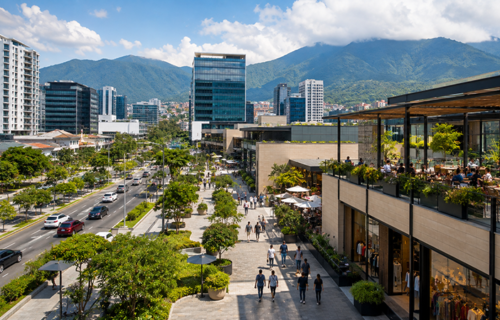
The western metropolitan area remains one of the strongest concentrations of higher-end commercial activity. Escazú and Santa Ana combine affluent residential communities with corporate offices, hotels, restaurants and established shopping destinations, creating demand extending beyond conventional shopping trips. Multiplaza Escazú remains an important destination, while Avenida Escazú and Escazú Village illustrate the increasing integration of retail with offices, residential accommodation, restaurants and hospitality.
Other parts of Greater San José have developed their own substantial commercial centres. Curridabat and San Pedro serve the eastern metropolitan population, while Moravia, Heredia and Alajuela provide important concentrations to the north and northwest. The result is an increasingly decentralised retail market in which downtown San José represents only one part of the capital region’s commercial geography.
This decentralisation is supporting convenience-oriented retail. Supermarkets, pharmacies, restaurants, gyms, health and beauty operators and other services depend heavily on frequent visits from nearby residents and workers and can therefore perform strongly without competing directly with the metropolitan area’s largest destination malls.
Traffic conditions reinforce the importance of proximity. Where relatively short journeys can require considerable travel time, consumers have a greater incentive to shop and access services close to their homes or workplaces. This supports neighbourhood centres and smaller commercial plazas alongside regional malls.
Mixed-use development is strengthening the same pattern. Retail incorporated into office, residential and hospitality projects can draw customers from different groups throughout the day. Residents provide recurring local expenditure, office workers support weekday activity, while restaurants and entertainment can extend demand into evenings and weekends.
For retailers, this changes the economics of location selection. Lower rent does not necessarily produce better store economics if another property can deliver greater customer traffic and stronger sales. Occupiers are increasingly assessing accessibility, surrounding demographics and sales productivity alongside occupancy costs.
Costa Rica’s economic performance provides a supportive backdrop. The economy expanded by approximately 4.6% in 2025, while the IMF expects growth of around 3.6% in 2026. Although this represents a moderation from the previous year, economic activity remains supportive of the consumer sector.
Household expenditure is particularly relevant to retail property. Private consumption is expected to increase by approximately 3.7% during 2026 following estimated growth of around 3.8% in 2025, providing a continuing foundation for retailers dependent primarily on domestic consumers.
Consumer confidence also entered the year on relatively stable ground. The University of Costa Rica’s Consumer Confidence Index reached 55.4 in November 2025, above its previous quarterly reading and historical average, while expectations among businesses operating in commerce improved ahead of the first quarter of 2026.
Conditions nevertheless vary between households. Consumers facing greater financial pressure remain more cautious, meaning affordability and value continue to influence purchasing decisions even as the wider economy expands. This allows different retail segments to perform simultaneously, with higher-income districts supporting premium brands and lifestyle concepts while supermarkets, pharmacies, discount operators and everyday services benefit from recurring expenditure.
Costa Rica’s low-inflation environment has also helped protect household purchasing power. For retailers, however, subdued price growth means revenue performance depends more heavily on customer numbers, transaction volumes and product mix rather than price increases.
Tourism provides an additional source of demand, although its effect on San José differs from Costa Rica’s coastal destinations. The capital functions primarily as the country’s business, administrative and transport centre, while much international leisure expenditure occurs elsewhere. San José nevertheless captures visitor spending through hotels, restaurants, shopping and entertainment, particularly in western districts frequented by business travellers and international visitors.
Domestic consumers and the metropolitan workforce remain the more important foundation for the capital’s retail market. Employment, household confidence, wages and residential development are therefore particularly important indicators for property owners.
The relatively limited amount of available space entering 2026 is gradually affecting the balance between landlords and occupiers. Retailers seeking particular unit sizes in established centres may find fewer alternatives than the overall size of the metropolitan market suggests, particularly where high visibility or access to a specific consumer group is required.
This does not automatically imply rapid rental increases. Retail lease terms depend heavily on unit size and position, retailer profile, fit-out requirements, lease duration and negotiations between landlord and occupier. Incentives and individually structured agreements can also make effective occupancy costs different from advertised rents.
Sustained limited availability could nevertheless strengthen the negotiating position of successful properties, particularly where retailers have few comparable alternatives. The more important divide in 2026 is therefore likely to be between properties capable of producing strong retailer sales and those that simply have space available.
Established shopping centres benefit from recognised locations and existing customer traffic, but their position cannot be taken for granted. Owners need to maintain their properties, adjust tenant mixes and introduce uses that encourage consumers to visit more frequently and remain for longer periods.
Restaurants, cafés, entertainment, fitness, healthcare, beauty and personal services have consequently become increasingly important. These activities generate visits that are difficult to replace digitally and can support shopping destinations even as consumers purchase a greater proportion of merchandise online.
E-commerce is changing the role of physical stores rather than eliminating them. Shops increasingly operate as sales locations, brand showcases, collection points and places for returns and customer service, linking physical premises with retailers’ wider digital operations.
For developers, low availability creates opportunities but does not necessarily justify another large wave of regional shopping centres. Greater San José already has a mature network of major retail destinations, while increasingly decentralised consumer demand favours projects designed around identifiable local catchments.
New development is therefore more likely to emerge through neighbourhood centres, mixed-use schemes, extensions of successful properties and commercial projects serving expanding residential communities. Supermarkets and other frequently visited businesses can provide anchors around which restaurants, services and smaller retailers develop.
For investors, limited vacancy provides a positive market signal, but individual asset quality remains more important than the headline availability rate. Tenant sales, lease duration, occupier diversity, customer traffic, operating expenses and future investment requirements all influence the resilience of income.
Established centres serving strong residential or employment catchments should remain comparatively defensive. Smaller properties can also perform strongly where they dominate their immediate area or provide convenient access to everyday goods and services. Older assets without a clear market position face greater challenges, even in a relatively tight market, if their physical condition, tenant mix or accessibility no longer corresponds with consumer expectations.
The economic outlook suggests that retail demand should remain supportive through the remainder of 2026, although slower economic growth and uncertainty surrounding international trade could affect confidence and investment. Costa Rica’s exposure to the US economy also means external conditions remain relevant to employment and household spending.
San José nevertheless enters this period with relatively favourable fundamentals. Retail space is well occupied, consumer expenditure continues to expand and the metropolitan area combines a growing network of residential catchments with a substantial corporate and services economy.
San José’s retail market in 2026 is therefore becoming less about adding square metres and more about the productivity of individual locations. Large destination malls, mixed-use districts and neighbourhood centres can all succeed, but each serves different consumer requirements.
With overall availability already relatively limited, future value will increasingly depend on whether properties can translate their catchments, accessibility and tenant mix into sustainable customer traffic and retailer sales. For landlords, developers and investors, identifying where unmet consumer demand exists is becoming more important than simply increasing the volume of retail space.
Source: © CIJ.World Research & Analysis Team