Tuesday, 29 September 2026
Europe’s push to expand artificial intelligence computing capacity is rapidly becoming an infrastructure and real estate challenge, with access to electricity emerging as one of the main factors determining where the next generation of large data centres can be developed. The issue is in focus in Frankfurt this week as investors, utilities, developers and public authorities examine how Europe’s planned AI computing facilities can be financed, connected to power networks and delivered.
The scale of the programme is substantial. The European Union is working towards as many as seven large AI computing facilities, with up to €10 billion of European and national public funding intended to mobilise at least €20 billion from private investors. Individual facilities could accommodate more than 100,000 advanced AI processors, creating electricity and infrastructure requirements substantially above those of conventional data centres.
Europe’s existing data-centre markets are already struggling to provide enough capacity. CBRE expects more than 750 MW of additional supply to be completed across Europe during 2026, while vacancy across major and secondary markets could fall to around 6.5% by year-end. Grid limitations are restricting development in several established locations, forcing operators to examine alternative sites and, increasingly, options for generating or storing electricity closer to their facilities.
The shortage of available power is also changing Europe’s data-centre geography. JLL research indicates that large facilities scheduled for development between 2026 and 2028 are, on average, being planned much further from established data-centre centres than projects delivered during the previous four years. The average distance has increased from approximately 46 km to 175 km, reflecting the growing importance of locations where sufficient electricity can actually be secured.
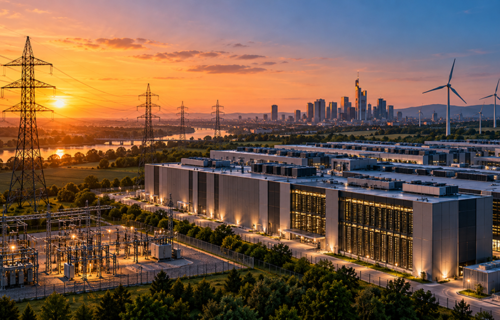
Frankfurt illustrates the shift. Despite remaining one of Europe’s largest data-centre markets, constraints on available grid capacity are encouraging developers to consider locations beyond the traditional cluster. For investors and developers, this means sites with confirmed access to large quantities of electricity can potentially carry a substantial advantage over land that may be cheaper or geographically better positioned but lacks a realistic route to sufficient power.
Financing presents another challenge. Europe’s AI facilities require investment not only in computing equipment but also in buildings, substations, transmission infrastructure, cooling systems and supporting energy assets. The European Commission and European Investment Bank are already working on mechanisms intended to make projects capable of attracting private capital, while industry participants have questioned whether the proposed public contribution will be sufficient given the scale of the required investment.
These pressures could create opportunities outside Europe’s traditional data-centre hubs. Markets in Central and South-Eastern Europe, as well as the Nordics, may attract greater attention where electricity generation, grid capacity, land and fibre infrastructure can be assembled into viable development sites. Lower land prices alone, however, are unlikely to determine investment decisions when the ability to secure hundreds of megawatts can be considerably more important than the cost of the site itself.
Europe’s AI expansion is therefore beginning to reshape the economics of data-centre real estate. Land with secured power, grid connections and the ability to accommodate additional energy infrastructure is becoming increasingly strategic. As AI computing requirements increase, competition for electricity capacity could ultimately determine where billions of euros of European digital-infrastructure investment is deployed.