Monday, 19 October 2026
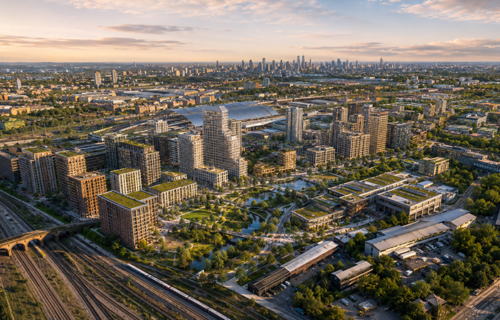
For years, the property story surrounding Old Oak Common was dominated by a railway station that had not yet opened. In 2026, that story is beginning to change. Land consolidation, a search for a major private development partner and the expansion of university-backed research and innovation activity are starting to turn one of west London’s largest brownfield areas into a genuine real-estate investment proposition.
The scale is exceptional. Plans for the core regeneration area envisage approximately 8,000 homes, thousands of jobs and up to 200,000 sq m of commercial and community accommodation. Around 70 acres of publicly controlled land are being brought together to support development with an estimated value of approximately £10 billion. This is significant because fragmented land ownership has historically been one of the greatest obstacles facing large London regeneration schemes. Acquiring dozens of individual sites can take years, introduce compulsory-purchase risk and make infrastructure planning difficult. At Old Oak, most of the land required for the core project is already controlled by public bodies.
That gives government and the Old Oak and Park Royal Development Corporation an unusual opportunity. Instead of selling individual plots independently, they can create a much larger development platform and bring private capital into the regeneration at district scale. During the second quarter of 2026, that process reached an important stage as the search began for a private development and investment partner capable of helping deliver the core area. This arguably represents a more important property milestone than another announcement concerning HS2 construction. For the first time, investors are being offered a realistic route into the creation of the district.
The railway remains central to the long-term investment case, but expectations around timing need to change. Old Oak Common will eventually become one of Britain’s most connected transport locations, bringing together HS2, the Elizabeth line, Great Western services and Heathrow Express connections. However, the high-speed railway will arrive considerably later than once anticipated. Current government projections suggest passenger services between Old Oak Common and Birmingham may not begin until sometime between 2036 and 2039, while the complete route into Euston could extend into the early 2040s.
That fundamentally changes the way property investors should underwrite the opportunity. Old Oak is not a short-term station regeneration play where developers can build immediately ahead of a transport opening and capture a sudden increase in land values. Investors entering the market today may need to hold development positions for many years before the full HS2 connectivity advantage is realised. Yet the delay does not necessarily undermine the regeneration case.
Old Oak already sits within west London’s existing transport network. The Elizabeth line has transformed east-west travel, while Great Western services provide connections towards Reading and the Thames Valley. Heathrow is accessible to the west and central London to the east. The regeneration can therefore begin functioning before HS2 arrives. In some respects, this may produce a healthier property market. Instead of the entire investment case depending on one railway opening, Old Oak can develop gradually as housing, employment, public spaces and local services are completed.
Residential development is likely to provide the first major test. Delivering around 8,000 homes would create a sizeable new London neighbourhood in its own right. The opportunity could encompass conventional apartments, affordable housing and potentially substantial institutional rental accommodation. London’s chronic housing shortage provides a powerful underlying demand argument, while the site’s transport accessibility should make higher residential density commercially attractive.
But building thousands of apartments does not automatically create a successful neighbourhood. The early phases will carry a disproportionate burden. Residents need shops, schools, healthcare, public spaces, restaurants and other amenities. Streets and pedestrian routes need to work before the area can establish a recognisable identity. This creates a development challenge that is very different from constructing an individual apartment block within an established neighbourhood. The first investors are effectively helping create the market in which their own properties will eventually operate.
That is why the choice of development partner will matter so much. Old Oak needs capital capable of looking beyond individual buildings and coordinating housing, infrastructure, public realm and commercial uses over an extended period. Short-term development strategies may struggle with the scale and sequencing involved.
Institutional capital could therefore enter the district in stages. The first wave will probably include developers, infrastructure investors and long-term capital prepared to accept construction, planning and placemaking risk. A second group may arrive once residential buildings are completed and rental evidence becomes available. Pension funds, insurers and other income-focused investors could then acquire operational rental housing or participate in later development phases. Eventually, completed buildings could trade between investors in the same way as institutional assets elsewhere in London.
That transition is what will determine when Old Oak becomes a genuine property submarket rather than simply a regeneration zone. Commercial development faces a more complicated path. The area has capacity for a substantial amount of employment space, but it would be risky to assume that Old Oak will immediately become another conventional office district.
London’s office market is increasingly selective. Businesses are concentrating demand on high-quality buildings in established locations, while speculative development has become more difficult to finance without strong pre-leasing. Old Oak therefore needs a reason for companies to locate there beyond cheaper rent.
One of the most important developments during 2026 may provide exactly that. Imperial College London and the development corporation have begun working together on a broader innovation and research strategy for west London. Imperial already controls a substantial landholding in the Old Oak area and has the capacity to support millions of square feet of future development.
The potential uses extend beyond conventional offices. Laboratories, technology businesses, advanced manufacturing, research facilities, student accommodation, housing and workspace for growing companies could all form part of the district. This creates a much more distinctive proposition.
Rather than trying to compete directly with the West End, City or Paddington for mainstream corporate offices, Old Oak could become part of a west London innovation corridor linked to Imperial’s established presence at White City. Universities can play an unusually powerful role in property regeneration because they create several different forms of demand simultaneously.
Researchers need laboratories. Technology businesses need specialist workspace. Students need accommodation. University staff need housing. Spin-out companies need space to grow. Investors need credible occupiers. An established university can therefore provide the economic anchor around which an entire development ecosystem emerges.
Imperial’s involvement potentially gives Old Oak something many regeneration areas spend years trying to attract: an institution with the ability to generate businesses and occupiers rather than simply lease space. That could ultimately prove as important to the property market as HS2.
The relationship with White City is particularly significant. The area has already developed into a growing science, technology and research cluster. Extending that activity towards Old Oak could create a larger west London innovation district with excellent connections to Heathrow, central London and eventually Birmingham.
For property investors, this opens opportunities beyond traditional office development. Specialist laboratories, research buildings, flexible workspace, advanced manufacturing facilities and university-linked accommodation can attract different forms of institutional capital. These buildings can also create stronger reasons for occupiers to remain in a location because specialist facilities are harder to replicate than conventional offices.
Industrial property adds another dimension to the regeneration. Old Oak sits alongside Park Royal, London’s largest strategic industrial area, where thousands of businesses operate across logistics, food production, manufacturing, automotive services, film production and numerous other activities.
This creates a major planning tension. Land surrounding a future high-speed railway station naturally attracts pressure for higher-density housing and commercial development. But London cannot simply remove the industrial activities that keep the city functioning. Urban logistics facilities are particularly difficult to relocate.
Delivery businesses need to be close to customers. Food manufacturers need access to the London market. Service companies need industrial premises within the city. Moving these activities far beyond London can increase transport costs, delivery distances and congestion.
The regeneration strategy therefore needs to distinguish between Old Oak’s development core and the wider Park Royal industrial district. Higher-density residential and commercial development can be concentrated around the station while much of Park Royal remains protected for employment and industrial activity.
This could create an unexpected investment consequence. As residential development increases around Old Oak, the industrial land that remains in Park Royal could become more valuable rather than less. London already has a severe shortage of well-located industrial sites. If redevelopment removes some older industrial buildings while planning protection restricts the creation of replacement sites elsewhere, the scarcity of remaining logistics property increases.
The future Old Oak property market could therefore contain two apparently contradictory trends at the same time: intensive residential development around the station and increasingly valuable industrial property nearby.
For investors, that creates several different strategies within a relatively small geography. Development capital can participate in the creation of the new residential district. Living-sector investors can target rental housing. Specialist investors can develop science and technology property. Logistics investors can seek industrial assets around Park Royal. Infrastructure capital can participate in utilities and transport-related development.
This diversity may ultimately distinguish Old Oak from some previous London regeneration schemes. King’s Cross demonstrated how railway land could become a mixed commercial, residential and educational district. Stratford showed how major infrastructure and public investment could transform east London following the Olympics. Old Oak has elements of both models but on a different timetable.
Its transport infrastructure is still being constructed, while the surrounding district remains heavily industrial. The full regeneration could therefore take decades rather than years. That makes the investment horizon particularly important.
A developer acquiring land or entering a partnership today needs to think beyond the next property cycle. Interest rates, construction costs, housing policy and office demand could all change several times before the district is fully built. This uncertainty partly explains why public-sector land consolidation matters so much.
Private investors are more likely to commit long-term capital when ownership is clear, infrastructure responsibilities are understood and development can be coordinated through a single framework. The approximately 70-acre land agreement provides that foundation. It does not remove development risk, but it makes the risk easier to understand and price.
The £10 billion projected development value should also be interpreted carefully. It describes the potential scale of the completed regeneration rather than capital that will immediately enter the market. Development expenditure will be deployed progressively over many years as individual phases become viable.
Institutional investors will therefore judge Old Oak one phase at a time. Residential performance will be watched closely. So will construction costs, achievable rents, sales values and the amount of affordable housing that can be delivered without undermining development viability.
Commercial investors will look for evidence that technology and research occupiers are genuinely establishing themselves rather than simply appearing in planning documents. Logistics investors will monitor whether regeneration restricts industrial supply sufficiently to drive rents and land values higher around Park Royal.
The most important indicator may eventually be transaction liquidity. Established London submarkets have rental evidence, investment transactions and comparable assets that allow investors and lenders to price buildings with confidence. Old Oak does not yet have that depth.
Its early development phases will therefore carry an additional uncertainty premium. Investors must estimate what the future district will be worth before there is enough completed property to demonstrate it. As more buildings are occupied, that uncertainty should gradually decline.
Once several thousand residents live in the area, shops and amenities are operating, major employers have arrived and institutional properties begin changing hands, Old Oak will start generating its own pricing evidence. At that point it can become a recognisable investment submarket rather than an extension of surrounding locations.
The arrival of institutional capital will consequently not happen on a single date. Development capital is already beginning to engage with Old Oak. Long-term investors will follow as individual buildings become operational. Income-focused capital will become more comfortable once rents and occupancy can be demonstrated.
Eventually, investors may begin buying Old Oak assets because they want exposure specifically to Old Oak rather than simply because the properties happen to be located near Paddington, White City or Park Royal. That will be the moment the regeneration has created a property market of its own.
The significance of 2026 is that the route towards that point has become much clearer. The combination of public land consolidation, the search for a major private development partner and Imperial College London’s expanding presence means Old Oak is no longer principally an infrastructure project surrounded by speculative development plans. It is beginning to become an investible district.
The delayed arrival of HS2 means investors will need patience. But it may also force the property market to develop on stronger foundations, driven by housing demand, existing transport connections, innovation, industrial scarcity and neighbourhood creation rather than relying solely on the promise of high-speed rail.
Old Oak therefore represents an unusual London investment proposition. The first institutional investors will not simply be buying buildings. They will be investing in the creation of the market in which those buildings will eventually be valued.
If that process succeeds, the £10 billion regeneration could transform a fragmented area of railway land and industry into one of London’s largest new residential and employment districts. By the time the first HS2 passengers eventually arrive, much of the property market the railway was expected to create may already have been built around it.
Source: CIJ.World UK Research & Analysis Team