Wednesday, 21 October 2026
Africa’s accelerating urbanisation is creating an enormous requirement for rental housing, but the scale of that need should not be confused with the size of the investible market. Across the continent, millions of additional urban households will require accommodation over the coming decades, yet relatively few cities currently offer the combination of achievable rents, development costs, financing and professional management required to support institutional rental housing at scale. That distinction is becoming increasingly important for investors looking at Africa’s emerging living sectors. Population growth provides an exceptional long-term demand story, but institutional residential investment depends on something more specific: households capable of paying rents that support development costs and provide sustainable returns.
Current demographic projections reinforce the scale of the challenge. Africa’s urban population is expected to approach 1.4 billion by 2050, while estimates of the existing housing deficit already run into tens of millions of homes. The continent therefore needs an extraordinary amount of new residential development. But a housing shortage does not automatically create a Build-to-Rent investment opportunity. Many African households rent because purchasing a home is financially inaccessible rather than because professionally managed rental accommodation is their preferred lifestyle choice. Limited mortgage availability, high borrowing costs, expensive housing and informal employment all contribute to keeping households within rental markets. This produces one of the central contradictions facing residential investors: a city can simultaneously suffer from an acute housing shortage and still struggle to support the rents necessary to make new institutional apartment development financially viable.
South Africa currently provides the strongest evidence that the model can work at scale. Johannesburg and Pretoria have a considerably more developed professional rental market than most other African cities. Large residential portfolios are already owned and managed by institutional property companies, creating an established investment market rather than simply a future development opportunity. SA Corporate’s residential platform illustrates the scale that has already been achieved. Its portfolio contains approximately 15,600 apartments and represents a substantial part of the listed property group’s asset base. Residential vacancy remained below 4% at the end of 2025, demonstrating the depth of tenant demand across the portfolio.
Institutional capital is also actively being deployed and recycled. SA Corporate’s acquisition of The Parks Lifestyle Apartments at Riversands for R1.64 billion demonstrates that completed rental communities can trade as substantial investment assets. Older properties are simultaneously being sold as portfolio owners adjust exposure and concentrate capital in stronger locations. This is important because it represents the characteristics of a genuine institutional residential market: large professionally managed portfolios, measurable occupancy, recurring rental income, acquisitions, disposals and established property-management platforms.
Johannesburg can also offer comparatively high headline rental returns, although gross yields should not be confused with the income ultimately received by institutional owners. Maintenance, property management, vacancy, security, utilities and continuing capital expenditure can reduce the effective return considerably. Cape Town presents a different investment equation. Residential demand remains strong, but land and construction costs are higher than in Johannesburg. Average construction costs are estimated at more than US$1,300 per sqm, making it harder to deliver rental apartments at prices affordable to middle-income households. The result is that South Africa itself contains several different rental markets. Gauteng can support large middle-market residential portfolios, while Cape Town’s higher development costs can push institutional projects towards more affluent tenants.
Nairobi appears to be one of the most interesting markets outside South Africa, but its economics demonstrate why urban growth alone cannot underpin institutional investment. Apartment rental yields across much of the Nairobi metropolitan market are generally around the mid-single digits, with stronger apartment schemes reaching approximately 7%. At the same time, borrowing costs remain substantially higher, with commercial lending rates still above 14% during 2026 despite monetary easing.
This creates a difficult development equation. If completed apartments generate gross rental returns of around 6–7% while debt costs remain in double digits, conventional leveraged Build-to-Rent development becomes difficult to justify. Institutional investors could overcome this through lower-cost equity, inexpensive land, greater development density or expectations of strong long-term rental growth. Nairobi’s expanding population, technology sector and professional workforce provide reasons for continued interest, but the market has not yet reached the institutional scale visible in Johannesburg.
Lagos represents an even more dramatic example of the difference between rental demand and investible demand. Nigeria’s largest city has an enormous housing requirement, limited mortgage penetration and rapidly increasing rents. Many households have little realistic alternative to renting because formal home finance remains inaccessible. That would appear to provide ideal conditions for institutional rental development, but the difficulty emerges when development costs are compared with what households can actually afford.
Lagos is one of Africa’s more expensive construction markets, with average building costs approaching US$2,000 per sqm. Prime land can add substantially to the development budget, particularly in locations such as Ikoyi, Victoria Island and parts of Lekki. Financing represents an even greater obstacle. Nigeria’s exceptionally high interest-rate environment makes conventional development borrowing prohibitively expensive for many residential projects. Prime apartments can generate relatively attractive headline rental yields, but those returns do not necessarily compensate institutional investors for construction costs, financing, currency movements, management expenses and development risk.
Lagos consequently presents perhaps Africa’s clearest rental-housing paradox. There is enormous demand for accommodation, rapidly rising rents and an acute housing shortage, yet producing professionally managed apartments at rents affordable to the mass market remains exceptionally difficult. The opportunity may therefore lie less in conventional premium Build-to-Rent and more in finding development models capable of reducing the cost per apartment. Higher density, modular construction, cheaper peripheral land and infrastructure partnerships could all become important if institutional rental housing is to reach beyond relatively affluent households.
Accra presents another early-stage market. Ghana has substantial rental demand partly because mortgage finance remains extremely limited. Mortgage lending represents only a very small proportion of the economy, although new government-supported programmes are attempting to improve access to home ownership. Residential yields in stronger Accra locations can reach the mid-to-high single digits, but professionally owned rental portfolios remain relatively limited compared with South Africa.
Institutional participation in housing is nevertheless beginning to develop through different structures. Pension and capital-market funding is being considered alongside rent-to-own programmes and other mechanisms intended to bridge the gap between renting and eventual ownership. This means Ghana’s institutional residential sector may not develop according to the conventional European or North American Build-to-Rent model. Instead, investment structures could combine rental housing, affordable ownership and long-term financing products designed around local household economics.
Cairo provides another distinct proposition. Headline residential yields can reach high single digits and, in some districts, move into double-digit territory. Rental growth has also been strong, supported by population pressure and rising housing costs. The challenge for international investors is that nominal rental growth needs to be considered alongside inflation and currency movements. A property generating an attractive return in Egyptian pounds may deliver a very different result when measured in euros or dollars. For domestic institutional investors with local-currency liabilities, those economics can be considerably more attractive. This illustrates why African residential markets cannot be assessed using a single international yield benchmark.
Casablanca offers yet another model. Residential yields can broadly reach the 7–9% range, while mortgage borrowing costs are substantially lower than in many Sub-Saharan African markets. That produces a more conventional relationship between property income and financing costs. However, Morocco does not yet possess institutional multifamily ownership on the scale visible in South Africa. Casablanca may therefore offer potential for future residential consolidation rather than an already established Build-to-Rent sector.
These differences demonstrate why applying a continent-wide yield assumption to African rental housing is misleading. Residential returns vary enormously according to city, district, apartment type and management model, while gross rental yields provide only part of the investment picture. The cost of capital is equally important. A 7% rental yield in a market where institutional debt costs 5% presents a fundamentally different investment proposition from the same yield where development borrowing costs 15% or 20%.
Currency exposure creates another layer of risk. International investors may receive strong local rental growth but still experience weaker hard-currency returns if the local currency depreciates substantially. Domestic pension funds and insurers can approach the same asset differently because their liabilities are denominated locally. Affordability may ultimately become the most important constraint. Institutional investors need sufficient rental income to recover land, construction, financing and management costs. Tenants, meanwhile, can only pay what household incomes permit. Where the rent required to make a project financially viable exceeds what the target population can afford, the housing shortage itself does not solve the problem.
This is why Africa’s institutional rental opportunity should not be measured simply by the number of homes that need to be built. The investible market is the smaller intersection between housing demand, household purchasing power and financially viable development. Professional management could nevertheless create an important competitive advantage. Much of Africa’s rental stock remains fragmented among individual landlords. Larger portfolios can centralise maintenance, leasing, security and tenant services while providing investors with more predictable operating information.
Scale also creates the possibility of portfolio transactions and eventually deeper capital markets. South Africa demonstrates how residential properties can evolve from individual apartment investments into large income-producing portfolios capable of attracting listed property companies and institutional capital. Similar platforms could eventually develop elsewhere, particularly as pension funds and insurers search for assets capable of producing long-term recurring income.
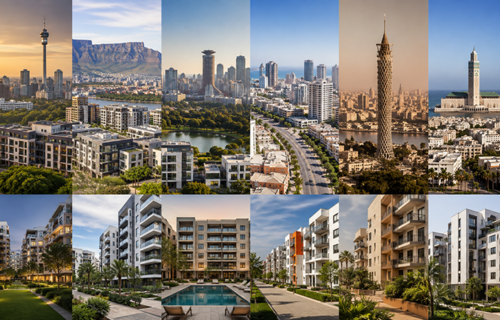
The cities most likely to attract that capital will not necessarily be those with the largest housing shortages. They will be the markets where land prices, construction costs, achievable rents and financing conditions can be brought into balance. Johannesburg already demonstrates that institutional rental housing can operate at scale. Cape Town has strong demand but higher development costs. Nairobi has attractive demographics but difficult financing mathematics. Lagos combines extraordinary housing demand with some of the continent’s toughest development economics. Accra remains early but is experimenting with institutional housing structures, while Cairo and Casablanca offer potentially attractive rental returns under very different macroeconomic conditions.
Africa’s urban expansion therefore represents a major long-term residential investment opportunity, but institutional capital will have to be far more selective than the continent’s demographic statistics initially suggest. The defining question is not how many Africans will need rental accommodation. That demand is already clear. The investment question is which cities can deliver apartments at a cost that allows tenants to afford the rent while still providing owners with predictable income and acceptable returns.
The African cities that solve that equation could turn today’s fragmented rental markets into one of the continent’s next significant institutional property sectors.
Source: © CIJ.World Africa Research & Analysis Team