Saturday, 19 September 2026
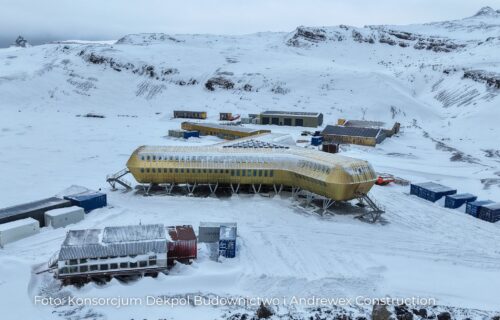
Construction of the new Polish Antarctic Station named after Henryk Arctowski has reached a significant milestone with the completion of the main building’s structural framework. The achievement marks the end of one of the most demanding phases of the project, carried out under some of the harshest environmental conditions on the planet.
The project is being delivered for the Institute of Biochemistry and Biophysics of the Polish Academy of Sciences (IBB PAN) by a consortium led by Dekpol Budownictwo, together with Andrewex Construction. Work has been underway on King George Island, located in the South Shetland Islands near the Antarctic Peninsula.
Construction activities carried out between November 2025 and April 2026 included the assembly of the building’s primary structure, floor systems and façade elements. The exterior was completed using specially selected cladding designed to withstand extreme weather conditions, including high humidity, salt exposure and strong winds.
The project team also advanced a range of internal works during the Antarctic summer season. These included the installation of partition walls, aluminium glazing systems, hydraulic lifting equipment, refrigeration and freezer facilities, as well as progress on electrical, mechanical and water infrastructure.
Before construction could begin, crews completed a week-long unloading operation for materials and equipment transported from Poland. Due to the absence of port infrastructure at the site, supplies were brought ashore using amphibious tracked transport vehicles.
The location presented considerable logistical and environmental challenges. Strong winds regularly interrupted construction activities, while humidity levels frequently exceeded 90 percent. Towards the end of the season, temperatures dropped to around minus 10 degrees Celsius, with wind chill reducing perceived temperatures to approximately minus 25 degrees Celsius.
Project representatives said that many of the technical solutions developed for the station have performed as expected under Antarctic conditions. These include high-resistance façade materials, reinforced window systems and insulation designed for severe weather. The main building has also been elevated approximately three metres above ground level to maintain access during periods of heavy snowfall.
Construction equipment and tools transported from Poland also proved reliable despite the remote location, which lies approximately 14,000 kilometres from Poland and offers limited opportunities for replacement supplies. In several cases, the construction team adapted or fabricated specialised tools using the station’s workshop facilities.
Work will continue throughout the Antarctic winter, with an 11-person team remaining on site to complete interior finishing activities. Planned works include the installation of timber joinery, completion of building services systems, floor finishes and other final fit-out elements.
The new station forms part of a broader modernization programme funded by Poland’s Ministry of Science and Higher Education. The overall project includes upgrades to research, residential, energy and technical infrastructure supporting Poland’s scientific activities in Antarctica.
The architectural concept for the new main building was developed by Kuryłowicz & Associates in cooperation with Buro Happold Polska, while technical design documentation was prepared by a consortium comprising DEMIURG Project, DEMIURG and Home of Houses. Project management and supervision involve a wide range of engineering, logistics and specialist consultants from Poland.
Once completed, the facility will provide modern research and living infrastructure for scientists working in one of the world’s most remote and environmentally challenging regions.