Tuesday, 15 September 2026
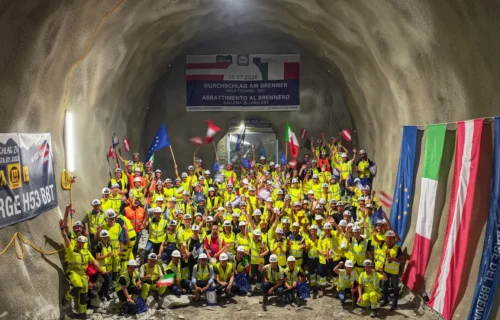
Construction of the Brenner Base Tunnel reached a major milestone as the ARGE H53 consortium, comprising PORR and MARTI, completed the breakthrough of both main tunnel tubes at the Austrian-Italian border.
The breakthrough connects the tunnel sections excavated from Austria with the previously completed Italian section, H61 Mauls 2–3, creating a continuous connection between the two countries through both main tunnel tubes.
The breakthrough took place around 1,408 meters beneath the Geigenspitze mountain at an elevation of approximately 794 meters above sea level. Construction crews encountered demanding geological conditions, excavating through hard central gneiss while working in underground temperatures of around 30°C and managing long transport distances.
Excavation on the H53 Pfons–Brenner section began in March 2024 using conventional drill-and-blast methods. By the time of the breakthrough, crews had completed approximately 5.0 km of the eastern tunnel and 5.1 km of the western tunnel. Depending on geological conditions, each blasting cycle advanced the tunnels by between two and five meters.
Construction of both tunnel tubes was carried out simultaneously, with teams of six to eight workers operating around the clock in four shifts. Surveying and construction required a high degree of precision, with deviations from the planned tunnel alignment limited to only a few centimetres over more than five kilometres to ensure the Austrian and Italian sections met accurately.
The milestone also marked the first time tunnelling teams working from Austria and Italy met underground after years of excavation.
The H53 contract includes the construction of 25.2 km of the two main tunnel tubes, together with an additional 3.6 km of connecting tunnel sections and their permanent concrete lining. The project is being delivered for BBT SE by the PORR–MARTI joint venture under a contract valued at €959 million.
Once completed, the 64 km Brenner Base Tunnel will become the central element of the rail corridor linking Austria and Italy beneath the Alps, improving both freight and passenger transport while supporting the transfer of traffic from road to rail.
Work will now continue on the next construction phase, with the tunnel boring machines Olga and Wilma continuing to excavate the main tunnel tubes towards Innsbruck.