Wednesday, 21 October 2026
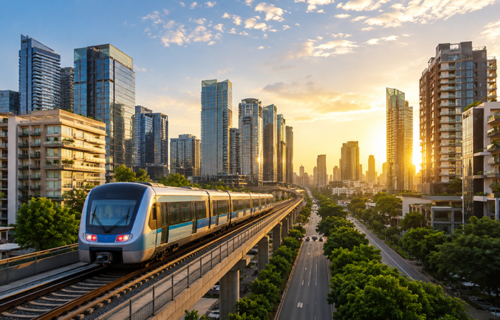
India’s rapid expansion of urban rail infrastructure is beginning to change the geography of its property markets. Metro systems and regional rail connections are no longer simply transport projects. As networks expand, they are influencing where people choose to live, where companies locate offices and where developers and investors identify the next generation of growth districts.
The relationship between transport and property is particularly important in India’s largest cities, where congestion has become one of the biggest constraints on urban expansion. A location may be geographically close to an employment centre but effectively much further away when commuting times are taken into account. New rail connections can change that calculation by bringing previously difficult-to-reach districts within practical commuting distance of major business centres.
This is creating opportunities around stations, transport interchanges and newly connected suburban districts. The effect, however, is more complicated than simply assuming that every property beside a metro station will increase in value. India’s planning strategy increasingly encourages greater development intensity around major public-transport infrastructure, combining improved accessibility with housing, employment, retail and services.
For real estate, this can significantly alter the development potential of land. Research published in 2025 estimated that India’s eight largest property markets contained more than 106 million sq. ft. of potential development or redevelopment associated with important transport locations. Delhi-NCR represented the largest opportunity at approximately 32 million sq. ft., followed by Mumbai with around 20 million sq. ft.
Chennai accounted for approximately 13 million sq. ft., Kolkata around 12 million sq. ft., Bengaluru 11 million sq. ft. and Hyderabad approximately 10 million sq. ft. Ahmedabad and Pune represented around four million sq. ft. each. These figures should not be interpreted as the total amount of property situated near metro lines. They represent identified opportunities around important transport locations, including major stations and interchange points where greater development intensity may become commercially viable.
The distinction is important because transport access alone does not create a successful property market. A station becomes much more powerful as a real-estate catalyst when it is combined with sufficient development land, supportive planning rules, pedestrian access, infrastructure and genuine demand for housing or commercial space.
Delhi-NCR provides one of India’s clearest examples. The region already has the country’s most extensive metro network and continues to expand it through Delhi Metro’s Phase IV programme. At the same time, the regional rail connection towards Ghaziabad and Meerut is creating a different form of property opportunity by reducing journey times between Delhi and neighbouring urban centres.
Meerut demonstrates the potential scale of the change. Around 3,273 hectares have been identified for transport-related development within the city’s planning framework, with approximately 2,442 hectares delineated into specific development areas associated with the regional rail and metro networks.
This creates the possibility of developing entire new districts rather than individual buildings around stations. Housing, offices, retail, hospitality and other commercial uses can potentially develop around the same transport infrastructure.
Property prices along parts of the Delhi-Meerut route have already recorded substantial increases. Market assessments during 2025 indicated that properties within approximately two kilometres of selected stations in Meerut had appreciated by around 30–50% over the preceding two years.
Those increases demonstrate the growing importance investors attach to transport connectivity, but they should not be interpreted as a pure railway premium. Property prices rarely move because of one factor alone. New highways, changing planning regulations, population growth, developer activity, new housing supply and broader market conditions can all influence values simultaneously.
Transport infrastructure is therefore better understood as a catalyst capable of accelerating other development forces. The strongest impact can occur where a major transport project reaches an area containing substantial undeveloped or underused land. Improved accessibility can suddenly make locations commercially viable for development that would previously have been difficult to justify.
In established districts, the effect can be different. Instead of creating entirely new neighbourhoods, improved public transport can strengthen existing property markets by making offices, shops and homes easier to reach.
Mumbai provides an example of this second model. Metro Line 3 has introduced a major underground north-south connection through some of the city’s most established employment and residential areas. With the route now operational across its 27 stations, its property impact can increasingly be assessed through actual changes in accessibility rather than expectations surrounding future construction.
The line connects important commercial, residential and transport locations across the city. Its significance for property lies largely in reducing dependence on road travel and improving access between districts that were already valuable but difficult to move between during peak periods. This could strengthen selected office and residential locations without necessarily creating completely new property markets.
Mumbai also illustrates why metro infrastructure should not be examined in isolation. The metropolitan region is simultaneously experiencing investment in roads, bridges, airports, redevelopment projects and other transport infrastructure. These projects collectively change journey times and development patterns. It is therefore difficult to attribute a specific percentage increase in property value solely to one metro line.
Bengaluru presents another version of the same transformation. The connection of Whitefield to the wider metro system has already improved public-transport access to one of India’s most important technology and office districts.
The next major development is the Blue Line, which is being constructed through the Outer Ring Road technology corridor towards Kempegowda International Airport. The route remains under development, meaning its full property impact is still prospective rather than proven. Nevertheless, it connects some of Bengaluru’s most important employment locations and could significantly alter commuting patterns once fully operational.
The northern part of Bengaluru has already experienced substantial property growth as airport development, highways and commercial expansion have changed the economics of areas including Hebbal, Yelahanka and Devanahalli. Future metro connectivity could reinforce this development, but it would be misleading to attribute the area’s appreciation entirely to rail infrastructure.
The airport itself, road improvements, technology-sector growth and availability of development land have all contributed. This highlights one of the most important lessons for property investors examining India’s transport expansion.
Proximity to a future metro station is not automatically an investment strategy. The strongest opportunities are more likely to emerge where several factors converge: transport infrastructure, employment growth, development land, appropriate planning rules and supporting social infrastructure.
When these elements come together, transport can dramatically increase the number of people capable of reaching a location within an acceptable commuting time. For residential developers, that can expand the pool of potential buyers and tenants.
For offices, improved transport can increase access to employees across a much wider part of the metropolitan area. This can become increasingly important as companies compete for skilled workers and employees become less willing to tolerate exceptionally long road journeys.
Retail property can benefit differently. Stations and interchange locations can generate large passenger flows, creating opportunities for convenience retail, food and beverage outlets and other services. Major transport hubs can eventually support much larger mixed-use developments where retail becomes one component of a broader commercial district.
Public authorities also have an economic interest in encouraging development around stations. Urban rail infrastructure requires substantial capital investment. Increasing the development value of land around stations can create opportunities to generate additional revenue through development rights, leasing, commercial projects and other mechanisms.
This connection between infrastructure investment and property value is likely to become increasingly important as India’s metro networks continue expanding. It can also encourage cities to develop more intensively around existing infrastructure rather than continuing to expand indefinitely across peripheral land.
That could gradually change the physical form of India’s metropolitan areas. Instead of employment being concentrated primarily in one or two traditional business districts, cities can develop several commercial and residential centres connected through high-capacity public transport.
Delhi-NCR already demonstrates elements of this structure, with major employment centres distributed between Delhi, Gurugram and Noida. Bengaluru’s technology sector is similarly spread across several office corridors, while Mumbai contains multiple commercial centres stretching across the metropolitan region.
Improved public transport can make these decentralised urban structures more functional. However, the quality of the connection between a station and surrounding property is critical.
A building may technically sit close to a metro station but still provide poor accessibility if pedestrians must cross major roads, navigate inadequate pavements or rely on another vehicle to complete the journey. Walking conditions, bus connections and other local transport options therefore influence the actual value created by metro infrastructure.
The strongest locations are likely to be those where different transport systems connect efficiently. Metro lines linked with regional railways, buses, airports and major road networks can create substantially larger catchment areas than isolated stations.
This helps explain why major interchange locations are increasingly attractive for large-scale redevelopment. For investors, timing is another important consideration.
Property markets frequently react to infrastructure announcements long before projects begin operating. Landowners and developers may increase asking prices once a new route is confirmed, meaning part of the expected future benefit can already be reflected in values several years before completion.
Buying property near an announced station therefore does not guarantee superior returns. Construction delays, changes in project schedules and excessive speculative pricing can reduce potential investment performance.
The most attractive point in the development cycle may occur when transport infrastructure has advanced sufficiently to reduce completion risk but surrounding property prices have not yet fully reflected the future improvement in accessibility. This makes project selection considerably more important than simply identifying properties within a fixed radius of metro stations.
India’s estimated 106 million sq. ft. of development potential around major transport locations demonstrates the scale of the immediate opportunity, but the longer-term market could become considerably larger.
As additional metro lines and regional transport systems open, new areas will become accessible for more intensive development. For developers, this can create opportunities for housing, offices, retail and mixed-use projects. For institutional investors, mature transport-connected districts can provide access to properties supported by deep occupier markets and increasingly resilient long-term demand.
There is nevertheless no reliable national formula showing that a property located a certain distance from a metro station will automatically appreciate by a specific percentage. Evidence from locations such as Meerut shows that substantial appreciation can accompany major transport investment, but the outcome depends heavily on local circumstances.
The more important investment principle is accessibility. Properties become more valuable when people can reach them easily from employment centres, residential areas and other important parts of the city.
Metro infrastructure can provide that accessibility at a scale that roads alone increasingly struggle to deliver in India’s largest metropolitan areas. India’s urban rail expansion is therefore developing into much more than a mobility programme.
It is beginning to influence the location and intensity of future property development, creating opportunities around new stations while strengthening selected established districts. Delhi-NCR demonstrates how regional rail can open large areas for development. Mumbai shows how new metro capacity can improve connectivity across an already mature property market. Bengaluru illustrates how rail infrastructure can reinforce expanding employment and airport corridors.
The effects will not be uniform, and not every metro station will create a successful investment market. But as India’s cities become larger and more congested, reliable public transport is likely to become an increasingly important component of property quality.
For developers and investors, the next generation of growth locations may therefore be determined less by simple distance from the city centre and more by how quickly and reliably people can reach them.
Source: © CIJ.World India Research & Analysis Team