Wednesday, 21 October 2026
Germany’s industrial transformation is creating an unusual real estate challenge. Large automotive plants and traditional manufacturing facilities are coming under pressure at the same time that defence, robotics, semiconductors and other advanced industries are searching for additional production capacity. The result could be one of the largest industrial property repositioning exercises Germany has faced in decades.
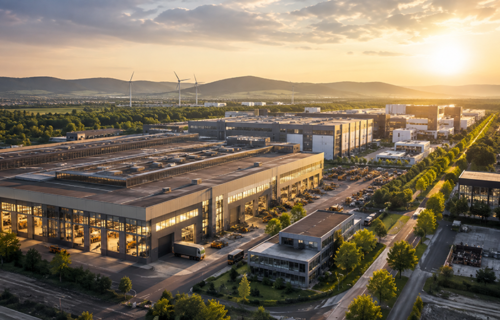
The question is no longer simply what happens to factories when traditional manufacturing contracts. Increasingly, investors, industrial companies and municipalities must decide whether existing sites can support the industries Germany wants to expand next. This matters because a manufacturing plant represents considerably more than the buildings visible from outside. Large German industrial campuses can contain substantial electricity connections, internal roads, rail infrastructure, water capacity, loading facilities, workshops, offices, testing areas and extensive secured land. Around many plants there is also an established workforce with decades of experience in engineering, machining, electronics, automation and industrial production.
Recreating that combination on a greenfield site can take years. That makes some factories whose original purpose is disappearing potentially valuable platforms for a new generation of manufacturing.
The automotive industry provides the most immediate source of such opportunities. German carmakers and suppliers are restructuring production as they respond to weaker demand, international competition, electrification and pressure to reduce costs. Some facilities are operating below previous capacity, while the future of others is increasingly uncertain.
Volkswagen’s Osnabrück plant has become one of the clearest examples of what industrial transition could look like. The factory faces uncertainty over vehicle production beyond 2027, creating a search for alternative uses for a site employing thousands of people. During the second quarter of 2026, discussions involving international defence company Rafael demonstrated that an automotive plant could realistically be considered for military-related manufacturing.
Whatever ultimately happens at Osnabrück, the significance extends beyond one factory. A car plant already possesses many characteristics a defence manufacturer would otherwise need to create. Large production halls, heavy electricity infrastructure, loading areas, secure land and skilled employees can dramatically reduce the time required to establish additional manufacturing capacity. That could become increasingly valuable as Germany expands defence expenditure and companies respond with larger production programmes.
Defence manufacturers are already becoming more visible in Germany’s industrial property market. As order books increase, companies require additional assembly space, engineering facilities, secure warehouses, testing locations and supplier capacity. The most specialised military facilities will probably continue to be developed and owned directly by defence companies, but the wider supply chain could create a much broader property opportunity.
Component manufacturers, electronics companies, engineering businesses, maintenance providers and logistics operators serving defence programmes can occupy relatively conventional industrial buildings. These properties may be capable of accommodating other advanced manufacturers later, making them more suitable for institutional investment than highly specialised weapons-production facilities.
The opportunity is particularly interesting because Germany’s defence expansion coincides with excess capacity emerging elsewhere in manufacturing. Instead of developing every new factory on undeveloped land, companies may be able to reuse existing industrial infrastructure. For government and municipalities, that can preserve employment and reduce the economic impact of automotive restructuring. For manufacturers, it can provide faster access to skilled workers and functioning industrial sites.
For property investors, however, the equation is more complicated. An empty factory is not automatically a cheap factory. Large automotive plants are frequently designed around highly specific production processes. Their floor layouts, ceiling heights, structural grids and loading arrangements may not suit another occupier. Machinery removal can be expensive, older buildings can require substantial energy upgrades and decades of industrial activity may leave environmental liabilities.
A facility that appears attractive because of its low purchase price can therefore require enormous additional expenditure before another manufacturer can use it. The ability to divide a site is another important consideration. A vehicle manufacturer might occupy several hundred thousand square metres across one campus, while few replacement occupiers require the same amount of space.
Successful redevelopment may therefore depend on transforming a single factory into a multi-occupier industrial district. That could involve retaining the best production halls, demolishing obsolete buildings and creating separate units for engineering companies, manufacturers, laboratories, warehouses and technology businesses. In effect, yesterday’s factory could become tomorrow’s industrial park.
This approach could also reduce reliance on finding one enormous replacement employer. Instead of replacing one automotive company with another company employing thousands of workers, a site could accommodate dozens of businesses across several growing industries.
Defence is only one possibility. Robotics and industrial automation could be particularly compatible with Germany’s existing automotive regions. The country’s car industry has spent decades developing expertise in automated manufacturing, machine vision, precision engineering, control systems and industrial software. That knowledge does not disappear when vehicle production declines.
Regions containing automotive engineers and suppliers could therefore attract companies producing robots, automation equipment, autonomous systems and specialised machinery. Many of these businesses require high-quality manufacturing and engineering space but do not need the highly specialised infrastructure associated with semiconductor fabrication or battery-cell production.
Semiconductors present a different opportunity. Germany continues to expand chip production, particularly around Dresden, where major investments are reinforcing one of Europe’s most important semiconductor clusters. However, converting a conventional automotive factory directly into a semiconductor fabrication plant is generally unrealistic.
Chip factories require extraordinary levels of vibration control, water purification, electricity reliability, cleanroom infrastructure and environmental control. Building these systems inside an existing factory can sometimes be more complicated than constructing a purpose-designed facility. The greater property opportunity may therefore sit around semiconductor production rather than inside the fabrication plants themselves.
Equipment manufacturers, component suppliers, electronics businesses, engineering companies, packaging operations and logistics providers can use more conventional industrial buildings. Former manufacturing sites located close to semiconductor clusters could consequently benefit from the industry’s expansion without becoming chip factories themselves.
Battery manufacturing provides another possible route, but recent developments show why investors should remain cautious. Germany has attracted significant battery investment as European carmakers attempt to develop regional supply chains. At the same time, some proposed gigafactory projects have been delayed or abandoned as manufacturers reconsider costs and future demand.
This demonstrates an important lesson for industrial property investors: government industrial strategy does not guarantee occupier demand. A factory cannot be valued simply on the assumption that batteries, defence or another politically favoured industry will eventually occupy it. Redevelopment needs to work against realistic demand from identifiable companies.
Power infrastructure could become one of the most important determinants of which sites succeed. Modern industrial users increasingly require enormous electricity capacity. Battery production, semiconductor manufacturing, data centres and some advanced industrial processes all compete for grid connections.
Germany’s electricity infrastructure cannot always accommodate major new users quickly. A redundant factory with an existing high-capacity connection may therefore possess strategic value even if much of the original building stock eventually has to be demolished. This changes how investors should assess older industrial property.
The most valuable part of a former manufacturing campus may not be the factory itself. Its electricity connection, rail siding, road access, water infrastructure, planning status and land ownership could be worth more than the existing halls. In some cases, the best redevelopment strategy may therefore involve preserving the site’s infrastructure while replacing most of its buildings.
Access to labour can be equally valuable. German automotive and engineering regions contain workers with highly transferable industrial skills. Welding, machining, electronics, quality control, automation and precision manufacturing are relevant to many industries beyond car production.
A defence or robotics company choosing between an undeveloped site and a former automotive plant may therefore be comparing not simply land prices but the availability of an entire industrial ecosystem. This could benefit regions that might otherwise appear vulnerable to automotive restructuring.
Some secondary industrial locations may become attractive precisely because they contain established manufacturing workforces and infrastructure. That could give them an advantage over more expensive metropolitan logistics markets where industrial land is scarce and skilled production labour can be harder to find.
Not every location will benefit. Germany’s automotive manufacturing footprint is too large for defence, robotics, batteries and semiconductor suppliers to absorb every site that could eventually become surplus. Some factories are also located in markets with limited alternative industrial demand. If a site requires extensive environmental remediation, has obsolete buildings and lacks modern power capacity, retaining its manufacturing function may no longer make financial sense.
Those properties could ultimately require more radical redevelopment. Factories close to expanding cities may be converted into logistics parks, mixed commercial districts or residential-led projects where planning allows. Other sites could be demolished and rebuilt as modern industrial estates. A smaller group may remain vacant for extended periods while owners, municipalities and lenders search for economically viable alternatives.
The German industrial transition will therefore create winners and losers at property level. The strongest sites are likely to combine substantial electricity capacity, transport infrastructure, flexible buildings, large plots and access to skilled workers. Locations close to established defence, aerospace, semiconductor or advanced engineering clusters should have additional advantages.
The weakest sites will be those where the existing buildings are highly specialised, remediation costs are high and replacement occupier demand is limited. This distinction could create opportunities for specialist property investors.
Rather than acquiring conventional warehouses with established tenants, investors could purchase large industrial campuses and reposition them for several occupiers. The strategy would resemble urban regeneration but on an industrial scale. Existing halls could be refurbished, obsolete structures removed, large sites subdivided and new roads and utilities used to create separate development plots. Flexible manufacturing and logistics buildings could then be added over time.
Such projects would require substantially more capital and expertise than ordinary logistics investments, but successful conversions could create industrial property in locations where obtaining new development land is increasingly difficult.
Germany’s planning system provides another reason why existing industrial land can be valuable. Securing approval for large new manufacturing developments can be slow, particularly when projects involve significant energy requirements, environmental impacts or local opposition. Established industrial sites may already possess land-use rights and infrastructure that would be difficult to reproduce elsewhere.
The time saved can become commercially important for industries under pressure to expand rapidly. This is particularly relevant to defence. Germany can increase military budgets much faster than industry can construct factories. If existing manufacturing sites can be adapted safely and economically, they could shorten the period between procurement decisions and actual production.
The same principle applies to other strategic industries. Germany wants greater domestic capacity in semiconductors, batteries, automation and advanced technology. All of these ambitions ultimately require physical property.
The industrial transition is therefore creating a new way of valuing Germany’s manufacturing heritage. A factory that no longer makes economic sense for its existing occupier should not automatically be considered obsolete real estate. Its buildings may be outdated, but the combination of land, infrastructure, energy and labour surrounding it can remain highly valuable.
The critical investment question is whether converting that infrastructure costs less than recreating it elsewhere. Where the answer is yes, Germany’s ageing industrial sites could become some of the most interesting redevelopment opportunities of the next decade. Where the answer is no, owners may discover that yesterday’s manufacturing assets have little value beyond their land.
The distinction will increasingly matter as automotive restructuring releases more industrial capacity while Germany simultaneously attempts to build new strategic industries. Germany’s next generation of factories may therefore not always rise on empty fields.
Some could emerge behind the gates of industrial plants built decades ago for an entirely different economy, retaining the power connections, skilled workforce and infrastructure of Germany’s manufacturing past while producing the technologies of its industrial future.
Source: CIJ.World Research & Analysis Team