Wednesday, 7 October 2026
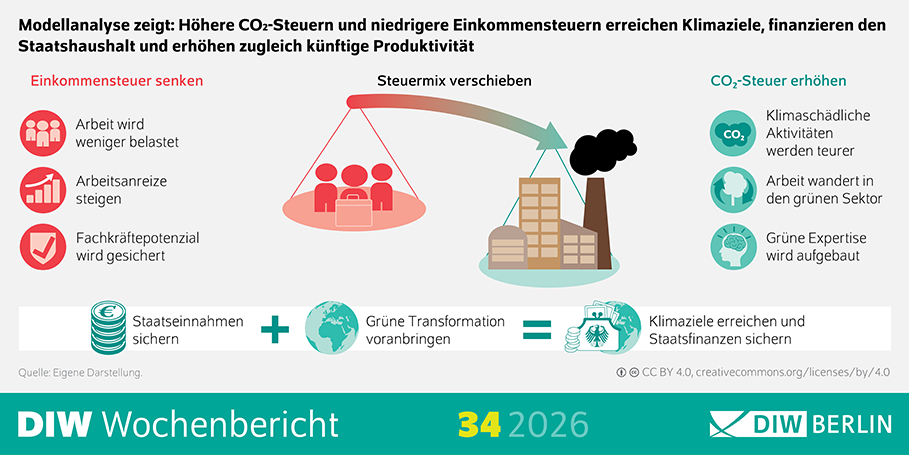
Higher carbon prices could have economic effects extending beyond reducing emissions, potentially accelerating the development of skills and productivity in climate-friendly industries, according to a model analysis by the German Institute for Economic Research (DIW Berlin).
The research challenges the idea that carbon pricing should be assessed mainly through the immediate costs it imposes on businesses and households. DIW’s analysis suggests that increasing the cost of emissions can gradually redirect employment towards lower-carbon activities, allowing workers and companies to accumulate experience with new technologies and production methods.
As employment shifts, knowledge and expertise develop within these sectors. According to the model, this learning process can improve productivity over time and potentially strengthen the economic foundations of the transition towards lower-carbon production.
“The concern that higher CO2 prices primarily burden the economy falls short,” said Sonja Dobkowitz, researcher in DIW Berlin’s macroeconomics department. She argues that focusing exclusively on immediate costs overlooks the knowledge and experience generated as workers move into emerging industries.
The study is based on a model using US data, although DIW says the underlying economic mechanism can also be applied to economies such as Germany. Germany does not operate solely through a conventional carbon tax, with carbon costs also established through emissions trading. From an economic perspective, the researchers argue that the important factor is that emissions carry a financial cost capable of influencing investment and production decisions.
The findings are particularly relevant as European governments face competing demands on public finances. Decarbonisation requires substantial investment while governments simultaneously need to support economic activity, maintain public services and manage pressure on household incomes.
Carbon pricing provides governments with revenue while also influencing where economic activity takes place. However, it creates a complicated fiscal relationship because successful climate policy progressively reduces the emissions from which that revenue is generated.
Higher carbon costs can also initially move workers from established industries into greener sectors where productivity may be lower during their early development. This can temporarily reduce wages and taxable labour income.
DIW’s modelling nevertheless suggests that these disadvantages can eventually be outweighed by productivity improvements generated through experience. As more employees work with climate-friendly technologies, their knowledge grows and businesses become better at applying those technologies efficiently.
This leads the researchers to a notable conclusion: an economically appropriate carbon price could potentially be higher than a level calculated solely according to the estimated social damage caused by emissions. Carbon pricing would then serve two purposes, discouraging pollution while accelerating the accumulation of skills required by a lower-carbon economy.
The way governments use the resulting revenue becomes important. DIW argues that additional carbon-related income should be used partly to reduce taxes on employment.
Lower income taxation could increase employees’ take-home pay and strengthen incentives to work, helping offset some of the economic burden created by higher carbon costs. The approach would effectively shift part of the tax burden away from employment and towards activities associated with emissions.
Such a strategy could have implications for investment across the economy. Higher carbon costs would strengthen the financial incentive for companies to improve energy efficiency, electrify processes and invest in cleaner technology, while lower taxation of labour could partly reduce the cost pressure associated with employment.
For real estate, the same economic logic could reinforce investment in energy-efficient buildings. As the cost attached to fossil-energy consumption rises, inefficient properties become comparatively more expensive to operate, strengthening the business case for renovation, improved heating systems and lower-energy new construction.
The effect could become increasingly visible in asset valuations and occupier decisions. Buildings requiring substantial energy expenditure may face higher operating costs, while properties capable of functioning with lower emissions could gain an advantage as carbon pricing becomes more influential.
However, the DIW analysis has important limitations. Its model represents an average household and therefore does not measure how higher carbon prices affect different income groups.
This matters because energy and transport expenditure generally consume a larger proportion of lower-income household budgets. DIW consequently acknowledges that stronger carbon pricing would need to be accompanied by targeted measures protecting households disproportionately affected by higher costs.
The model also does not capture every possible response from industry. In particular, it does not incorporate the possibility that energy-intensive manufacturers could move production abroad when faced with significantly higher domestic carbon costs.
That risk is especially relevant for European industries competing with producers operating in countries with less demanding environmental policies. If production simply moves elsewhere, part of the intended environmental benefit can be lost while domestic employment and investment are weakened.
The findings therefore do not imply that increasing carbon prices automatically improves economic performance. The outcome depends partly on how the wider tax system, household support and industrial policy respond.
The broader argument is nevertheless significant for Europe’s transition. Climate policy is frequently discussed as a trade-off in which governments accept near-term economic costs in exchange for lower future emissions. DIW’s research suggests that this interpretation may overlook an additional economic benefit.
If carbon pricing encourages workers, businesses and investment to move towards emerging technologies, the transition itself can create expertise. Over time, that accumulated knowledge can make low-carbon industries more productive and potentially more competitive.
The debate over carbon prices consequently extends beyond determining how expensive emissions should become. It also concerns how governments recycle the revenue and whether economic policy allows the skills generated during the transition to translate into higher productivity.
From this perspective, keeping carbon prices artificially low may reduce immediate pressure on companies and households but could also slow investment and learning in industries expected to become increasingly important to Europe’s economy.
DIW’s analysis therefore presents carbon pricing not simply as an environmental charge, but as a potential mechanism for influencing where future productivity develops. The challenge for policymakers is ensuring that the transition encourages investment and expertise without placing disproportionate costs on vulnerable households or undermining the international competitiveness of European industry.