Sunday, 25 October 2026
Germany’s economy is showing increasingly convincing signs of stabilisation after a prolonged period of weak growth, with improving industrial activity, stronger exports and rising business confidence providing momentum. The recovery remains uneven, however, as subdued household spending, employment weakness, higher energy costs and continuing geopolitical risks limit the prospect of a rapid rebound.
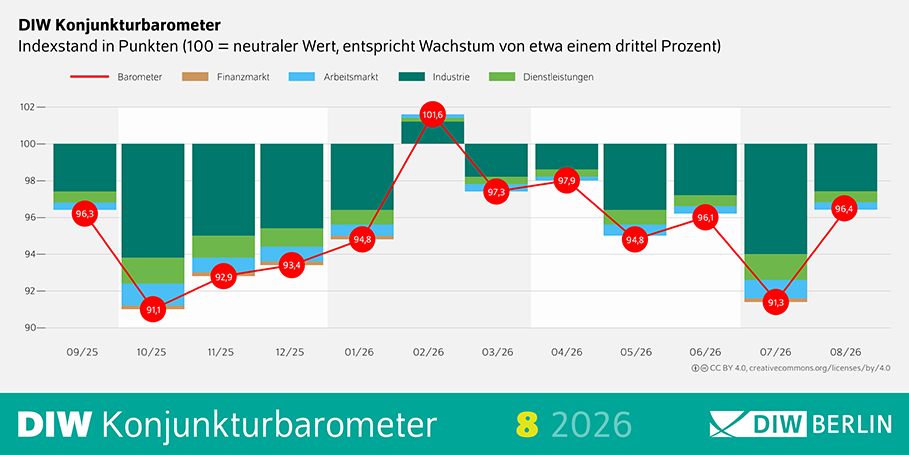
The latest economic barometer from DIW Berlin rose by more than five points in August to 96.4, reversing much of the decline recorded in July and moving closer to the 100-point level associated with Germany’s longer-term average rate of economic expansion. Official figures provide some support for the improving picture. Germany’s economy expanded by 0.3% quarter-on-quarter in the second quarter of 2026, according to the latest detailed figures from the Federal Statistical Office. The result was revised upwards from the preliminary estimate of 0.2% and followed growth in the opening quarter of the year.
The improvement remains modest, but two consecutive quarters of expansion are significant after several years in which Germany struggled with weak industrial production, high energy costs, declining competitiveness and subdued investment. “The economic barometer, which has fluctuated in recent months, reflects the overall unstable economic picture, but the German economy now appears to be slowly finding its footing,” said Geraldine Dany-Knedlik, Head of Economic Forecasting at DIW Berlin.
Business confidence provides another indication that conditions are improving. The ifo Business Climate Index increased from 86.7 points in July to 88.8 in August, with companies reporting better assessments of both their present situation and expectations for the months ahead. Manufacturing recorded a particularly noticeable improvement in sentiment. The sector’s ifo balance increased from -9.6 to -4.2 during August. Manufacturers were more positive about current conditions and less pessimistic about the outlook, although companies continued to report dissatisfaction with their order books.
The industrial evidence therefore points towards stabilisation rather than a powerful manufacturing rebound. Official production figures reinforce that distinction. German industrial output increased 0.2% month-on-month in June, following a revised 0.7% increase in May. Production during the second quarter was 0.7% higher than in the preceding three months, but June output remained slightly below its level a year earlier.
Manufacturing orders have strengthened more substantially. Real new orders increased 3.1% month-on-month in June and 6.5% compared with a year earlier, with domestic demand particularly strong. The headline figure nevertheless requires qualification. When unusually large orders are removed, manufacturing orders declined 0.5% from the previous month. Machinery, electronics and other sectors receiving major individual contracts contributed heavily to the overall increase.
Germany’s growing defence expenditure appears to be one factor supporting this part of the industrial economy. Larger public investment programmes could provide manufacturers, construction companies and infrastructure businesses with a more dependable source of demand at a time when private investment remains comparatively restrained.
“Exports and strong public investment are currently stabilising economic activity in Germany and providing greater confidence in industry,” said Laura Pagenhardt, economic expert at DIW Berlin. “The decisive issue now is whether these short-term impulses are followed by more private investment, higher productivity and a sustainable strengthening of Germany as a business location.”
Foreign trade is another increasingly supportive component. German exports reached approximately EUR 817.8 billion during the first half of 2026, around 3.9% higher than a year earlier in nominal terms. June exports increased 0.9% from May and stood 6.6% above their level in June 2025. The figures support the view that external demand is helping Germany’s recovery, although descriptions of exports reaching record levels need qualification. Nominal trade values are influenced by prices, and Germany’s inflation-adjusted trade volumes have not recovered as strongly as the headline monetary figures suggest.
The economic picture is considerably weaker when attention turns towards German households. Consumer confidence remains subdued, while renewed inflationary pressure and an uncertain labour market are limiting household expenditure. Employment has recently declined, reducing the likelihood that consumer spending will provide a powerful additional growth engine in the immediate future.
Services are consequently experiencing different conditions depending on their exposure to business or household demand. Business-oriented services have become more optimistic, while consumer-facing activities remain restrained. Construction sentiment also improved noticeably in August, although companies remained cautious about their current operating conditions. This suggests that expectations surrounding infrastructure and public investment may be improving faster than actual activity on the ground.
For commercial real estate, this uneven economic recovery is important. Industrial and logistics property could be among the earlier beneficiaries if manufacturing production, exports and public investment continue improving. Greater industrial confidence can eventually translate into investment in production capacity, supply chains and distribution facilities, although the still-fragile order situation argues against expecting a rapid return to aggressive occupier expansion.
Infrastructure-related real estate could also benefit from Germany’s increasing public expenditure. Defence, energy, transport and digital infrastructure investment can generate requirements extending beyond the projects themselves into manufacturing, logistics, technical services and supporting property.
The outlook for offices is more complicated. Improving business confidence and business-service activity are supportive, but economic growth alone is unlikely to reverse structural changes in office demand. Employment trends, corporate investment and workplace strategies will remain at least as important as headline GDP growth.
Retail property faces a less favourable economic backdrop. Weak consumer confidence, higher prices and uncertainty around employment are restraining discretionary spending. Prime retail locations may continue to perform relatively well, but economic stabilisation has not yet developed into the household-led recovery that would provide broad support across the sector.
Germany also continues to face external risks capable of interrupting the improvement. DIW points particularly to geopolitical instability in the Persian Gulf, disruption affecting shipping through the Strait of Hormuz and renewed increases in oil prices. Low water levels on important German waterways following this summer’s unusually hot conditions represent another constraint. Reduced shipping capacity can increase the cost of transporting raw materials and industrial goods, adding pressure to manufacturers already dealing with relatively high energy and production costs.
These factors help explain why the latest indicators should not be interpreted as confirmation that Germany has entered a strong new growth cycle. The evidence is nevertheless becoming more encouraging. GDP has expanded for two consecutive quarters, business confidence improved in August, exports strengthened during the first half and industrial production appears to be stabilising. Manufacturing orders also provide evidence of improving demand, even if large individual contracts are responsible for part of the increase.
For Germany’s property market, the important question is therefore shifting from whether the economy can escape stagnation towards which parts of the economy will lead the recovery. At present, the answer appears to favour industry, exports and public investment rather than household consumption. If that pattern continues, Germany could experience a correspondingly uneven commercial property recovery, with industrial, logistics and infrastructure-related assets gaining momentum before sectors more dependent on consumers or broad private-sector expansion.
The foundations are becoming firmer, but Germany has yet to demonstrate that the improvement can develop into sustained investment, employment and productivity growth. For property investors, that distinction will matter more than whether any single economic indicator has finally moved back into positive territory.