Saturday, 24 October 2026
For decades, the formula for successful industrial property development was relatively straightforward: secure affordable land with access to roads, ports, workers and major consumer markets. Across Africa, another factor is increasingly becoming just as important. Manufacturers, logistics companies, data centres and other power-intensive occupiers need to know not simply whether electricity is available, but whether sufficient capacity can be delivered reliably and at a commercially sustainable cost.
This is beginning to change the geography of industrial investment. Africa possesses large areas of comparatively inexpensive development land, yet land alone cannot support manufacturing. Factories require continuous electricity for machinery, cooling, processing and production systems, while modern logistics facilities increasingly depend on automation, refrigeration and sophisticated warehouse technology. Data centres take the requirement considerably further, making access to large quantities of dependable electricity one of the fundamental criteria determining where projects can be developed.
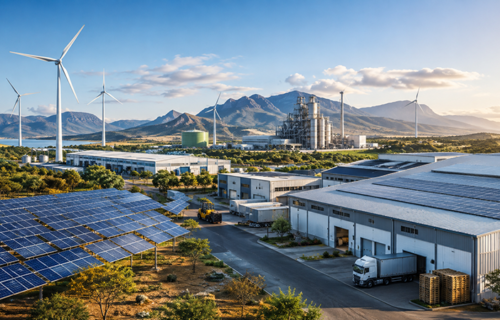
Renewable-energy investment is potentially altering this equation. Solar, wind, geothermal and hydroelectric generation can increase available capacity, reduce exposure to imported fuels and allow industrial developments to create more resilient power systems. When combined with storage, grid infrastructure and backup capacity, renewable generation can therefore become part of the competitive proposition of an industrial location.
The distinction is important because renewable electricity is not automatically reliable electricity. Solar generation falls when the sun disappears and wind output changes with weather conditions. A factory operating continuous production cannot simply stop whenever generation declines. Industrial occupiers therefore need complete energy systems combining generation with storage, grid access, alternative supply or other forms of balancing capacity.
For industrial-property investors, this means the relevant question is increasingly broader than whether a development has solar panels. What matters is how much power can be delivered to occupiers, how dependable that supply is, what it costs and whether additional capacity can be provided when tenants expand.
South Africa provides perhaps the clearest example of how energy conditions can influence commercial property decisions. Years of electricity constraints encouraged landlords and occupiers to invest directly in alternative generation and energy resilience. Rooftop solar, embedded generation, battery systems and backup electricity have consequently become increasingly common features of modern industrial and logistics developments.
This has changed what occupiers expect from buildings. A distribution centre with excellent motorway access but unreliable electricity may be less attractive than a competing facility capable of maintaining operations during disruption. For manufacturers, where an interruption can stop an entire production line, the economic difference can be considerably greater.
The result is that energy infrastructure is increasingly becoming part of industrial property quality. Developers capable of providing dependable electricity can potentially differentiate their projects in much the same way that superior road access, ceiling heights, loading facilities and yard space distinguish modern logistics buildings from older stock.
South Africa could therefore provide an early indication of whether an identifiable power premium begins to develop within African industrial property. That premium may not necessarily appear solely through higher rents. Energy-secure buildings could benefit through lower vacancy, stronger tenant retention, reduced operating disruption and greater appeal to institutional investors.
The relationship between power and property could become even more significant as manufacturing processes become increasingly electrified. Companies attempting to reduce emissions across international supply chains are also paying greater attention to the source of electricity used by their factories. An industrial location capable of providing reliable renewable electricity can therefore potentially offer both an operating advantage and an environmental one.
Morocco provides a particularly important example of how those factors can converge. The country has developed substantial renewable-energy capacity while simultaneously expanding automotive, aerospace, electronics and other manufacturing industries. Tangier and the industrial areas connected with Tanger Med demonstrate how transport infrastructure, industrial land and export-oriented manufacturing can combine to create a major production cluster.
Renewable power adds another component to that proposition. Manufacturers exporting into European markets are increasingly exposed to environmental requirements from customers, investors and regulators. The carbon intensity of electricity used in production can therefore influence the competitiveness of manufacturing locations.
This could become particularly important for industries such as batteries, automotive components and other products incorporated into lower-carbon supply chains. Morocco’s proximity to Europe, established industrial base and continuing renewable-energy investment give it an opportunity to position industrial development around both logistics efficiency and cleaner electricity.
The property implications extend beyond individual factories. As manufacturing clusters deepen, suppliers require additional industrial units, warehouses and distribution facilities. Logistics companies need space to handle materials and finished products, while developers require serviced land capable of accommodating future expansion. Energy availability can consequently influence demand across an entire industrial ecosystem.
Egypt is pursuing the relationship between energy and industrialisation at considerably larger scale. The country has substantial solar and wind resources and is seeking to expand renewable generation while attracting manufacturing and energy-intensive industries.
The Suez Canal Economic Zone is particularly relevant because ports, industrial land, logistics infrastructure and energy investment are being developed within the same broader economic corridor. Sokhna and other locations along the zone are attracting manufacturing projects alongside plans associated with renewable energy and green hydrogen.
For commercial property investors, however, announced investment should be distinguished from completed industrial development. Large energy and manufacturing agreements can create expectations of future demand without immediately producing occupied factories, warehouses or rental income. The important measure will be how much announced capital ultimately becomes operational industrial capacity.
If that conversion occurs at scale, the property consequences could be substantial. Energy-intensive industries require large sites, specialised buildings, storage facilities and extensive supporting infrastructure. Their suppliers and logistics providers can then create secondary demand for conventional industrial and warehouse space.
Green hydrogen could amplify this effect because production requires large quantities of renewable electricity and supporting infrastructure. Projects may therefore create new industrial clusters around locations where renewable generation, water, ports and available development land can be combined.
Namibia provides one of the most interesting tests of this model. The country’s enormous renewable-energy potential has generated plans for large green-hydrogen investments, particularly in the south and around coastal export infrastructure.
If those projects move from planning into large-scale operation, they could influence property markets around places such as Lüderitz and Walvis Bay. Industrial land, logistics facilities, storage, port infrastructure, construction accommodation and eventually permanent worker housing could all experience additional demand.
The important point is that energy investment could create industrial locations where little institutional property demand previously existed. Rather than renewable generation simply supporting an established city, the availability of energy could help determine where entirely new economic clusters develop.
Kenya offers a different model because geothermal power provides a comparatively stable form of renewable electricity. The country’s geothermal resources around the Rift Valley create opportunities that differ significantly from intermittent solar and wind generation.
The Naivasha area is particularly interesting from an industrial-property perspective because geothermal generation, transport infrastructure and available industrial land can potentially reinforce one another. The connection with Kenya’s Standard Gauge Railway and the wider transport system creates the possibility of combining energy access with logistics connectivity.
This could strengthen the case for energy-intensive manufacturing and processing facilities outside Nairobi. Industrial development does not always need to sit beside the largest consumer market if reliable transport allows goods to move efficiently and another location offers significantly better power economics.
The same principle could become increasingly important across Africa. Historically, manufacturers frequently concentrated around major cities because that was where infrastructure, workers and customers were located. Improved transport corridors and decentralised renewable generation can potentially give secondary industrial locations a stronger competitive position.
Zambia and the Democratic Republic of Congo demonstrate why this matters for mineral processing. Both countries occupy important positions in global copper and critical-mineral supply chains, yet the largest economic benefit comes when raw materials are processed and transformed into higher-value products rather than simply extracted and exported.
Additional processing requires substantial quantities of electricity. Expanding reliable generation could therefore influence whether more refining, processing and eventually manufacturing can take place closer to the mineral resource.
If that occurs, the property consequences would extend beyond mining sites. Processing plants require industrial land, logistics facilities, warehouses, maintenance operations and supporting services. More sophisticated manufacturing can create additional supplier networks and demand for purpose-built industrial accommodation.
This highlights a wider opportunity for Africa. The continent possesses many of the minerals required for batteries, renewable-energy equipment and other technologies, but resource ownership alone does not guarantee that manufacturing will occur locally. Industrial infrastructure, skills, finance, transport and dependable electricity remain essential.
Renewable-energy investment can address one part of that equation, but it cannot solve the entire industrialisation challenge. A solar farm does not compensate for poor roads, congested ports, uncertain regulation or inadequate water infrastructure. Successful industrial locations will increasingly be those capable of combining several advantages rather than relying on one.
This is why the relationship between renewable power and special economic zones could become particularly important. An industrial park capable of offering serviced land, efficient customs procedures, transport connectivity and dependable electricity provides a considerably stronger proposition than a zone offering tax incentives but weak physical infrastructure.
Developers may consequently begin treating electricity capacity as part of the property product itself. Instead of marketing only the size and location of industrial plots, projects can increasingly compete on guaranteed power availability, renewable content, backup systems and the ability to accommodate energy-intensive occupiers.
Data centres could accelerate this shift. Africa’s digital infrastructure market is expanding rapidly, but data centres require far more electricity than conventional warehouses and many manufacturing facilities. Their site-selection requirements can therefore place enormous importance on grid capacity, renewable generation and long-term power availability.
A location unable to provide sufficient electricity may be excluded regardless of how attractive its land prices are. Conversely, industrial areas capable of combining fibre connectivity, large development sites and reliable renewable power could attract investment that would previously have concentrated in established metropolitan markets.
This changes the economics of industrial land. Cheap land without electricity can remain cheap because occupiers cannot use it effectively. More expensive land connected to dependable power infrastructure may generate considerably greater development value.
For institutional investors, this could eventually influence acquisition strategy. Energy resilience may become part of industrial-property due diligence alongside tenant covenant, lease length, location, building specification and transport connectivity.
Older industrial estates could face a similar challenge to ageing office buildings. Properties designed for relatively modest electricity requirements may struggle to accommodate manufacturers using increasingly automated production equipment, electric vehicle fleets or high-capacity cooling systems. Upgrading electricity infrastructure can therefore become an important part of asset repositioning.
The opportunity is not restricted to large power projects. Rooftop solar installed across logistics parks and factories can reduce dependence on external electricity and make use of the enormous roof areas characteristic of modern industrial buildings. Battery systems can improve resilience, while larger developments can combine multiple occupiers into private or embedded energy networks where regulation permits.
This could gradually change the relationship between property developers and energy providers. Industrial landlords may increasingly become active participants in electricity infrastructure rather than passive consumers of grid power.
The financial implications are potentially significant. Energy investment requires additional development capital, but it can also create new income opportunities, reduce operating risk and strengthen tenant retention. For occupiers, the relevant calculation is the total cost and reliability of operating from the property rather than simply the headline rent.
That distinction could become particularly important in African markets where industrial rents appear inexpensive by international standards but electricity and backup-generation costs are high. A building charging a slightly higher rent while providing dependable and efficient electricity may ultimately be cheaper for a manufacturer to occupy.
Africa’s renewable-energy expansion should therefore not be viewed only as an electricity-sector story. It has the potential to alter where factories, logistics parks, processing facilities and data centres can operate economically.
The strongest industrial property locations of the next decade may consequently be those where several forms of infrastructure converge: renewable generation, dependable grid capacity, storage, transport corridors, ports, fibre networks and serviced development land.
For developers and investors, that introduces a new dimension to location strategy. Access to a motorway remains important. Proximity to ports and consumers remains important. Labour availability remains important. But electricity is increasingly moving from an operational consideration to a fundamental real estate decision.
Africa has no shortage of land capable of accommodating industrial development. The scarcer asset in many markets is land that combines the right location with sufficient, reliable and competitively priced electricity.
As renewable generation expands and industrial users demand greater energy security, that distinction could become one of the defining factors shaping the continent’s next generation of manufacturing and logistics property.
Africa’s future industrial map may therefore be drawn not simply around its biggest cities or cheapest development sites, but around the places where power, infrastructure and property come together. In that market, reliable electricity could ultimately become one of the most valuable amenities an industrial landlord can provide.
Source: © CIJ.World Africa Research & Analysis Team