Tuesday, 17 November 2026
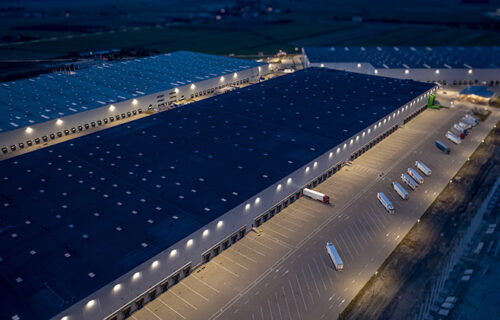
Almost 400,000 sqm of warehouse and industrial accommodation at two developments southwest of Warsaw is now fully leased, according to figures released by CTP on 17 November 2026. The properties, located in Wiskitki and Mszczonów, have attracted businesses involved in manufacturing, distribution and retail supply chains. With no vacant space remaining in the completed buildings, the developer is considering further construction at both sites, where land is available for approximately 93,600 sqm of additional accommodation.
The developments form part of the industrial property market surrounding Warsaw, which continues to account for a substantial proportion of Poland’s warehouse stock. Knight Frank estimates that the Warsaw metropolitan region contained approximately 7.6 million sqm of industrial and logistics space at the end of June 2026, equivalent to around one-fifth of the national total. The western and southwestern approaches to the capital have attracted warehouse and manufacturing investment because of their connections to major road networks, including routes serving central and western Poland.
In Mszczonów, more than 180,000 sqm has been completed at CTPark Warsaw South, one of seven developments operated by the company in the Warsaw region. The site has sufficient remaining land for approximately 16,600 sqm of additional buildings. Future construction could accommodate smaller industrial units alongside conventional warehouse space, although the developer has not confirmed a timetable or disclosed whether new premises would be built before tenants are secured.
The larger development at Wiskitki, CTPark Warsaw West, consists of four completed buildings providing more than 200,000 sqm. A further 77,000 sqm could be constructed within the existing site. The company also intends to open a communal building with meeting and recreational facilities before the end of 2026. Neither the investment required for the proposed expansion nor the expected delivery dates have been announced.
The two properties represent a significant proportion of the developer’s Polish leasing activity. CTP reports that it has leased more than one million square metres across the country to date, with approximately 40% of that cumulative total attributable to Wiskitki and Mszczonów. The figure describes the company’s leasing record over time and should not be confused with annual warehouse take-up or newly signed contracts during 2026.
Bartosz Kozieł, Business Developer at CTP Polska, said the concentration of leasing activity at the two locations had influenced the company’s development plans. He indicated that the absence of vacant accommodation in the completed buildings was encouraging consideration of additional construction, although no firm commitments or schedules were provided.
The range of businesses occupying the company’s Warsaw-area properties also reflects the different uses of modern industrial buildings. Across its seven developments in the region, manufacturing, logistics and trade each account for approximately 26% of lease agreements, according to the developer. These figures relate to the number of contracts rather than the amount of floorspace occupied, meaning the three sectors may have different shares of the total leased area.
The distribution of tenants suggests that the facilities are used for more than the storage and movement of goods. Manufacturing businesses require premises for production and associated operations, while retailers and distributors use industrial buildings to manage stock and fulfil customer orders. The figures nevertheless represent one developer’s portfolio and do not establish the tenant composition of the wider Warsaw warehouse market.
Kozieł also observed that some occupiers are reassessing the number and location of facilities used in their supply chains. Businesses seeking to reduce transport distances or simplify operations may favour premises capable of accommodating several functions at one site. Building efficiency and the availability of additional space can influence these decisions, particularly where companies anticipate changes in production or distribution requirements. These observations have not been accompanied by independent market-wide data establishing the extent of such changes.
The remaining development capacity at the two sites totals approximately 93,600 sqm, equivalent to almost one-quarter of their existing combined completed area. If constructed, the additional buildings would increase the amount of industrial accommodation available in this part of the Warsaw region. However, development capacity should not be interpreted as confirmed construction activity, and the timing of any new buildings will depend on commercial decisions and tenant requirements.
The reported full occupancy also requires consideration within the wider market context. A fully leased development demonstrates that its completed premises have been taken up, but it does not necessarily indicate a shortage of industrial accommodation across the metropolitan area. Availability varies between locations and buildings, while demand is influenced by transport connections, rental costs, technical specifications and the suitability of existing premises for individual businesses.
For property investors and developers, the performance of the Wiskitki and Mszczonów sites provides evidence of sustained occupier interest in established industrial locations outside Warsaw. Their position along routes connecting the capital with other regions makes them relevant to companies serving national distribution networks and businesses requiring access to central Poland.
The next stage will depend on whether sufficient demand emerges to support the proposed buildings and whether construction costs and achievable rents justify further investment. For now, the two developments have reached full occupancy across almost 400,000 sqm of completed accommodation, while their remaining land provides the possibility of additional industrial construction without the need to establish new locations.