Tuesday, 17 November 2026
Poland accounted for more than half of commercial property investment across Central and Eastern Europe’s six principal markets during the first nine months of 2026, as regional investors increased their participation in transactions previously dominated by international capital. According to Colliers, investment volumes in Poland exceeded €4.7 billion between January and September, representing an 81% increase compared with the same period in 2025. Approximately €1.7 billion was transacted during the third quarter, reflecting continued activity across retail, industrial and office properties.
The Polish market contributed approximately 54% of the nearly €8.8 billion invested across the six CEE markets during the nine-month period. Regional investment volumes increased by 22% year on year, with transactions worth almost €3.1 billion completed between July and September. The overall result approached the level recorded during the corresponding period in 2019, although the financial conditions facing investors have changed considerably. Borrowing costs remain higher than during the previous investment cycle, while government bonds and other financial instruments continue to compete with property for institutional capital.
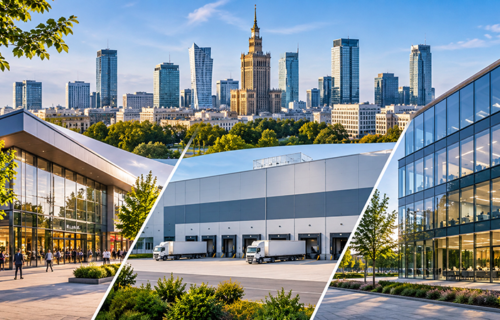
The increase in Polish investment activity was distributed across several property sectors rather than concentrated in a single category. Retail properties attracted approximately €1.5 billion, representing a 230% increase compared with the first nine months of 2025. Industrial and logistics investment reached €1.3 billion, up 54%, while office transactions totalled around €1.1 billion, an increase of 24%. The figures suggest that investors have become more willing to consider different types of commercial property, although transaction volumes remain influenced by the availability and timing of individual acquisitions.
Retail recorded the largest annual increase, reflecting renewed transaction activity following a period of more limited investment. However, the substantial percentage rise should be viewed in the context of the previous year’s lower comparison base. In the industrial and logistics sector, investors continued to acquire distribution and manufacturing facilities, while Warsaw remained the principal location for major office transactions.
One of the most significant office acquisitions was Eastnine’s purchase of The Bridge complex in central Warsaw from Ghelamco Poland. The transaction was based on an underlying property valuation of €285 million, while the adjusted purchase price was approximately €240.6 million, according to Eastnine. The property comprises approximately 55,300 sqm of lettable space. The distinction between the valuation and the final purchase consideration is important when assessing the transaction’s financial structure and its contribution to reported market activity.
Poland’s investment performance was accompanied by increased activity elsewhere in Central and Eastern Europe. The Czech Republic remained the region’s second-largest commercial property investment market, with transactions approaching €2.1 billion during the first nine months. Romania recorded approximately €691 million, an increase of 64% year on year and its highest January-to-September volume since 2020. Bulgaria attracted around €472 million, more than twice the previous year’s level and a record for the corresponding nine-month period.
An important development across the region has been the growing contribution of investors based in Central and Eastern Europe. Colliers estimates that regional buyers accounted for nearly €4.3 billion of commercial property acquisitions during the first nine months of 2026, equivalent to almost half of the total investment volume across the six markets. Czech investors represented the largest individual source of capital, with approximately €2.5 billion deployed, followed by Hungarian investors with around €806 million and Polish investors with close to €500 million.
The figures indicate a change in the composition of property investment following the reduction in activity by some traditional international buyers after 2022. Regional investment groups and domestic purchasers have become more prominent, alongside new European investors entering selected markets. This change has affected competition for assets and the types of transactions taking place, particularly where local knowledge, access to financing and familiarity with national market conditions influence acquisition decisions.
Piotr Mirowski, Senior Partner and Head of Investment Services at Colliers, said the results reflected a restructuring of Poland’s investor base. He observed that established international purchasers had increasingly been replaced by a combination of domestic and regional capital, with additional participation from investors operating across several European markets.
The increased role of regional investors is also changing how property returns are assessed. Grzegorz Sielewicz, Chief Economist for Central and Eastern Europe at Colliers, noted that economic growth expectations, government bond yields and financing conditions vary considerably between European markets. Investors consequently need to assess property acquisitions against the financial circumstances of the country concerned rather than relying exclusively on comparisons with German or other Western European government securities.
This is particularly relevant in Poland, the Czech Republic and Romania, where government bond yields have generally remained higher than those available in several major eurozone economies. The difference influences the returns investors require from commercial property and can affect the prices they are prepared to pay. Higher financing costs also place greater emphasis on rental income, occupancy levels and the ability of individual buildings to maintain their financial performance.
Across the wider European market, investment demand remains concentrated on properties where income prospects can be assessed with reasonable confidence. Logistics facilities, rental housing and data centres continue to attract attention, while selected office, retail and hotel properties are also finding buyers. Nevertheless, investors remain cautious about buildings requiring substantial capital expenditure, properties facing uncertain tenant demand and transactions dependent on optimistic assumptions about future valuations.
In Poland, the availability of debt financing continues to influence the investment market. Banks remain willing to support selected acquisitions, particularly where properties have established tenants and predictable income. However, the cost of borrowing means that investors must place greater weight on current financial performance and achievable improvements rather than assuming that lower interest rates will automatically increase property values.
Colliers identifies retail properties and office buildings in regional Polish cities as areas to monitor during the final quarter of 2026. Transaction activity will depend on the availability of suitable properties and whether buyers and sellers can agree on pricing. The consultancy also anticipates some upward pressure on capitalisation rates, which could affect valuations where rental income does not increase sufficiently to compensate.
The recovery in transaction volumes therefore does not necessarily indicate a corresponding increase in commercial property values. Higher investment totals may reflect the completion of larger acquisitions, changes in the number of properties sold or the return of buyers to sectors that experienced limited activity in previous years. The reported 81% increase in Poland’s investment volume should be understood as a measure of transaction activity rather than property price appreciation.
The first nine months of 2026 nevertheless demonstrate that commercial property transactions across Central and Eastern Europe have recovered despite financial conditions remaining more restrictive than during the previous decade. The greater involvement of regional capital has contributed to this recovery and reduced the market’s reliance on some traditional sources of international investment.
Poland’s position as the region’s largest investment market reflects both the scale of its commercial property stock and the range of assets available to investors. Whether the current level of activity can be maintained will depend on economic conditions, financing costs, rental performance and the availability of properties at prices that meet buyers’ return requirements. The increasing influence of regional investors is likely to remain an important factor in how the Central and Eastern European property market develops beyond 2026.