Saturday, 10 October 2026
Zalando, CEVA Logistics and German robotics specialist Sereact have introduced artificial intelligence-driven robotic equipment at distribution facilities in Świebodzin, Poland, and Greven, Germany. The technology is designed to handle returned fashion products with limited manual intervention, marking an initial stage in a wider European automation programme aimed at improving the efficiency of e-commerce logistics operations.
The introduction of intelligent robotic systems at two European distribution centres represents a further development in the automation of warehouse activities. The collaboration between Zalando, CEVA Logistics and Sereact focuses on one of the more demanding areas of online fashion retail: managing merchandise returned by customers. The systems have entered operational use at facilities in Poland and Germany, where they are intended to reduce the amount of repetitive manual handling required to process returned goods.
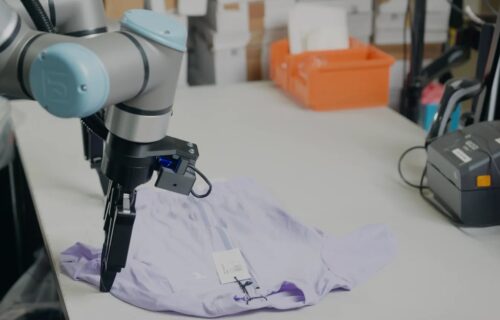
The installations use robotic equipment with two independently controlled arms, supported by Sereact’s Cortex artificial intelligence platform. The technology enables the machines to recognise, pick up and separate products without requiring individual programming for every item. According to the companies, the systems can adapt to unfamiliar merchandise, allowing them to handle the variety of products encountered in fashion returns operations.
Processing returned clothing presents particular challenges for conventional warehouse automation. Unlike newly manufactured goods arriving in standard packaging, returned items can differ considerably in shape, condition and presentation. Clothing may be folded inconsistently, compressed into packaging or placed in unexpected positions, making automated handling more difficult than the movement of uniform boxes or containers.
The new equipment is intended to address these variations by analysing individual objects and determining how they should be handled. Rather than relying exclusively on predetermined instructions linked to specific product references, the systems use visual information and artificial intelligence to guide their movements. This allows the robotic equipment to respond to different products and handling conditions during warehouse operations.
The deployment in Świebodzin and Greven is the first operational stage of a broader cooperation agreement between the three companies. Their longer-term objective is to introduce intelligent automation across additional European logistics operations, although no timetable or confirmed number of future installations has been disclosed.
The collaboration also has an investment dimension. In July 2026, Zalando joined Sereact’s Series B financing round as a strategic investor, strengthening the relationship between the online fashion retailer and the robotics developer. The investment connects Zalando’s operational requirements with the development of technology intended to improve the handling of merchandise within its distribution network.
CEVA Logistics is introducing the systems through a service-based commercial arrangement under which robotic equipment and associated technology are provided as an ongoing operational service. This approach, commonly known as Robotics-as-a-Service, offers an alternative to purchasing and maintaining automated equipment entirely through conventional capital expenditure.
For logistics operators, service-based automation arrangements can provide flexibility when introducing new technology, particularly where operational requirements may change over time. However, the companies have not disclosed the financial terms of the agreement, the cost of the installations or the expected period required to achieve a financial return.
The introduction of robotic handling systems reflects the growing importance of returns management within online retail. Fashion products are particularly challenging because customers frequently order multiple sizes or styles before returning items they do not wish to keep. Returned merchandise must then be received, identified, assessed and directed towards the appropriate next stage of processing.
These activities can require considerable labour, particularly during periods of increased order volumes. The condition and presentation of returned products can also vary substantially, making it difficult to apply the same automated procedures used for newly received inventory.
By introducing equipment capable of adapting to different products, the companies aim to reduce the amount of repetitive handling performed by warehouse employees. Staff will continue to be involved in supervising operations, addressing items that require additional attention and carrying out quality-related tasks that depend on human assessment.
The companies present the technology as a way to support warehouse employees rather than eliminate the need for human involvement. Repetitive physical activities can be transferred to robotic equipment, while employees concentrate on monitoring processes and resolving situations that automated systems cannot complete independently.
CEVA Logistics expects the technology to improve the consistency of returns processing and reduce the number of manual stages involved. Nevertheless, the announcement does not provide quantified operational results, such as the number of products handled per hour, changes in processing costs or measurable improvements in productivity.
The absence of these figures means that the financial and operational benefits of the installations cannot yet be independently assessed. Their commercial significance will depend on how reliably the systems perform under normal warehouse conditions and whether the technology can accommodate changes in merchandise volumes and product characteristics.
For the industrial and logistics property sector, the deployment illustrates how artificial intelligence is becoming increasingly relevant to the operation of distribution buildings. Warehouse automation has traditionally relied on equipment designed to perform repetitive movements involving relatively standardised goods. More adaptable robotic systems could extend automation into activities that previously required extensive manual intervention.
The development may also influence the requirements placed on logistics facilities. As occupiers introduce increasingly sophisticated equipment, warehouse buildings may need to accommodate additional electrical installations, digital connectivity, maintenance areas and operational layouts suitable for collaboration between employees and machines.
These considerations could become more important for logistics developers and property owners as occupiers assess whether existing facilities can support new technologies. However, the installations announced in Świebodzin and Greven do not establish that major building modifications were required, and the companies have not identified any associated property investment.
The decision to introduce the technology in Poland and Germany is significant because both countries play important roles in European e-commerce distribution. Poland has developed a substantial network of modern logistics facilities serving domestic and international retailers, while Germany remains one of Europe’s largest consumer and distribution markets.
The two installations also provide an opportunity to evaluate the technology across different operating environments before considering wider deployment. Experience gained from the initial facilities could help the companies assess the reliability, flexibility and commercial suitability of the systems for additional logistics locations.
The project reflects a broader development in which technology investment is increasingly directed towards improving the use of existing logistics infrastructure. Rather than depending exclusively on additional warehouse space or larger workforces, operators are exploring ways to increase the volume and complexity of activities that can be managed within established distribution networks.
For property investors, this development is relevant because the operational requirements of occupiers influence the long-term competitiveness of logistics buildings. Facilities capable of accommodating changing technologies may offer greater flexibility as retailers and logistics companies adapt their distribution processes.
At the same time, the financial case for automation will vary between operators and locations. Labour availability, wage levels, product volumes, installation costs and the complexity of warehouse activities will all influence whether robotic systems provide sufficient operational benefits to justify their use.
The introduction of artificial intelligence into returns processing therefore represents an operational development rather than evidence of an immediate transformation in logistics property demand. Its longer-term influence will depend on whether the technology can demonstrate reliable performance and measurable financial advantages across a wider range of facilities.
For Zalando, CEVA Logistics and Sereact, the installations in Świebodzin and Greven provide the first practical stage of their European cooperation. Further expansion will depend on the results achieved at these locations and the ability to introduce the technology into other distribution operations.
The project nevertheless demonstrates how artificial intelligence is moving into physical warehouse activities that have traditionally been difficult to automate. As retailers and logistics operators seek greater efficiency in handling returned merchandise, adaptable robotic equipment could become an increasingly important part of European distribution operations, with potential implications for the design, operation and long-term use of logistics properties.