Friday, 30 October 2026
There was a time when booking an airline ticket was a relatively straightforward affair. You chose your destination, selected your seat, paid an increasingly unreasonable amount of money and turned up at the airport expecting to travel in something resembling comfort. Those days appear to have departed, presumably on an earlier flight. Today, booking an airline seat is rather like entering a raffle where the prize is the seat you thought you had already purchased. You carefully select your preferred position, receive confirmation and begin looking forward to the journey, only to receive a charming little notification informing you that your seat has been changed due to operational reasons. Apparently, your original seat has developed ambitions of its own and decided it would rather spend the afternoon with somebody else.
The airline kindly explains that every effort has been made to find you a seat as close as possible to your original selection. How reassuring. This is rather like booking a sea-view suite at a respectable hotel and arriving to discover that you have been relocated to a broom cupboard overlooking the bins. The receptionist smiles politely and explains that both rooms are technically in the same building. No explanation of why your original accommodation disappeared, no suggestion that the replacement might be inferior, just a cheerful assumption that you will accept your new surroundings with the enthusiasm of a Labrador discovering a muddy puddle. In the airline’s defence, operational changes are sometimes unavoidable, but when these little surprises become a regular feature of your travels, one begins to wonder whether the seat allocation department is being run by someone with a particularly mischievous sense of humour.
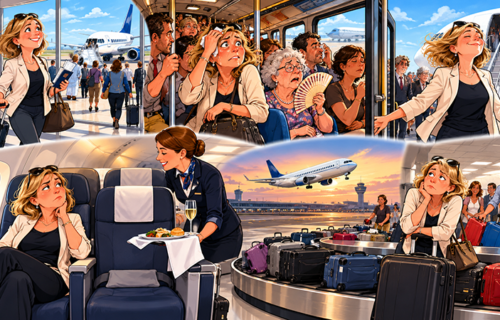
My latest adventure involved the 15:20 flight from Warsaw to London, a journey that has never exactly resembled a luxury cruise along the French Riviera. Having paid for Business Class, I naturally anticipated at least a modest degree of civilisation. Nothing extravagant, you understand. Perhaps a comfortable seat, a reasonably organised boarding process and the opportunity to reach the aircraft without first undergoing the sort of endurance exercise normally reserved for military recruits. Instead, we were herded onto a bus along with what appeared to be the entire population of a small Polish village. Business Class, Economy Class and anyone unfortunate enough to be standing near the boarding gate were united in one glorious demonstration of aviation equality. The only thing missing was a conductor shouting, “Move down the back, please!”
Once aboard our luxury airport transport, we were driven to the aircraft and then left sitting outside it for approximately ten minutes with the doors firmly closed. There was no noticeable air conditioning, no opening windows and precious little fresh air. We were packed together like sardines, although I suspect sardines enjoy better ventilation and considerably more personal space. The temperature climbed to a level normally associated with industrial ovens, while breathing began to resemble sucking air through a heated drinking straw. One elderly lady became so uncomfortable that she needed to sit down, which rather took the amusement out of the situation. Watching passengers struggle in an overheated bus is hardly the premium experience anyone imagines when purchasing an airline ticket. When the doors finally opened, the rush of cooler air was so magnificent that I briefly considered abandoning London altogether and spending the afternoon standing on the airport tarmac. Never has ordinary outdoor air felt quite so much like a five-star spa treatment.
Eventually, we climbed aboard the aircraft, where Business Class awaited in all its extraordinary glory. For those unfamiliar with European short-haul premium travel, Business Class can sometimes be a fascinating exercise in creative marketing. The seats are essentially the same as those in Economy, the legroom is often identical, and the principal distinction is that the middle seat remains empty. You are therefore paying considerably more money for the privilege of sitting beside a small patch of unoccupied upholstery. Admittedly, dinner and drinks are provided, accompanied by a napkin, which appears to be the airline’s way of confirming that you have entered a higher social class. I examined my surroundings carefully, searching for evidence of the premium experience, but apart from the refreshments and the empty seat, the differences were about as obvious as those between two identical garden chairs, one of which had been blessed by a Michelin-starred chef.
The flight itself eventually proceeded, although we arrived approximately twenty-five minutes behind schedule. Not particularly dramatic by modern aviation standards, where arriving on the correct day can sometimes feel like a triumph. Unfortunately, reaching the destination airport is no longer the same as actually arriving. Our aircraft then spent another twenty minutes waiting for somewhere to park, apparently because its designated position had become unavailable. We sat patiently while the airport worked out where to put us, rather like a motorist circling a supermarket car park on Christmas Eve. I began to wonder whether the aircraft itself had received one of those familiar messages informing it that its original parking space had been changed for operational reasons. Perhaps the plane had been allocated a replacement stand somewhere near Brighton, with every effort made to ensure it was as close as possible to London.
Eventually, we escaped the aircraft and made our way towards baggage reclaim, that wonderful final chapter in the modern flying experience where hope gradually gives way to resignation. Having travelled Business Class, my suitcase was supposedly entitled to priority handling. A splendid concept, although one that appeared to have been interpreted rather creatively. I watched ordinary luggage emerge onto the carousel while my priority bag remained conspicuously absent. Suitcases belonging to passengers who had paid considerably less were enjoying their freedom, while mine apparently preferred to remain behind for a private conversation with the baggage handlers. By the time it finally appeared, priority had taken on an entirely new meaning. Perhaps the label refers not to the order in which luggage arrives, but to the importance of developing patience and emotional resilience.
What makes the whole experience particularly irritating is the increasingly generous amount of time passengers must allow for what should be a routine journey. I have always considered myself reasonably organised, normally leaving around two hours between my scheduled arrival and any important meeting or social engagement. That once seemed perfectly sensible. These days, however, two hours feels about as reliable as a chocolate teapot in a sauna. Between delayed departures, overcrowded buses, mysterious seating arrangements, aircraft parking adventures and luggage that appears to be travelling independently, I am beginning to think three or four hours should be the minimum allowance. At this rate, anyone arranging dinner in London after an afternoon flight from Warsaw would be wise to book the restaurant for breakfast the following morning. The alternative is to arrive halfway through dessert, looking like someone who has escaped from a particularly unpleasant hostage situation.
And then, of course, there is the price. Flying is no longer the inexpensive convenience it was once advertised to be, particularly when purchasing Business Class tickets. Airlines have become remarkably talented at charging separately for almost everything, from selecting a particular seat to carrying a suitcase that contains more than a toothbrush and a spare pair of socks. Yet despite the growing cost, the actual travelling experience seems determined to move in the opposite direction. We are encouraged to pay for comfort, convenience and priority, only to discover that comfort is optional, convenience depends on circumstances and priority may simply mean being first in the queue to wait. The extraordinary achievement of modern aviation is that it can transport a passenger across Europe in a couple of hours while somehow making the entire experience feel longer than travelling by horse and carriage.
Perhaps the most remarkable part of this increasingly theatrical performance is how casually everything is explained. Seats are changed for operational reasons. Buses are delayed for operational reasons. Aircraft wait for parking positions for operational reasons. Luggage arrives late for reasons that may well be operational, although nobody seems particularly interested in discussing them. Operational reasons have become the aviation industry’s equivalent of a magician’s hat, capable of concealing almost any inconvenience while producing absolutely no rabbits. I am beginning to suspect that somewhere in airline headquarters there is a large button marked “Operational Reasons”, which employees press whenever explaining something properly would require more than thirty seconds of effort.
I do not expect miracles from airlines. I understand that aircraft occasionally need replacing, airports become congested and schedules can unravel through circumstances beyond anyone’s control. What I do expect, particularly when paying a premium fare, is a reasonable degree of transparency and some genuine recognition that passengers are purchasing more than the theoretical possibility of reaching their destination. If a seat is changed, explain why. If priority baggage is offered, make a reasonable effort to deliver it as promised. And if passengers must spend ten minutes trapped in an overheated bus, perhaps consider opening the doors before somebody starts hallucinating about Alpine meadows and refrigerated supermarkets.
Until then, I shall continue my travels with the cautious optimism of a British passenger who has learned that disappointment is best accompanied by a sense of humour. I will book my preferred seat, receive confirmation, pack my suitcase and prepare for another round of aviation musical chairs. I will allow four hours for a journey that should require two, carry enough patience to survive a minor diplomatic crisis and remember that Business Class is not necessarily about having more space, but about paying more money to discover precisely how little space one actually needs.
And when the next email arrives informing me that my seat has once again been changed, I shall simply smile, put the kettle on and congratulate my original seat on its exciting new relationship.
After all, in modern aviation, the only thing guaranteed to travel exactly where it wants to go is your money.
Author: Mitzilinka (Turning grim reality into comic relief-without losing the truth)