Wednesday, 30 September 2026
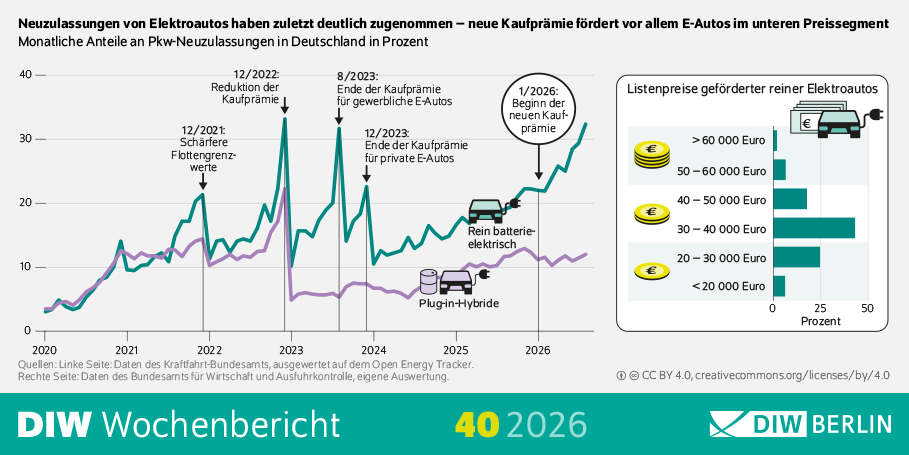
Germany is on course for its strongest year yet for electric-car registrations, with fully electric vehicles representing around a quarter of new passenger cars registered during the first eight months of 2026. The share increased to roughly one third in August, compared with an average of about 19% during 2025, according to research from DIW Berlin.
The expansion has coincided with the introduction of new purchase support. More than 52,000 applications had been approved by early September, with battery-electric cars accounting for around 90% of the total. Lower-priced and smaller vehicles are particularly prominent among supported purchases, suggesting that the electric market is gradually broadening beyond the larger and more expensive models that have dominated registrations in recent years.
Even with this year’s acceleration, electric vehicles remain a relatively small part of Germany’s overall passenger-car fleet. Around 2.5 million battery-electric cars are currently in use, representing approximately 5% of all passenger cars. Most new vehicles registered each month also still contain a combustion engine, highlighting the scale of the transition required before electric technology becomes dominant across the existing fleet.
DIW cautions against attributing the recent market growth entirely to government support. It remains unclear how many subsidised purchases would not otherwise have taken place. The programme has reached many applicants with annual incomes below €45,000, although around two thirds of approved applications have so far involved households without children. The institute therefore considers the programme’s broader social and economic effects difficult to determine at this stage.
The shift towards smaller electric cars is also exposing a weakness in the product ranges of Germany’s domestic manufacturers. German brands currently offer relatively few models in the lower-price segments receiving significant support, allowing Asian and US manufacturers to capture a larger share of subsidised purchases than their position in Germany’s overall vehicle market. Foreign brands can nevertheless generate domestic economic activity, with Tesla, for example, manufacturing vehicles at its plant in Brandenburg.
Plug-in hybrids account for less than 10% of vehicles supported under the programme, but their inclusion has been questioned by DIW. These vehicles tend to be larger and more expensive, while their emissions performance depends heavily on how regularly they are driven electrically. The institute consequently argues that future public support should concentrate more clearly on fully electric vehicles.
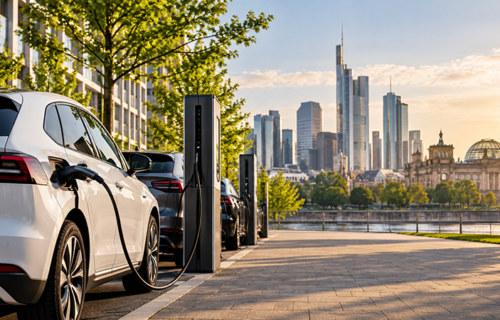
The rapid increase in electric-car registrations also has implications for property and infrastructure investment. A larger electric fleet will require additional charging capacity at residential developments, offices, retail centres, logistics properties and motorway locations, alongside greater electricity-grid capacity. With adoption now accelerating, the next stage of Germany’s transition will increasingly depend not only on vehicle affordability but also on whether charging and energy infrastructure can expand at a comparable pace.