Sunday, 20 September 2026
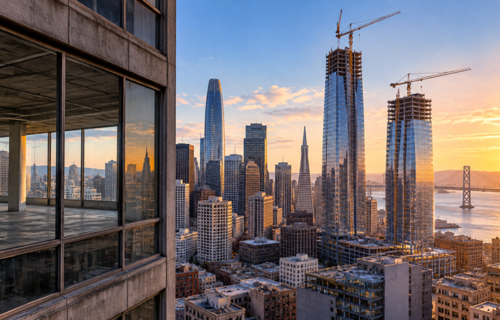
San Francisco still has one of the highest office vacancy rates among major US business centres, yet developers are again considering large new towers in the city. The apparent contradiction is becoming one of the most important features of the market’s recovery. Major property advisers placed citywide office vacancy at roughly 28% to 30% in the second quarter of 2026, depending on methodology. Those figures remain far above pre-pandemic levels, but conditions are improving as positive absorption accelerates, leasing increases and vacancy retreats from its recent peak.
Artificial intelligence companies are playing a substantial role in that change. AI businesses leased more than 2.9 million sq ft in San Francisco during the first six months of 2026, exceeding their leasing volume for the whole of 2025. They accounted for close to half of new leasing during the period, while active requirements across the market increased to around 8.6 million sq ft. The numbers suggest that San Francisco’s recovery is increasingly being supported by companies associated with the rapid expansion of the AI sector.
The recovery, however, is not being distributed evenly across the city’s office inventory. Large technology and AI occupiers are increasingly choosing properties offering modern infrastructure, efficient floorplates, strong amenities and locations capable of helping companies attract employees. While overall vacancy remains close to 30% under some measurements, availability among the strongest office properties is considerably lower. Better-quality buildings are capturing a disproportionate share of leasing and commanding rental premiums, while older and less adaptable offices continue to struggle for occupiers.
This difference helps explain how San Francisco can simultaneously have millions of square feet standing empty and growing competition for certain offices. A vacant building does not automatically provide a suitable alternative for a company seeking a large block of modern, high-specification space. The development slowdown of recent years adds to the issue because relatively little new office accommodation is currently under construction. With major towers requiring years to plan, finance and build, developers considering projects today are effectively assessing what demand could look like towards the end of the decade rather than responding simply to the vacancy rate in 2026.
One example is 536 Mission Street, where plans include an office alternative providing roughly 1.35 million gross sq ft in a 46-storey tower, alongside a separate mixed-use option incorporating housing. The office proposal also illustrates another potential constraint on future supply: San Francisco’s Proposition M system limits the amount of major office development that can be approved. A second ambitious proposal is taking shape at the former Oceanwide Center site, which has been redesigned as Fifty at First, a proposed 56-storey tower containing approximately 1.5 million sq ft of premium workplace space and targeting completion around 2031.
Neither project should yet be considered certain to reach construction. Financing, building costs, planning requirements and the ability to secure major occupiers will ultimately determine whether they proceed. Their emergence is nevertheless significant because developers are once again considering very large office investments in a city that only recently appeared overwhelmed by excess supply. At the same time, the greater long-term challenge may concern San Francisco’s older buildings. If demand continues concentrating in the best properties, falling citywide vacancy will not necessarily rescue every asset. Some offices will require extensive refurbishment, conversion, redevelopment or substantial repricing to compete.
San Francisco’s office problem is therefore changing. The city still has an enormous amount of vacant space, but increasingly the question is whether that space corresponds to what the next generation of occupiers requires. AI growth is accelerating the recovery while exposing weaknesses in ageing inventory. If current trends continue, San Francisco could eventually reach a situation that once appeared improbable: new office skyscrapers rising while millions of square feet in existing buildings remain empty. The explanation would not be a shortage of offices in absolute terms, but a shortage of buildings capable of competing for the companies driving the city’s next phase of growth.
Source: CIJ.World Research & Analysis Team