Saturday, 19 September 2026
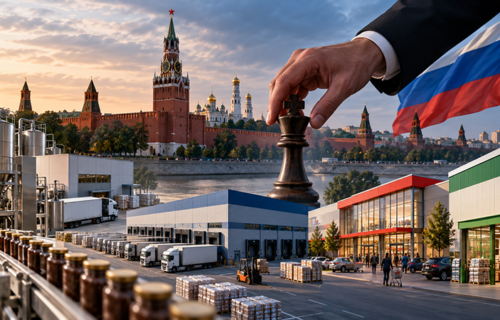
Russia has placed businesses connected with Nestlé, Auchan, FM Logistic and the former Leroy Merlin operation under temporary external management, extending state intervention into sizeable manufacturing, retail and logistics platforms. President Vladimir Putin signed the decree on 17 September, appointing Moscow-based L.E.V. Management to oversee the affected corporate interests. The measure transfers management authority but does not currently amount to a formal change of ownership.
The decision has a substantial commercial property dimension because the businesses operate extensive networks of factories, stores and distribution facilities. Nestlé has six production sites in Russia and around 7,000 employees, while Auchan operates around 230 stores across the country. Lemana Pro, the home-improvement retailer created from the former Leroy Merlin Russia operation, has 112 stores in 66 cities.
The largest directly identifiable logistics portfolio belongs to FM Logistic. The company operates 25 warehouse complexes covering approximately 865,000 sqm in Russia and handles around 830,000 transport operations annually, according to Kommersant. This gives the intervention a direct connection with industrial and logistics real estate, with the affected facilities forming part of distribution networks serving manufacturers and retailers across the Russian market.
Nestlé has maintained a reduced presence in Russia since the country’s full-scale invasion of Ukraine in 2022. It suspended new capital investment, advertising and much of its non-essential import and export activity while continuing production in selected food categories. Russia now represents an estimated 1% of the group’s worldwide sales. Following the latest intervention, Nestlé said it was examining its options and intended to protect its interests while maintaining continuity for employees and other stakeholders.
Auchan has remained one of the largest international retailers still operating in Russia. Reuters reported 229 stores and 24,236 employees at the end of 2025, while Russian sources currently give totals ranging from around 230 to 241 locations depending on the formats included. The business generated RUB 127bn in sales during the first half of 2026. Its Russian subsidiary said stores and other facilities continued operating normally following the decree while it sought clarification from the authorities.
The property exposure associated with Auchan has already changed considerably. Ceetrus, the real-estate business linked with the Auchan group, previously disposed of its Russian property assets, separating much of the group’s former shopping-centre ownership from the retail operation now affected by the decree. The latest intervention should therefore be viewed primarily as affecting Auchan’s operating business rather than the same property portfolio historically controlled by the wider group.
Lemana Pro also requires a distinction between its historical and current ownership structure. The business originated from Leroy Merlin’s Russian operation, which French parent Adeo transferred to local management in 2023. Vedomosti reports that almost all of its operating company, Le Monlid, is now held by UAE-registered Scenari Holding LP. The latest measure therefore affects a business with French origins but which is no longer simply a directly French-owned Russian subsidiary.
Temporary administration has become one of the mechanisms used by Russia to intervene in businesses with foreign ownership or connections. It allows an appointed administrator to exercise management powers while ownership formally remains with the existing shareholders. Similar arrangements have previously been applied to companies including Danone, Carlsberg and Fortum. Some businesses subsequently changed hands, while temporary administration has also been lifted in other cases, meaning the mechanism does not automatically result in a sale.
The Kremlin has linked the latest action partly to the companies’ connections with countries Russia considers unfriendly amid the continuing confrontation with Western governments over Ukraine. The specific reasons individual businesses were selected are less certain, however, and Moscow has not announced that the affected companies will be permanently transferred to new owners.
The intervention comes against an increasingly restrictive environment for international companies seeking to reduce or dispose of Russian investments. Foreign-controlled businesses can face government approval requirements, mandatory valuation discounts and additional payments when attempting to leave the market. Reuters reports that a 2025 estimate by Moscow law firm NSP put the value of private assets brought under Russian state control since 2022 at more than $50bn, including property belonging to foreign companies.
For commercial real estate, the significance extends beyond formal property ownership. The value of factories, warehouses and retail facilities is closely connected to the companies operating them, their supply chains and the ability of shareholders to determine investment and disposal strategies. An intervention at corporate level can consequently change effective economic control over substantial operating property even when the title to individual buildings has not been transferred.
The FM Logistic portfolio illustrates the scale of that exposure. Its approximately 865,000 sqm warehouse network alone represents a significant industrial property platform, while the wider group of affected businesses includes Nestlé manufacturing facilities and extensive Auchan and Lemana Pro retail networks. The decree therefore reaches considerably further into Russia’s physical economy than a conventional intervention involving corporate shareholdings alone.
For international investors retaining Russian exposure, the development adds another layer of uncertainty to asset valuation and exit strategies. Temporary administration should not be treated as completed confiscation, and the ultimate ownership of the affected businesses remains unresolved. Previous cases nevertheless demonstrate that effective management control can change well before the final ownership structure is determined, making the distinction between legal title and economic control increasingly important when assessing foreign corporate and real-estate exposure in Russia.